

Trump’s Vietnam
Plus, judge deals setback to Kestenbaum case against Harvard

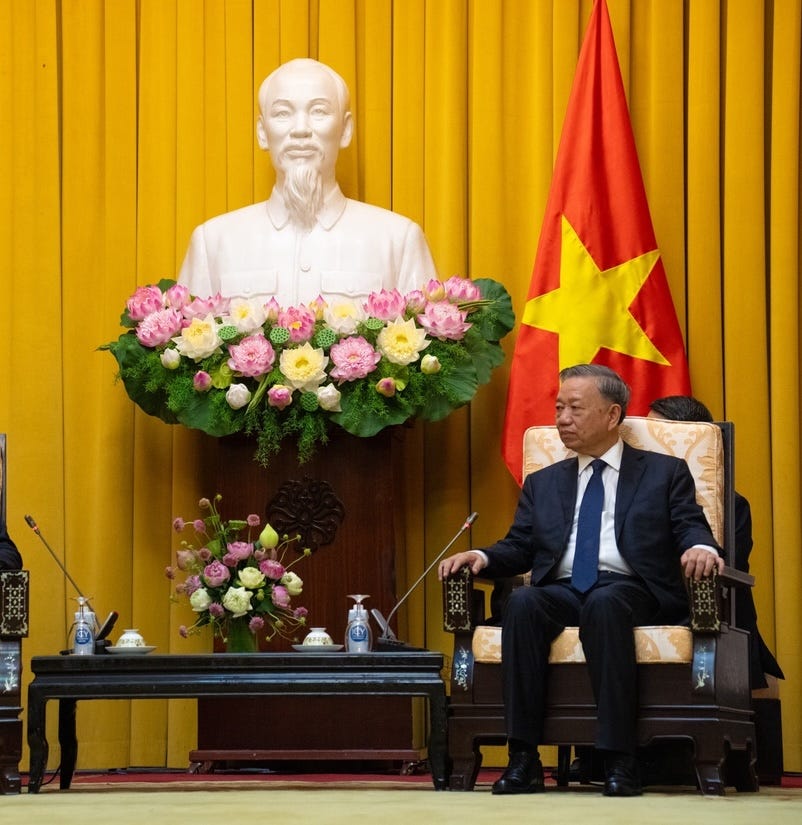
President Trump posted to social media on April 4, “Just had a very productive call with To Lam, General Secretary of the Communist Party of Vietnam, who told me that Vietnam wants to cut their Tariffs down to ZERO if they are able to make an agreement with the U.S. I thanked him on behalf of our Country, and said I look forward to a meeting in the near future.”
I have not been a fan of Trump’s tariffs, but that the president’s move has left the Vietnamese Communists begging America for terms, precisely 50 years to the month after the April 1975 evacuation of the American embassy in Saigon, may yet offer a pathway to advance freedom and achieve a long-delayed American win.
Here is how:
Any trade agreement between the U.S. and Vietnam would be incomplete if it deals only with tariffs and not with the freedom of workers in Vietnam to form unions that are not controlled by the government.
Such unions are now effectively banned in Vietnam. If legalized, they could be a lever—both to increase wages and improve working conditions for workers there so they do less to undercut American workers, and also, more significantly, to help defeat communism in Vietnam, the same way that the Solidarity labor movement defeated communism in Poland in the 1980s.
The U.S. State Department’s 2023 country report on Vietnam’s human rights practices says: “the government severely restricted the establishment of associations involved in what it considered “sensitive” fields such as politics, religion, and labor rights….the government generally prohibited the establishment of private, independent organizations, insisting that persons work within established, party-controlled mass organizations, usually under the aegis of the [Communist Party of Vietnam]’s Vietnam Fatherland Front (VFF).”
The unions that do exist in Vietnam—under the umbrella of the Vietnam General Confederation of Labor—are controlled by the Communist Party of Vietnam. The union leaders were appointed by the Communist Party rather than freely or independently elected by union members.
Freedom House’s 2024 report on Vietnam gave that country a zero on a four-point scale measuring labor rights. “The Vietnam General Conference of Labor (VGCL), the only legal labor federation, is controlled by the [Communist Party of Vietnam],” the Freedom House Report says. “A revision of the labor code that took effect in 2021 would theoretically allow workers to form their own representative bodies, but the change had little effect in practice, and independent unions outside the VGCL still face enormous obstacles to legal registration.”
Backing independent unions in Vietnam would be a continuation of work begun long ago. “A.F.L.-C.I.O to Aid Unions in Vietnam As a Bar to Reds,” was the headline over a New York Times dispatch that appeared July 31, 1966. It reported on a press conference at Saigon by the international representative of the A.F.L.‐C.I.O., Irving Brown, who announced what the Times called “a program to strengthen the trade union movement in South Vietnam to rally popular support against the Vietcong.” Brown said he’d seek American government support to assure a “key and decisive role for a free labor movement in the national struggle.”
When I wrote on April 3 here,
The labor movement and the college-educated urban elites both failed when it came to labor rights abroad. Instead of pushing to organize independent labor unions in unfree countries such as Communist China or Vietnam, too many American labor leaders chose to pull back from international affairs and focus instead on organizing workers in U.S. health care, education, and government sectors. Likewise, American consumers and investors enjoyed the cheap products (and the profits from selling them) without moral qualms about the power of the Communist state being used to prevent workers from exercising their free association rights.
One commenter wrote, “Organizing labor unions in China and Vietnam? If you think either one of those governments would allow that you are severely delusional.”
The same could have been said about Solidarity in Poland. What perished in the end was the Communist government, not the free labor union. There’s plenty of credit to go around for the fall of the Soviet Union—between the Soviet Jewry movement, which itself imposed trade barriers in the form of the Jackson-Vanik amendment; President Reagan’s moral clarity, missile defense, and military buildup; Pope John Paul II—but Lech Walesa’s Solidarity, backed by Lane Kirkland and Tom Donahue’s AFL-CIO and Albert Shanker’s American Federation of Teachers, played a crucial role.
Again, I’m not a fan of Trump’s tariffs. But if Trump plays his cards right he could have a chance to achieve something that eluded his predecessors—helping the Vietnamese to liberate their country from the plague of communism. The American president would have to negotiate not only for lower tariffs but for more freedom.
Judge deals setback to Kestenbaum case against Harvard: In an April 4 order, Judge Richard Stearns of the federal district court for the district of Massachusetts rejected former Harvard Divinity School student Alexander “Shabbos” Kestenbaum’s attempt to amend his lawsuit to include two current Harvard students who also say they were and are subject to antisemitic discrimination at the university.
Stearns said too much time had elapsed to allow the two additional plaintiffs to join with Kestenbaum in an amended complaint. “Although the court may have been amenable to amendment in the immediate wake of the settlement agreement (the court is not convinced that it would have been, as the claims of the individuals, despite having some factual overlap, are nonetheless distinct), two months had passed from the finalization of that agreement before plaintiff filed this motion,” the order said. “And while it appears that the parties privately stipulated to staying discovery deadlines in the wake of that settlement, any joint stipulation ended more than a month before the motion was filed. In the absence of any adequate explanation for plaintiff's lack of diligence (an omission that is especially glaring in light of the impending deadline for fact discovery), the motion is denied.”
Kestenbaum’s filing had said that if the amendment was rejected, the Harvard Law School student and Harvard Business School student seeking to join in would file their own lawsuits, which might then be consolidated with his, leading to the same result he sought with the amended complaint. That may or may not happen, and Harvard is now also facing a $9 billion threat from the Trump administration that looms larger than the student lawsuits. In the meantime, though, a suit from a single former student is less of a challenge to Harvard than one from a former student and two current students together. I mocked Harvard’s lawyers for the quality of their work and the ridiculousness of their argument, but at least on this motion it appears that they got the result they sought.
Recent work: “New York Times Stokes New Fear About Israeli ‘Occupation’ — of Syria” is the headline over my latest piece for the Algemeiner. Please check it out over at the (no paywall) Algemeiner if you are interested.
The optimistic scenario is that the tariffs will mainly be a substrate for deals, with leaders making pilgrimages to the White House to pledge changes that earn exemptions. But China will not be eligible because the rational use of tariffs is threefold:
1. To curb countries with a military posture against the USA
2. To ensure that the USA has capabilities that would be needed in case of war or pandemic, either domestically or from trusted partners (e.g., aluminum made in Quebec using its comparative advantage of having James Bay hydroelectric power).
3. To press other countries to reduce actual tariffs, as enunciated by Elon Musk for low tariff trade with Europe.
We don't always get the optimistic scenario, but we should not be shocked if good sense prevails, and we see world leaders coming to Trump to plead for deals.
The visits started today, with Israel's PM meeting with Commerce Secretary Lutnick. Stay tuned.