


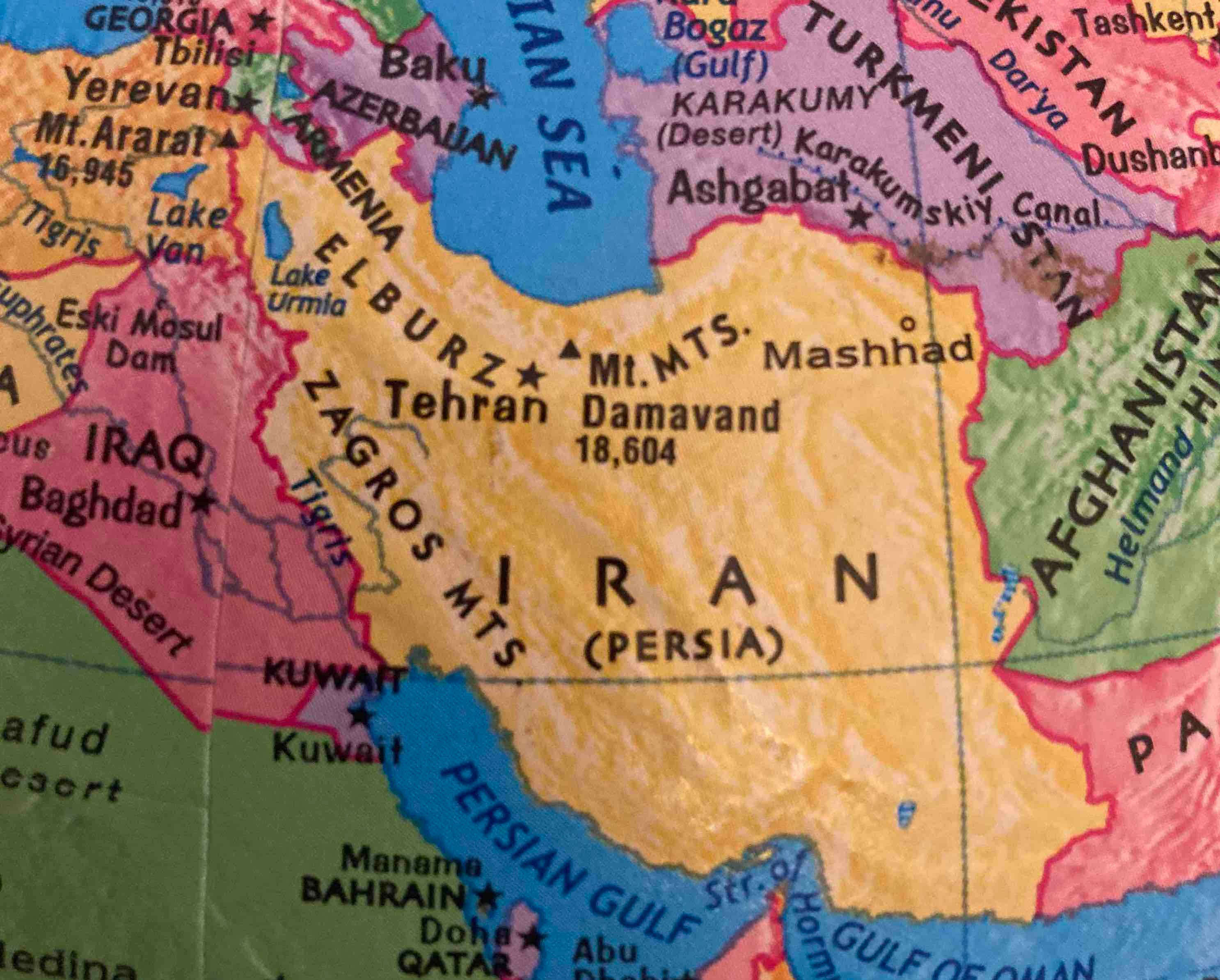
Hopes are dimming for a rapid end to Ayatollah Kamenei’s terror-sponsoring, human-rights-abusing regime in the Islamic Republic of Iran, after President Trump declared a ceasefire and says his administration hopes to negotiate directly with the Iranian government.
With its nuclear weapons program destroyed and its ballistic missile program significantly damaged along with its air defenses, its regional proxies, and its prestige, the Islamic Republic is a diminished threat to Israel, the U.S., and their allies. But Iran retains significant capabilities. Its navy is untouched, as is most of its oil and gas capacity. Trump says he’ll allow Iran to sell gas to China. Iran can still fund terrorism abroad, use the internet to attack Western institutions, and support foreign fighters with money, intelligence, and weapons. It can also still brutally oppress its internal critics.
Prime Minister Netanyahu had publicly encouraged Iranians to rise up and free their country, and Trump himself even posted to social media in favor of “Make Iran Great Again.”
Yet on the plane to the NATO summit, Trump was asked directly, “do you want to see regime change in Iran?” He replied, “No. If there was, there was, but no, I don’t want it. I’d like to see everything calm down as quickly as possible. Regime change takes chaos, and ideally we don’t want to see so much chaos, so we’ll see how it does. You know the Iranians are very good traders, very good businesspeople, and they got a lot of oil, they should be fine, they should be able to rebuild and do a great job. They’re never gonna have nuclear, but other than that, they should do a good job.”
That was an abrupt reversal from Trump’s social media post of June 22, in which he stated, “It’s not politically correct to use the term ‘Regime Change,’ but if the current Iranian Regime is unable to MAKE IRAN GREAT AGAIN, why wouldn’t there be a Regime change??? MIGA!!!”
The shift reflects caution and humility in the Trump administration about the possibility of remaking Iran successfully after the challenges the U.S. faced in Iraq and Afghanistan. It also reflects a desire to focus on other regions and issues, such as China, rather than the Middle East.
Some Israelis felt like they had a great opportunity to put an end to the Islamic Republic, but they also realized it was ultimately up to the Iranians. The Israelis are happy about the destruction of the Iranian nuclear weapons program and the setbacks to the Iranian ballistic missile program, but they also are concerned that the Iranian regime will pursue its “death to Israel, death to America” goals as long as it remains in power. Israel still relies on the U.S. for some bombs and defense technology, as well as a U.N. Security Council veto, so Israel was hesitant to pursue an Iranian regime change unilaterally over American objections.
The achievements of the Israel-U.S. effort are worth appreciating, even if they stopped short of the “total victory” or “unconditional surrender” that Netanyahu and Trump spoke about. Russ Roberts has a piece up (“I underestimated him”) praising Trump’s boldness, the military results and the geopolitical transformation. Not all problems are solvable, and certainly not all problems are immediately solvable. The Islamic Republic of Iran may have to stay, alas, in the “not immediately solvable” basket for some more time. Yet anyone who thinks that Iran is contained or incapable of making trouble is exhibiting an October 6 mentality. That is what Israelis deluded themselves into thinking about Hamas in Gaza until they were unpleasantly surprised by an attack by the Iranian-backed terrorists.
Why Zohran Mamdani won, and what it means: The victory of anti-Israel socialist Zohran Mamadani in New York’s Democratic primary for mayor was a risk that we highlighted here in a series of pieces. June 6: “Capitalist Capital May Elect a Socialist Mayor.” June 9: “Everything That’s Wrong With Zohran Mamdani’s Policy Platform; If elected, he could demonstrate to New Yorkers how ruinous socialist policies are.” June 19: interview with New York City mayoral candidate Whitney Tilson, who talked about the risk to the city of Zohran Mamdani (“super-dangerous…extremely radical”).
So one lesson of Mamdani winning the primary, as he did yesterday, is to pay attention when The Editors warns about that sort of thing. It’s not so much that we are prescient, but we have some smart and sophisticated sources, who are also readers of this newsletter, and when they see something like this coming, the best of them pick up the phone and emphatically tell us to pay attention and to bring the situation to the attention to our readers.
What are the other takeaways?
A lot of the energy and support for Mamdani’s campaign came from voters too young to remember the Soviet Union and the failures of Communism. Growing up during the Cold War this was just the basic stuff of education and politics—in the Soviet Union, the government owned and operated everything, and the supermarket shelves were empty and the cars were scarce and broke down frequently, while in America, we believed in private enterprise, and it led to prosperity, abundance, and technological superiority.
Politics are downstream of culture. Mamdani’s father is an Israel-hating Columbia professor. Polls showed Mamdani with more support than Cuomo among voters with more college education. As Larry Summers put it, “Harvard and other universities' moral weakness after Oct 7 in condoning hateful, anti-Israeli, and even antisemitic, rhetoric and activity opened the Overton window in ways that contributed to yesterday’s outcome.”
Andrew Cuomo, who seemed old, had resigned as governor of New York, and touted his service in the Clinton administration, was a flawed rival to Mamdani. There’s a risk that the national Democratic Party lurches in the direction of Bernie Sanders, Alexandria Ocasio-Cortez, and Zohran Mamdani. The Democratic National Committee, Senator Schumer, and Governor Hochul all basically cheered on Mamdani’s victory, even though he was, as Summers put it, “a candidate who failed to disavow a ‘globalize the intifada’ slogan and advocated Trotskyite economic policies.”
On the other hand, not every Democratic primary has voters as left-wing as those who turned out in New York City yesterday. Some of the moderates will be stronger candidates than Andrew Cuomo. The value stock in American politics right now are moderate, pro-growth, pro-Israel Democrats. You could think of them as a species headed to extinction or you could think of them as one poised for recovery. Eric Adams running as an independent may yet prevail over Mamdani in a general election.
New York City survived Bill de Blasio, it survived John Lindsay; it’s fragile and delicate but it’s also, simultaneously, robust and resilient and has strengths that transcend a single local politician’s ability to destroy them. That’s not to be dismissive of the amount of damage Mamdani could do to America’s largest city, which is significant, but there are some guardrails, starting with the market feedback effects of businesses, capital allocators, and property owners fleeing his proposed policies.
The Massachusetts State Constitution of 1780, a remarkable and inspired document in many ways that was primarily crafted by John Adams (though Samuel Adams handled the religious-related aspects) limited the vote to property owners. Mamdani’s biggest campaign issue was a rent freeze. Had the New York electorate been limited to property owners, not renters, it might have been a different outcome. I’m not calling for restricting the franchise or rolling back the political clock to 1780, but the problem of non-property owners using government power to gang up and shake down the property owners was something that the most brilliant political craftsmen of all time were highly attuned to and concerned about. It is an issue in the New York City of today as it was a risk in Massachusetts of the 18th century.
Finally, the “change” mandate that Mamdani marshaled as a rebellion against the lack of “affordability” in New York is really not a rebellion against capitalism but a rebellion against the big-government policies of a Democrat-dominated and public-employee-union-dominated city. Landmark preservation districts restrict new housing construction. Prevailing wage laws make new construction expensive even when it is allowed. If New York is not “affordable” it’s partly because of the regulations and tax-and-spend policies that progressive Democrats and their advocacy-group allies have implemented for years. He wants a freeze on rents on apartments that are already governed by a vast rent-stabilization regime. In that sense Mamdani is less a revolutionary than he is a more-of-the-status-quo candidate.
A simple solution to solving New York's problems would be to move to Florida.
A better government in Albany could do much to mitigate a reckless government in NYC.