

“Those Who Vilify Us Can No Longer Annihilate Us,” Netanyahu Says as German Chancellor Merz Visits
Plus, New York Times fundraises for Beinart’s boycott-Israel “Jewish Currents”

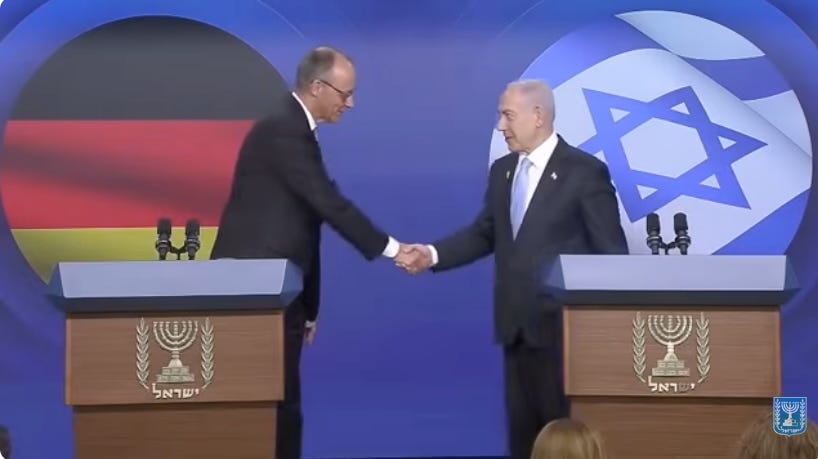
Prime Minister Netanyahu of Israel welcomed Chancellor Merz of Germany to Jerusalem, Israel today, undercutting the “pariah state” storyline being pushed by Netanyahu’s domestic critics and by Israel’s international enemies. His remarks were perceptive and true and resonated with me to the point that I thought they were worth republishing here in full, as I’ve done in the past with some other Netanyahu speeches. They typically don’t get much coverage in the U.S. press. Plenty of people easily find reasons to be downcast about Israel’s international standing. If one takes a long view of it, though, it is really an amazing and great thing for the prime minister of Israel, as a sovereign regional power, to be hosting a German chancellor in Jerusalem and to be explaining, while the German chancellor stands by, both how medieval hatred against the Jews persists, and also how Jewish sovereignty has changed the reality.
Prime Minister Netanyahu, this afternoon, at the joint press conference with German Chancellor Friedrich Merz, at the Prime Minister’s Office in Jerusalem:
“Thank you, Chancellor Friedrich, it’s good to welcome you and your delegation to Jerusalem, not for the first time, but as you say, the first time as chancellor. We had the opportunity between these visits to speak many times on the phone, and I have to tell you, I speak to many world leaders, when I speak to Friedrich Merz, it’s an open, honest conversation. Even when we have disagreements. And often we have agreements. But these are open conversations between friends and people who respect each other.
I have to say that I took note not only of our differences, but also the forthright statements that you made about what Israel is doing for the rest of humanity. You said that during the Rising Lion operation, our 12-day war with Iran, you said it just now, in Ankara, quite forcefully, and I think these and other statements are very important because they reflect a deeper commitment which expresses the intertwined destinies of Israel and Germany.
We went through the greatest tragedy that any people suffered on German soil and committed by Germans. The generations that followed the Holocaust were understood that there was a special moral commitment to enable the Jewish state, the Jewish people to recover from this horror. And Germany was committed and remains committed to Israel’s security in many important ways.
What has happened since the rise of the Jewish state, is that we have been able to fend off our enemies, and in order to do that, we developed capacities that now enable us to reciprocate. Not only does Germany work in the defense of Israel, but Israel, the Jewish state, 80 years after the Holocaust, works for the defense of Germany. And that is a historical change that comes at the time of great international turbulence and change.
We discussed the ways that we can continue this defense cooperation in a changing world, but it’s not only cooperation in military matters. We discuss the cooperation in technological matters. Israel and Germany are two of the most advanced economies in the world. We have extraordinary people, extraordinarily gifted people, and in the field of high technology, high tech, deep tech, AI, quantum, all these things that are going to change the face of this planet and the future of humanity. These are things that we are ranked very high. But together, cooperating in this will rank even higher. There’s not much space to go. I think that working together, we can not only better the citizens of Israel and Germany, but I think we can better the world and our immediate neighborhood in the Middle East. We discuss that and we are ready to seize the future together.
This will help peace. We are at the point where we believe that peace opportunities are at hand. The Iran axis has been battered. It was the major engine of disruption in the negative sense of terrorism, of extremism, and fanaticism. It’s definitely been relegated to a back seat. So, now opportunities for peace are there. We tend to exploit them. I’m going to discuss them with President Trump when I meet him later on this month, but we discuss them as well.
We discuss, of course, how to bring an end to the Hamas rule in Gaza because that’s an essential part of ensuring a different future for Gaza and a different future for us, facing Gaza. We finished the first part, as you know. Phase one, we’re almost there. We have one more deceased hostage, Ran Gvili, a hero of Israel, to return here. And then we very shortly expect to move into the second phase, which is more difficult, or equally difficult. I wouldn’t say more difficult because nobody believed that with our combined action, Israel’s military action in Gaza City and President Trump’s effective diplomatic action in bringing the Arab and Muslim world to press Hamas to give up the hostages. Nobody believed that we would achieve it, but we did.
Now we have a second phase, no less daunting, and that is to achieve the disarmament of Hamas and the demilitarization of Gaza. And as I mentioned to the Chancellor, there is a third phase, and that is to de-radicalize Gaza, something that also people believed was impossible. But it was done in Germany. It was done in Japan. It’s done in the Gulf States. It can be done in Gaza, too. But, of course, Hamas has to be dismantled. These are challenges in front of us, but we do not shirk from them. We think we have great opportunities.
I think Israel, the people of Israel, the soldiers of Israel, have demonstrated amazing resilience and amazing courage. We have fought a seven-front war against malign forces led by Iran that are openly committed to annihilate us, this, eight decades after the Holocaust, an openly declared attempt to annihilate the Jewish state. Imagine that you had an openly declared attempt to annihilate Germany, an openly declared attempt to annihilate France, or Austria, or any other country. Israel faced with that, obviously, mustered its resources and fought a just war with just means.
We are undergoing vilification on a stark scale. A stark scale for the last eight years, but not for the Jewish people. We’ve been maligned through centuries. In the Middle Ages, in Germany, and throughout medieval Europe, we were accused of poisoning the wells, of slaughtering Christian children to use their blood to bake Passover matzas. We were carrying vermin. These were the accusations that were always, always preceded the actual annihilation that followed. And Jews were attacked. They suffered pogroms. They suffered expulsions. And they suffered wholesale massacres from a very large swathe from Spain to Ukraine. Enormous vilifications, enormous attacks culminating in the greatest massacre of them all, the Holocaust.
What has happened since we thought some thought – actually, I didn’t, but some thought – that antisemitism was gone. It’s not gone. That cyclical phenomena, attacking the Jews in ways that prepare their destruction, de-legitimize them, was transferred from the Jewish people to the Jewish state. They just took a respite. A few decades where antisemitism was not done in polite company. Now it’s done in every capital. And people carry the flags of Hamas. The flags of Hamas. These people who tortured women, raped them, then beheaded them, burned children alive, babies alive, took hostages, Holocaust survivors, babies. This is outrageous.
People demonstrate for them and accuse Israel of bogus war crimes because Israel has gone to a length that no army in history has done in the most difficult urban situation, urban warfare situation, asking the population to leave and Hamas shooting them to keep them there so the casualties can appear on the various international networks.
I understand the enormous effect this has on the public in Germany and Europe, and to some extent America. But I will tell you, as I told the chancellor, there’s one big difference. We may not be able to control that, but we have changed Jewish history in the sense that those who vilify us can no longer annihilate us. Because when they come to do that, as they did on October 7, we roll them back.
And as they try to put a noose of death around us, as Iran tried with its proxies, we roll them back. That’s the big difference. And I think this truth will emanate and I commend the chancellor for speaking the truth in a number of important occasions. But we still have a job to do to explain what it is we’re fighting, how we’re fighting it, and why we’re doing what we’re doing is not only for our defense, but for Germany’s defense and the defense of free societies everywhere. And I will say our non-radical Arab neighbors as well. In fact, they understand it better than most.
On the question of two states, now we have a different point of view, obviously, because the purpose of a Palestinian state is to destroy the one and only Jewish state. They already had a state in Gaza, a de facto state, and it was used to try to destroy the one and only Jewish state. We believe there’s a path to advance a broader peace with the Arab states and a path also to establish a workable peace with our Palestinian neighbors. But we’re not going to create a state that will be committed to our destruction at our doorstep.
And as you know, Israel is gigantic [Netanyahu said this sarcastically]. It’s 50 kilometers wide, 70 kilometers wide at its widest point. And we are obviously going to take care of our security.
The one thing that we will always insist upon is that the sovereign power of security from the Jordan River, which is right here, to the Mediterranean Sea, which is right there, that will always be in Israel’s hands. And that means that Israel will control its destiny, continue to protect its security for our sake and for others as well.
I have to say, Friedrich, I think we’re at the cusp of a new age because I think that we will achieve the expansion of peace. I think that we are at a new age because I think that the possibilities of technology with their risks, especially in AI, but with their positive benefits are enormous in every field, I mean, from agriculture to health to transportation. I think that we are, together, we can lead this and become not a secondary power, but a primary power in the advance of humanity.
I look forward to our discussions, and I have to say that your wife was supposed to come here, bring her next time. It will be an opportunity, a moment to expand on these things.
So welcome, Friedrich, welcome, friend.”
Rubio on the radical Muslim threat: Netanyahu said, “what we’re doing is not only for our defense, but for Germany’s defense and the defense of free societies everywhere.” That is a point well aligned with remarks by Marco Rubio, the secretary of state and national security adviser, in a December 2, 2025 interview with Fox News’s Sean Hannity:
QUESTION: We talk a lot, and a lot of people talk in the Make America Great Again movement, about America First. And I believe in America First, but I also believe that we have to have insight, wisdom, understanding that goes along with that. And it seems like every one of the examples I just gave you where the President did use the might of the U.S. military, it’s against radical Islam. And that threat, I think when people are chanting, “Death to Israel,” when they’re chanting, “Death to America,” specific threats against our country, I have not forgotten 9/11/01. What is the nature of radicalism that maybe some people don’t understand why it’s in America’s first interest?
SECRETARY RUBIO: Because ultimately all radical Islamic movements in the world identify the West writ large but the United States in particular as the greatest evil on the Earth. And every chance they have – the notion that somehow radical Islam would be comfortable with simply controlling some province in Iraq or Syria is just not borne out by history. Radical Islam has shown that their desire is not simply to occupy one part of the world and be happy with their own little caliphate; they want to expand. It is a – it’s revolutionary in its nature. It seeks to expand and control more territories and more people.
And radical Islam has designs, openly, on the West – on the United States, on Europe. We’ve seen that progress there as well. And they are prepared to conduct acts of terrorism – in the case of Iran, nation-state actions, assassinations, murders, you name it. Whatever it takes for them to gain their influence and ultimately their domination of different cultures and societies.
That’s a clear and imminent threat to the world and to the broader West, but especially to the United States, who they identify as the chief source of evil on the planet. Okay, the reason why they hate the Kingdom of Saudi Arabia, the leadership of the UAE, of Bahrain, is because they’ve allowed the United States to partner with them. That’s why they hate them. They consider them infidels for it. They hate Israel. But they also hate America, and they hate anywhere in the world that we have influence; they seek to attack it, including here in the homeland.
If you look at the domestic terrorist – at the attacks that have happened here domestically, the overwhelming majority of them have been inspired by radical Islamic viewpoints.
QUESTION: Do you —
SECRETARY RUBIO: And that includes the shooting in the Pulse nightclub in Orlando, Florida. That includes the Saudi pilot in Pensacola, my home state. Two attacks that people seem to have forgotten.
New York Times fundraises for Jewish Currents: Today’s print New York Times carries a feature in which the newspaper’s opinion columnists tout charities for the paper’s readers. The print text in the newspaper says, “Please consider donating to these groups this holiday season.”
Included in the package is a headline, “Help a magazine that dares to tell the truth,” over an article that concludes, “Please join me in helping to support Jewish Currents and the vital work it does.” Online, that sentence includes a hyperlink to a donate page at Jewish Currents.
What is Jewish Currents? It’s a publication so extremely hardline anti-Israel that when its editor-at-large Peter Beinart—who advocates eliminating Israel and replacing it with a country Beinart calls “Israel-Palestine,” “a Jewish home that is also, equally, a Palestinian home,” “a Jewish home that is not a Jewish state”—recently publicly apologized for speaking at Tel Aviv University, the publication’s editor in chief, Arielle Angel, commented, “I’m glad to see Peter’s apology. Jewish Currents was not aware of this event until the 11th hour, and was not consulted on his decision. If I had been, I would have urged him not to cross the picket line. I appreciate him taking responsibility for his mistake.”
It’s a boycott-Israel-advocating publication. And it’s already backed by George and Alex Soros’s Open Society Foundation, to the tune of more than $800,000 since 2020, and by the Nathan Cummings Foundation ($125,000 in 2022, $50,000 in 2023 to the “Association for the Promotion of Jewish Secularism,” which is the name of the publishing nonprofit.) The Times says of Jewish Currents, “Recent pieces include an investigative story on the Trump administration’s campaign against George Soros and progressive philanthropy,” without noting that the publication itself is Soros-funded. The Times does disclose that “Seventy-nine years ago, Jewish Currents was founded as a Communist publication.”
A lot of states now have anti-BDS (the movement to Boycott, Divest, and Sanction Israel) laws, and it may be an interesting question how, or whether, the Times language about “please consider” and “please join me,” together with the hyperlink to the donate interacts with those state anti-BDS laws. It is a question the Times lawyers may have themselves mulled, to judge by the fine print included about how “Neither the authors nor The Times will be able to address queries about the groups or facilitate donations.” How much “facilitation” is needed beyond the “please join me,” “please consider donating,” “help,” and the hyperlink to the donate page?
Anyway, I was pleasantly surprised the other day to see that the Marc Rowan-led, Zohran-Mamdani-is-our-enemy, UJA-Federation of New York is still an official partner of what used to be the Times “neediest cases” fund that now has some more anodyne name (The New York Times “communities fund”). Maybe this appeal for boycott-Israel Jewish Currents is somehow designed to balance that out? It made me think Netanyahu was right on target when he said, “We are undergoing vilification on a stark scale.” And also that, “We may not be able to control that, but we have changed Jewish history in the sense that those who vilify us can no longer annihilate us.”
Thank you: Unlike Jewish Currents, The Editors gets no support from either the Soros Open Society Foundation or the Nathan Cummings Foundation, and we don’t have friendly New York Times opinion columnists hustling shekels for us. We are a reader-supported publication that relies on paying subscribers for our editorial independence. If you are a paying subscriber to The Editors already, thank you. For the rest of you, if you appreciate the content, please become a paying subscriber today to assure your full access and help support our independent journalism. The cost is as little as $1.54 a week, which is less than a cup of coffee.
During the Iraq war, while cruising on the canals of Berlin with colleagues at a scientific meeting, I asked a German colleague for insights on why de-radicalizing of Germany worked so well. The reply was that the devastation was so huge and the Allies offered a reasonable vision of the future that Germans decided it made sense to try the Allied approach.
It worked.
Netanyahu's speech was very good. Thanks for making us aware of it and Merz' visit to Israel.