


The University of Chicago just extended president Paul Alivisatos’s term through June 2030. Here is the message Alivisatos sent to students on September 30 at the start of the Autumn Quarter: “Here we argue hard and listen harder. …Harmony is not the goal—the goal is truth-seeking, however fraught and hard. People may say things that you find deeply offensive. We will not punish them for expression that falls within the wide bounds of our carefully crafted policies of time, place, and manner, and anti-harassment and anti-discrimination. Rather, we have set the conditions to refute bad ideas. So, take the opportunity to contest them, take them apart, and help one another drive toward truth. To make that dialogue possible, we also hold a simple limit: you may disagree, protest, and challenge ideas, but you may not prevent others from learning, speaking, or being heard. Passion is welcome; preventing the conversation from happening is not. Enter disagreements with kindness and humility, and always be ready to hear another view. That is how understanding deepens.”
Meanwhile, at The Free Press, Joel Klein, who is the former chancellor of New York City’s public schools system and the former head of the Justice Department’s antitrust division, has a beautifully written piece, published September 28, about his experiences clerking for Chief Judge David Bazelon on the United States Court of Appeals for the D.C. Circuit (who, by Klein’s account, was cruel) and for Supreme Court Justice Lewis Powell. Klein writes, “I now find certainty overrated….. Don’t get me wrong: I have beliefs, deep beliefs, and strong convictions. But I rarely let conviction harden into certainty. When people disagree with me, I try to listen and evaluate their contentions. At times, I’ve changed my mind.”
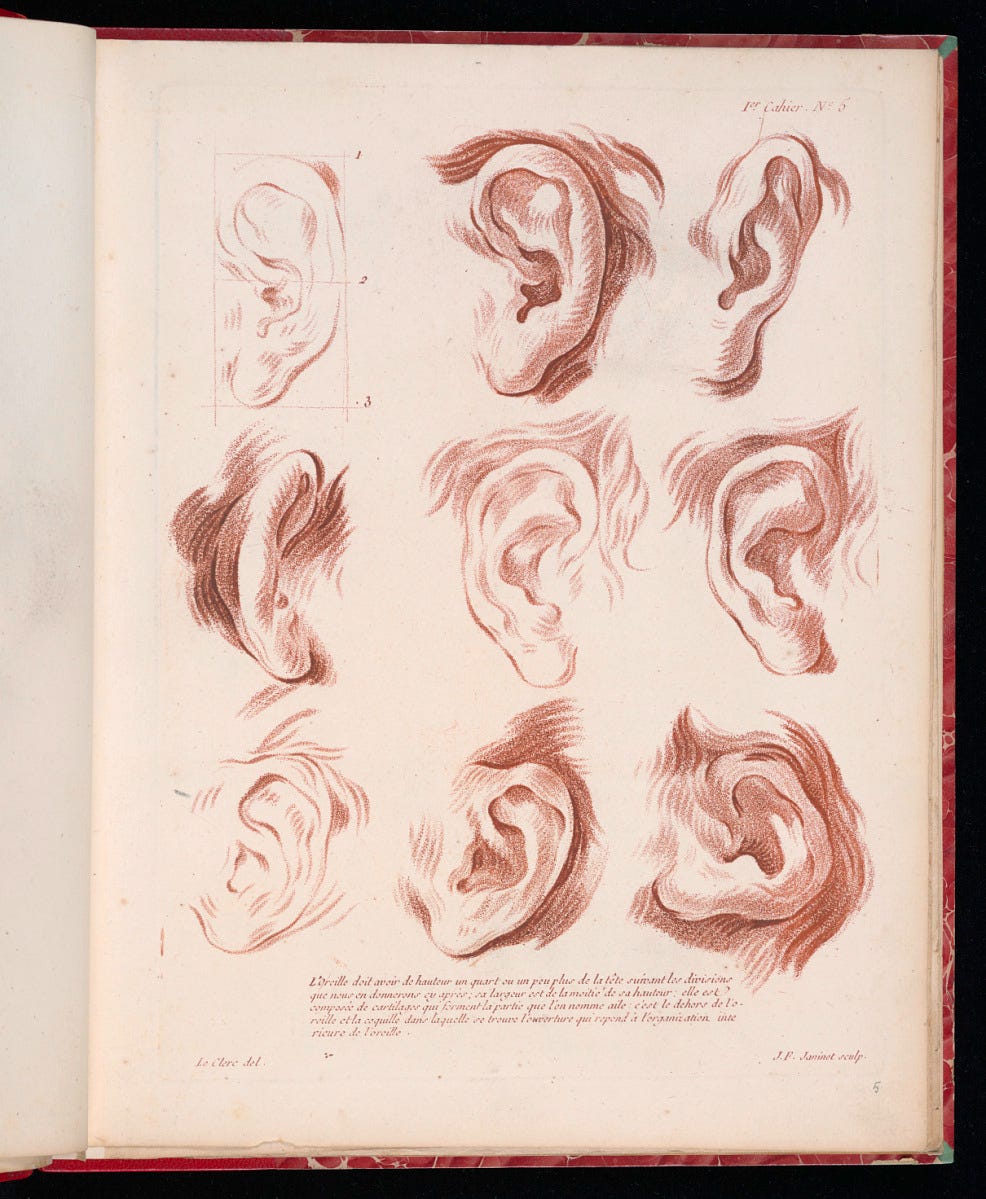
The bolding is mine. I was struck that these two messages from wise and accomplished people both emphasize listening. Not just sitting there quietly and pretending to listen, but listening in a way that you actually hear and might adjust in reaction to the new information. It’s such an important skill and one that often gets overlooked in favor of other skills and virtues—being good at math, or public speaking, or reading and writing, or working hard, or grit/resilience or excellence at social media or sales or stock-picking. Those are all important and valuable, but so is listening.
It reminded me, also of Exodus 24:7. I had to sort through a lot of English translations to find the one that conveyed the point I was looking to bring out from the Hebrew text, but our friends at Sefaria have one from Metsudah Publications that conveys the response of the people after Moses read the Book of the Covenant in their ears.
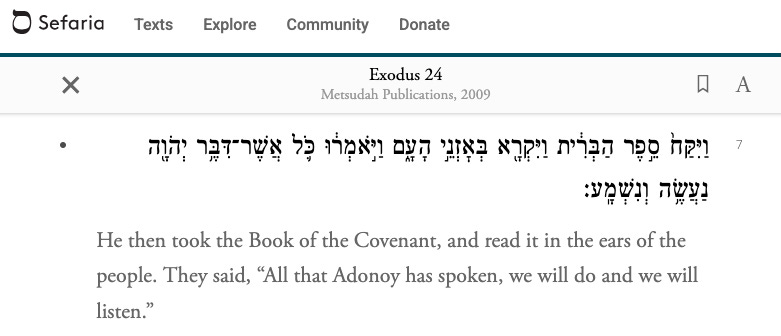
They reply: “we will do and we will listen.” There’s endless rabbinical commentary about the order—why listen, or hear, only after doing, not before—but the point that I think I hear coming from Alivisatos and Klein and maybe even also Exodus is that it’s listening that gets us closer to truth, not even strictly in that academic sense of accuracy or advancing the frontiers of knowledge, crucial as those are, but in the big-T Truth and virtue sense of relating to other people with dignity, opening the possibility of learning from them.
Israeli general predicts postwar economic boom:
Brigadier General (Reserve) Amir Avivi, the founder and chairman of Israel’s Defense and Security Forum, has been generally accurate and reliable in predicting developments in the war, including Israel’s move into Rafah and into Lebanon. This morning Avivi did one of his regular online video briefings and predicted that the war will wind up rapidly—in one, two, or three months—either as a result of the diplomatic deal Trump and Netanyahu announced or proposed on Monday or, if Hamas does not release all the hostages, via military action by Israel.
Avivi outlined a postwar agenda for Israel, including welcoming Aliya, or immigration of Jews currently living outside Israel, and shifting resources to police or a national guard to get better control over the Negev and the Galilee. Intriguingly, he spoke of a “huge, huge economic boom that is going to be here after the war.” He didn’t go into a lot of detail but it makes sense that, just as the U.S. saw dramatic post-Covid growth and the U.S. saw a post-World War II boom, Israel would see strong growth as resources are reallocated away from warfighting and tourism returns.
Potentially, Israel could also gain from trade cooperation with this Pakistan-Indonesia-Saudi Arabia-Turkey-Qatar-Egypt-Jordan-UAE lineup that the U.S. is hoping will counter Russia and China. I have my doubts about that lineup, as I outlined yesterday (“Missing from Trump Gaza Plan: Rule of Law, Democracy”), but it could happen. One thing Trump said Monday helps puncture the “pariah state” myth being pushed by the Wall Street Journal news section and the New York Times. As President Trump put, “Many countries have gained great respect for Israel for the way they fight.”
Three terrible New York Times stories: The New York Times publishes news articles that are missing crucial context or are just fundamentally inaccurate so frequently that it makes it hard to keep up, but here are three recent ones that are particularly blatant examples of bad journalism.
First example: A long feature with video and photos that appears under the headline “How China Is Losing Its Title as the World’s Sneaker Factory.” It carries the credit, “By Alexandra Stevenson and Tung Ngo” with “Photographs and Video by Linh Pham.” Ling Pham and Tung Ngo are both based in Vietnam, which is a communist dictatorship that doesn’t allow a free press. The Times says. “Alexandra Stevenson and Tung Ngo visited factories in Ho Chi Minh City and neighboring provinces to interview executives and workers at companies that make each part of the sneakers you wear.” Anyway, the Times goes to Vietnam and writes a whole article about manufacturing there without reporting how much money the workers in the factories earn, or what would happen to them if they tried to form a labor union that wasn’t controlled by the Communist Party but instead was independent and controlled by the workers themselves. Those are such obvious questions that it’s just journalistic malpractice not to ask them. The failure to include the information makes a reader suspect that the not asking it, or not including it in the story, was a condition for obtaining access to the factories. Where were the editors?
Second example: A Times article by Michael Bender headlined “Harvard Blasts Administration Over ‘Distorted’ Civil Rights Investigation.” Bender writes, “In a strongly worded, 163-page letter with attachments on Sept. 19, which has not been previously reported, Harvard assailed the government’s findings. The university accused investigators at the Health and Human Services Department of relying on ‘inaccurate and incomplete facts,’ failing to meet a single legal requirement to prove discrimination and drawing sweeping conclusions from a survey of one-half of 1 percent of the student body.”
But there are multiple Harvard surveys showing Jewish students there get an inferior experience that has gotten worse in recent years. (See “Harvard’s Own Survey Data Shows Jewish Students Get Inferior Experience.”) And the survey Harvard is dismissing was published by its own professors. If they are so sloppy, what are they doing on the Harvard faculty? Meanwhile, the Times is elsewhere touting its own poll as evidence of supposedly plummeting support for Israel. That Times poll surveyed a much smaller percentage of Americans than the Harvard poll did Harvard community members. It’s almost like what the Times cares about isn’t the reliability of the poll methodology, but whether the findings will allow the Times to bash President Trump, Israel, and Prime Minister Netanyahu while minimizing the seriousness of antisemitism on campus.
Bender doesn’t publish or link to the 163-page Harvard letter. Failure to link to the primary source is frequently a sign that the reporting is less than fully trustworthy.
Just how tilted Bender’s account is is also clear from his description of a ruling by a federal judge in Boston, Allison Burroughs. Bender writes that the judge “rebuked the administration,” that is, the Trump administration. But the Times omits that the judge also castigated Harvard. She wrote, “It is clear, even based solely on Harvard’s own admissions, that Harvard has been plagued by antisemitism in recent years and could (and should) have done a better job of dealing with the issue,” Burroughs said. “Harvard was wrong to tolerate hateful behavior for as long as it did.” That made her the second federal judge to fault Harvard on this issue; in August 2024, another federal district judge, Richard Stearns, ruled, “Harvard has failed its Jewish students.” The news here is that Harvard is, sadly, still denying the severity of its antisemitism problem rather than moving to fix it. That’s not to question Alan Garber’s motives or his sincerity or to entirely bless the Trump administration’s tactics, but the Times article reads like it was written by a Harvard spokesman or lawyer rather than by a journalist trying to do justice to all sides of the situation.
Third example: Erika Solomon, reporting from Cairo, “For Arab Nations With Ties to Israel, Attacks on Qatar and Gaza City Raise Anxiety.” She writes, “Some of the angriest responses to these actions have come from Egypt, the first Arab country to sign a peace treaty with Israel in 1979. Like Qatar, Egypt has also acted as a mediator in Gaza cease-fire negotiations. The attack on Doha raised questions of whether Egypt, too, could be vulnerable to Israeli strikes — and whether any country in the region is truly off limits, analysts said.”
The story goes on, “Like much of the Arab world, Egyptians were already seething over the war, which has killed tens of thousands of Palestinians. Egypt shares a border with southern Gaza in the Sinai Peninsula. Egyptian officials fear that the latest escalation of the war, which leaves people almost nowhere to flee to, could create pressure on their border by Palestinians desperate to escape…Domestic security concerns are just as critical. If Hamas militants managed to cross the border with refugees, it could provoke an Israeli attack on Egyptian soil.”
To write a whole article about Israel-Egypt relations without mentioning that Egypt—including President Sisi’s son—reportedly earned billions of dollars smuggling arms, supplies, and terrorists across the Gaza-Egypt border seems, again, like journalistic malpractice. (See “Sisi’s Son Is Said to Profit from Gaza-Egypt Smuggling.”) Egypt is less concerned about Israel striking Hamas inside Egypt than it is concerned that Hamas-aligned Muslim Brotherhood extremists will overthrow the Egyptian government. This is another example of a Times reporter based in a not-free country, in this case, Egypt, writing in a way that will prevent her getting arrested or kicked out of Egypt, but also prevent Times readers from getting the full truth. Again, where were the editors?
Program note: We plan to publish next on Friday October 3, owing to the Yom Kippur holiday.
Thank you: If you know someone who would enjoy or benefit from reading The Editors, please help us grow, and help your friends, family members, and associates understand the world around them, by forwarding this email along with a suggestion that they subscribe. Or send a gift subscription. If it doesn’t work on mobile, try desktop. Or vice versa. Or ask a tech-savvy youngster to help. Thank you to those of who who have done this recently (we see the results, and they are encouraging) and thanks in advance to the rest of you.
As Jewish Harvard students get an inferior experience that has gotten worse in recent years, have material numbers decamped to other schools or elsewhere? If not, why not? Has the percentage of Jewish students declined? Numbers?
People who have spent their entire lives in free countries tend to underestimate the degree to which speech is curbed in non-free countries. Ira Stoll performs an important service in disabusing us of such gullibility. Listening to the accounts of people who grew up in non-free countries and emigrated to free countries conveys the same wisdom.