

The Oxford Union Disgraces Itself, and Oxford University
What has happened to the world’s most prestigious debating society?

[The Editors is called The Editors, plural, not The Editor, singular, for a reason. When I launched it, a shrewd friend advised, “it can’t just be you.” I’m delighted to start introducing some additional voices. Today’s comes from Michael Mosbacher, who is associate comment editor at London’s Daily Telegraph. He is a past editor of Standpoint and The Critic, having co-founded both British magazines.—Ira Stoll.]
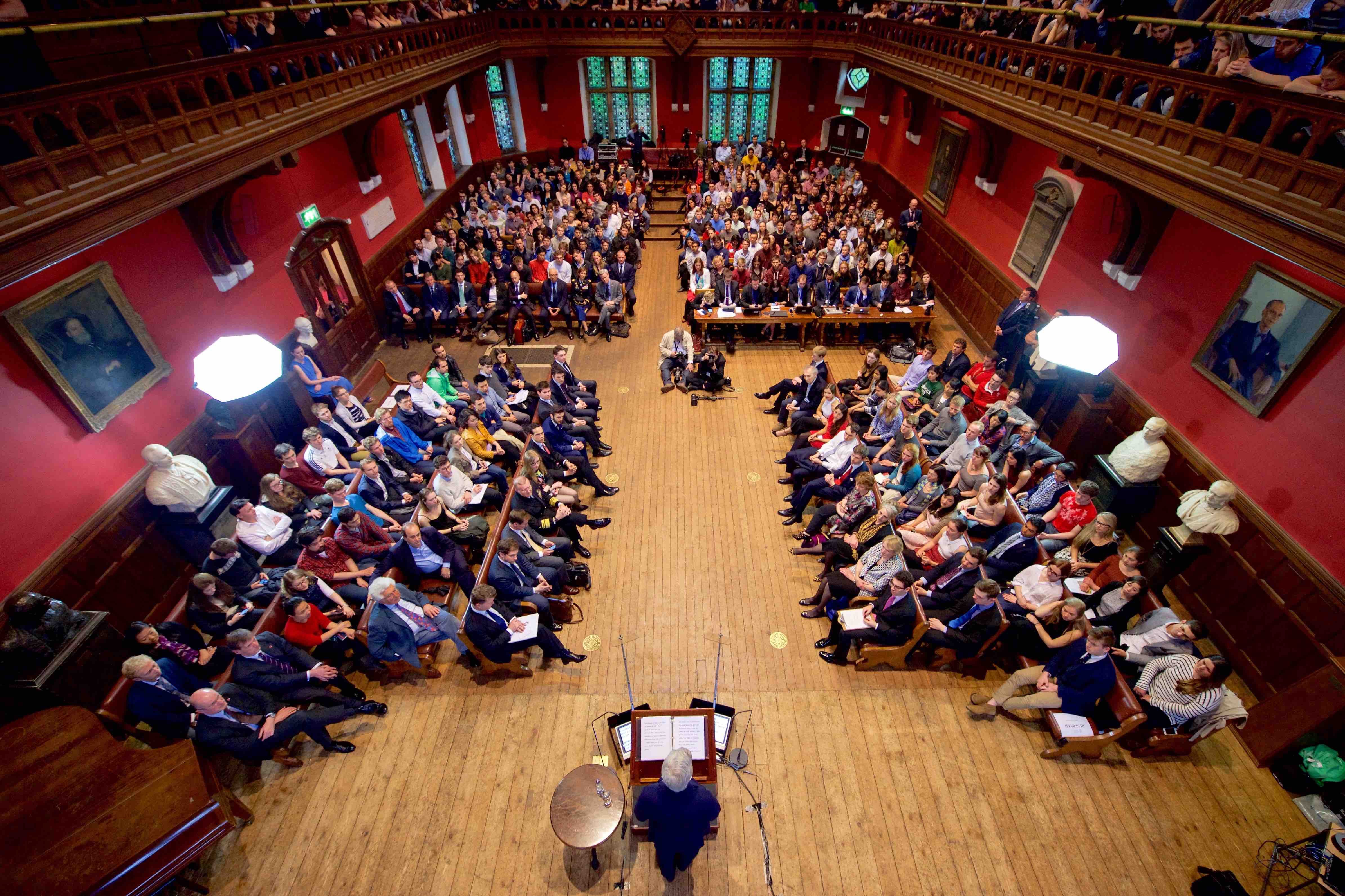
On February 9, 1933 — just 10 days after Hitler became Chancellor of Germany — the Oxford Union voted, in the so-called King and Country debate, by 275 votes to 133 “That this House will under no circumstances fight for its King and country.” Last week the Oxford Union once more disgraced itself.
“This house believes Israel is an apartheid state responsible for genocide” was approved by an even larger margin — 278 votes to 59. Worse than the margin of victory for the forces of hate was the way the debate itself was conducted. As Jonathan Sacerdoti, one of the speakers against the motion, has put it, “This was not an audience interested in debate… It was a baying mob… They interrupted every pro-Israel speaker with jeers, coughs, and outright abuse.” Anti-Israel extremist Miko Peled, speaking for the motion, described the October 7 Hamas butchers as “heroic.” When another speaker asked all those in the audience who condemn the October 7 massacres to raise their hands, only a few shot up. The Union’s president — Ebrahim Osman-Mowafy, an Egyptian Arab — instead of acting as an impartial chair was blatantly, outspokenly, and proudly biased against Israel’s case.
The Oxford Union is an institution that advertises itself, seemingly without irony, as “one of our last bastions of civilised debate.” Its speakers still dine together before jousting in the debating chamber and dress in black tie. Its past presidents — there are plenty to choose from, as the organization rotates through three a year to maximize the ability of its members to claim the now-dubious distinction — went on to serve as prime ministers, cabinet ministers, and newspaper editors. British 1970s prime minister Edward Heath and Pakistan’s assassinated prime minister Benazir Bhutto won their leadership races, while Boris Johnson ran and lost.
Yet it now seems to be reprising its worst mistake in once more calling for the appeasement of the darkest antisemitic malevolencies. What has happened to the world’s, certainly England’s, most prestigious debating society?
The Oxford Union is a private member club closely linked to the eponymous university, not officially tied to it. This makes its descent all the more surprising — it is not the traditional stomping ground for student radicals, organizing sit-ins or other protests. Most of that genre of student has traditionally regarded the Union as a bastion of well-heeled public school (i.e., what Americans would call prep school) privilege.
Leftist agitators were not entirely unknown in the past — the Trotskyist Tariq Ali, co-organiser of the anti-Vietnam war march on the US embassy in London’s Grosvenor Square in 1968, which descended into a riot, was president of the Union in 1965. Ali restaged the King and Country debate during his term; this time the motion was narrowly defeated. But the Ali types were in a distinct minority. Instead it has been a breeding ground for wannabe and future Tory politicians.
But in recent years, the atmosphere has changed. Those standing for Union office have often stood on a platform denigrating rather than celebrating the institution. They have called for the institution to be shaken up and reformed, for it to abandon its traditions and change its modus operandi. They have promised that their reforming zeal will turn the Union into an agent of social change, rather than just a place for Oxford’s undergraduates to entertain themselves while they are avoiding their studies.
Osman-Mowafy stood on just such a platform. His election descended into the accusations and mud slinging so often found in student politics, with Oswan-Mowafy’s win first voided, then reinstated. His associates accused the Union of “racism, islamophobia, and persistent bias.” For those of his mindset, only this could explain why his victory was contested. The question needs to be asked, if they so hate the Oxford Union and for what it stands, why do they want to run it?
The other oddity is that he is only the most recent of a whole series of candidates elected on similar platforms — each proclaiming they are the essential shakeup the fusty institution needs. Yet somehow at the following election, a new batch of candidates manage to promise just the same.
So what is to be done? Last week’s debate is not an isolated incident in Oxford, or indeed any of Britain’s universities. Retired Oxford professor Sir Vernon Bogdanor notes that 101 incidents of anti-Semitic bullying, harassment, and intimidation against Jewish and Israeli students have been recorded recently at the university. The day before the debate Oxford elected a new Chancellor, or ceremonial figurehead. The winner was William Hague, a former foreign secretary and Conservative Party leader with a solid record of defending campus free speech against the woke mob. His direct powers are limited, especially in regard to the Oxford Union with its status as a members club. But Hague certainly has the ability to speak out, and this he must do.
Some wags have suggested that Oxford University should itself adopt a new name to escape the shame brought on the institution by the debating society. Let’s hope it doesn’t come to that. In the meantime, the situation may help to serve the world as a reminder, the latest in a recent series of them, that attending a fancy university is no indication of common sense, wisdom, or moral reliability.
Harvard has a "Policy on the Use of Harvard Names and Insignias" at https://trademark.harvard.edu/policy-on-use-of-harvard-names-and-insignias. It states that "Attaching a Harvard name to an event, project or publication implies a close connection with the University, usually sponsorship or endorsement. For example, such forms as the "Harvard Project on..." or the "Harvard University Guide to..." should be used only when they refer to activities for which the University itself or one of its delegated authorities is accountable. Involvement by individual Harvard faculty, students or staff members is not, by itself, a sufficient basis to title an activity as "Harvard" sponsored. Rather the activity must be one for which the University takes institutional responsibility."
There are also rules on "Use of Harvard Names and Insignias in Electronic Contexts" at https://trademark.harvard.edu/use-of-harvard-names-and-insignias-in-electronic-contexts. It states that "Advance written permission must be obtained before any Harvard name or the name of any Harvard School, unit or activity in any form (including acronyms, abbreviations, or the use of the Harvard name in combination with other words not containing "Harvard" in them) may be used in a domain name or email address."
Because of the policy on domain names we use https://advocatesforrotc.org/harvard/ instead of putting Harvard in the domain name. But the Oxford Union uses https://oxford-union.org/.
Oxford is of course a place name, but so is Harvard.
The legal climate may be different in the UK than in the USA, but Chancellor William Hague should explore whether Oxford University should have policies similar to those of Harvard to make clear what activities are sponsored by the university.
Ok, I’ll say it: an attack on Israel should be regarded presumptively as an attack on Western civilization.