


During that February 28 Oval Office spectacle between President Trump, Vice President Vance, and President Zelensky of Ukraine, Zelensky attempted to make an important point.
Zelensky: “[There are] a lot of questions. Let's start from the beginning. First of all, during the war, everybody has problems, even you, but you have a nice ocean [in between], and don’t feel it now, but you will feel it in the future. God bless you.”
The reference to the “ocean” may have been mystifying to those tuning in for the first time. To anyone who has been listening carefully to Trump, though, it was a key, substantive attempt to counter what has been a core, frequently repeated Trump talking point about the war in Ukraine.
On February 26, Trump said in remarks before a Cabinet meeting, “as you know, we’re in for, probably, $350 billion and Europe is in for $100 billion. And that’s a big difference. So, we’re in for, probably, three times as much. And yet, it’s very important to everybody, but Europe is very close. We have a big ocean separating us. So, it’s very important for Europe. And they, hopefully, will step up and do maybe more than they’re doing and maybe a lot more.”
Trump said something similar on February 19 in Miami Beach: “this war is far more important to Europe than it is to us, and that there’s a very big, beautiful ocean as separation. This is — you know, we’re helping Europe. We’re trying to help Europe.”
He made the same point on February 18 at Mar-a-Lago: “I think Europe has given 100 billion, and we’ve given, let’s say, 300-plus, and it’s more important for them than it is for us. We have an ocean in between, and they don’t.”
Those are just a few among many examples from Trump and members of his administration. It’s one thing for Trump to say this sort of thing as a talking point in the midst of negotiations to try to get a better deal for America in a peace deal with Ukraine, Europe, and Russia. Yet if Trump isn’t careful, the American people and our allies and enemies around the world might interpret “big, beautiful ocean” as shorthand for the idea that, because of geography, America is insulated and protected from the rest of the world and can therefore safely retreat from it. If Zelensky doesn’t have the English-language communications skills or the public stature to explain to the American public how wrong this is, someone else should make an attempt. Here is a try:
History has shown that a “big, beautiful ocean” is no protection against enemy attacks.
There was a “big, beautiful ocean”—the Pacific—between America and Japan, yet the Japanese still managed to attack our naval base on Hawaii on December 7, 1941.
There is a “big, beautiful ocean”—the Atlantic—between America and Afghanistan, yet the Afghanistan-based Al Qaeda still managed to attack the World Trade Center and the Pentagon on September 11, 2001.
A land-based nuclear-armed intercontinental ballistic missile can get from Russia to the U.S. mainland in about 30 minutes.
And Russia has submarines and ships that are armed with missiles and that regularly operate not far from the U.S. east and west coasts. The U.S. Naval Institute News reported June 11, 2024, “A nuclear Russian submarine carrying guided missiles with a range of 1,000 nautical miles is operating off the East Coast as part of Russian missile drills in the Atlantic. Kazan, a Yasen-M-class guided missile submarine, is part of a naval action group the Russian Ministry of Defense deployed to the Atlantic. The group is bound for the Caribbean as part of military drills ordered by the Kremlin against the backdrop of the war in Ukraine, according to the MoD. On Tuesday, Kazan and the advanced guided-missile frigate Admiral Gorshkov tested anti-ship missiles virtually in the Atlantic at targets with a range of more than 350 miles before resuming its transit to a previously scheduled port visit to Havana on Wednesday, the Russian MoD said in a statement. … The group was operating just east of the Florida Keys.”
Trump is wisely investing in layered missile defense, including, crucially, “Development and deployment of proliferated space-based interceptors capable of boost-phase intercept.” But until such a defense is deployed and proven failsafe, that “big, beautiful ocean” is a defense against Russian tanks but not missiles.
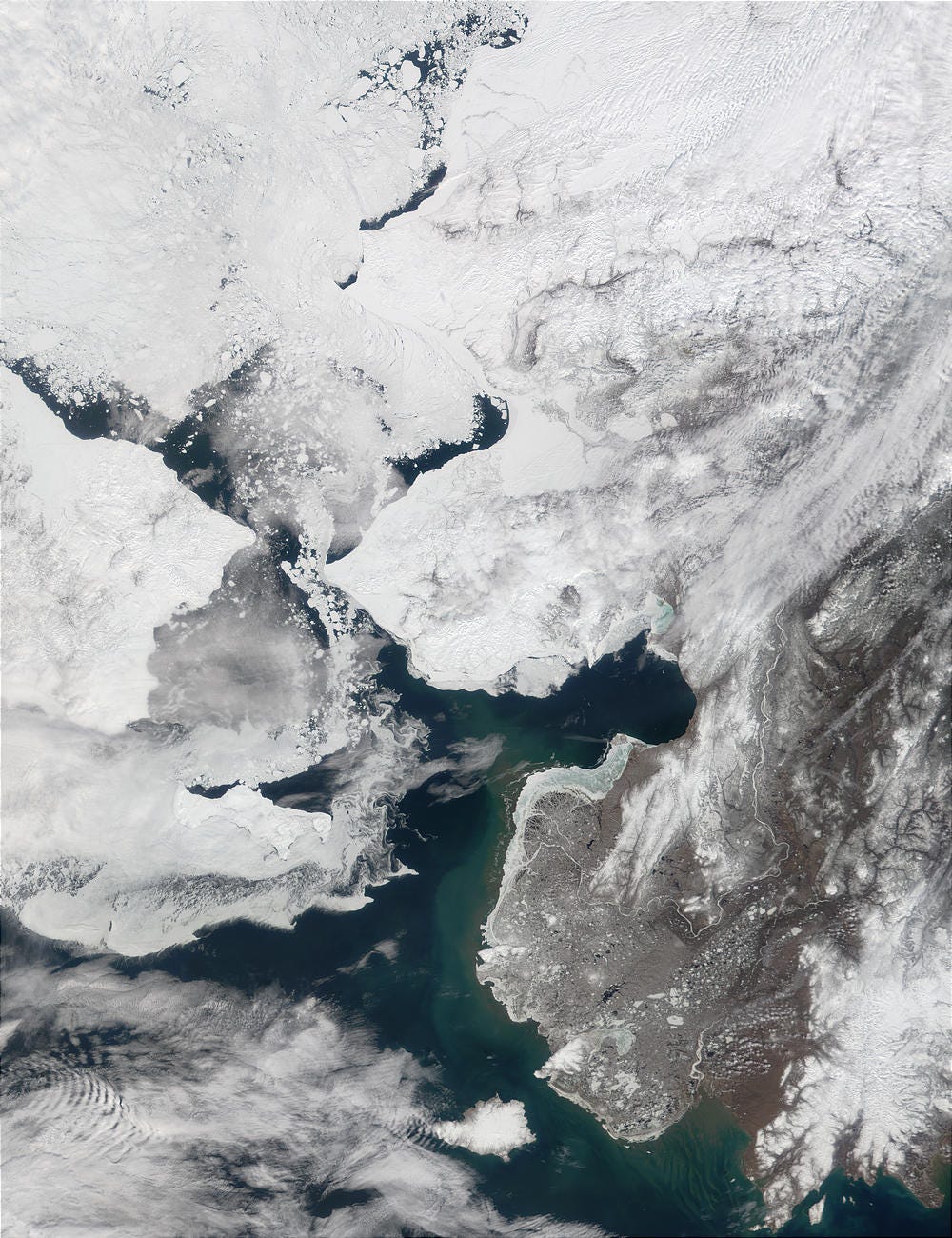
It’s also worth remembering too that Russia is closer to America than many people realize. The Bering Strait dividing Alaska from Russia is only 44 nautical miles wide, about 50 land miles. (That may help account for why one of Alaska’s senators, Lisa Murkowski, a Republican, said, “I am sick to my stomach as the administration appears to be walking away from our allies and embracing Putin, a threat to democracy and U.S. values around the world.”)
And American embassies, assets, and personnel overseas are also vulnerable to attacks, as demonstrated by the October 2000 attack on the USS Cole, the attack on a U.S. Air Force housing facility at Khobar Towers in Saudi Arabia in 1996, and the 1998 bombings of U.S. embassies in Kenya and Tanzania. The isolationists can claim America is making itself a target with its military bases overseas, but do they propose to close all the American embassies, too? Or retailers and restaurants? Short of telling Starbucks, McDonald’s, Chase, Gap, Apple and other American companies to stop operating worldwide, or instructing U.S.-flag commercial airline carriers to stop flying to foreign destinations, there’s no way to put all American assets on this side of a “big, beautiful ocean.”
None of this is to dismiss entirely the geostrategic value of an ocean’s distance. Nor is it to say that defending every last inch of Ukraine at any cost should be America’s number one national security priority. But whether it is Zelensky’s “nice ocean” or Trump’s “big, beautiful ocean,” the idea that America can rely on some sea as a security guarantee is a dangerous delusion.
True
What is your opinion of Trump's call for a ceasefire when one country was on the receiving end of an attack?