

The Dick Cheney I Knew
His exit marks a changing of the guard, away from vast vision and American power
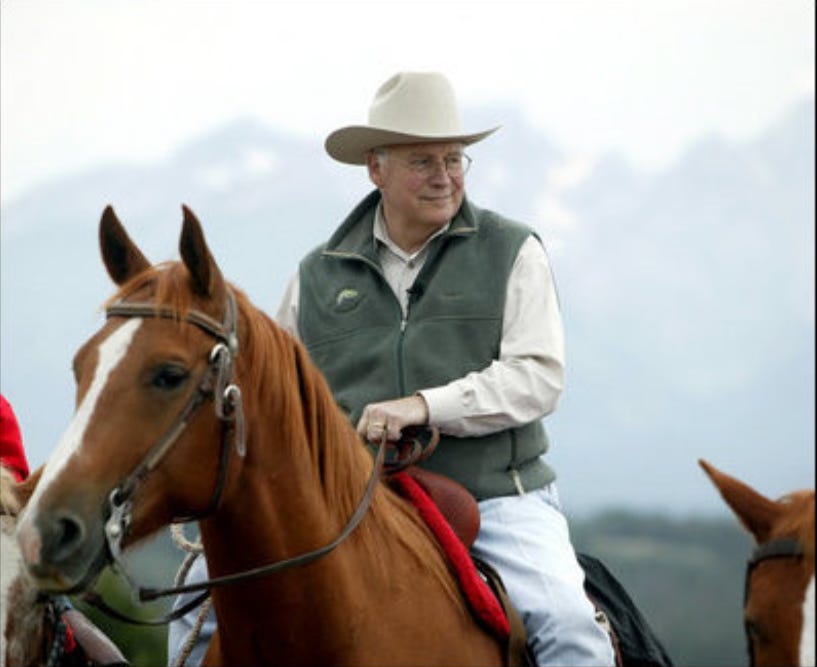
David Wurmser is a senior fellow at the Center for Security Policy in Washington and at the Jerusalem Center for Security and Foreign Affairs in Israel. He was senior advisor to Vice President Cheney.
Vice President Cheney was not a terribly difficult man to read. He was a Western man — a child of a railroad family and man whose ancestors were woven into the fabric of American society, especially the American society that pushed westward and built the nation. In his West Wing office hung a memento to his ancestor that had fought in the Civil War, a statue of a famous Indian chief, and a replica of a B-2 bomber. His values were of that pedigree: a quiet but strong man, understated, yet a determined and passionate patriot and warrior for the United States. There was nothing terribly complicated about his values or outlook; he was intensely intelligent and had an unfailing memory. He collected knowledge the way others breathed air. He grew up in the shadow of World War II, and came to Washington at a time when those slightly older than him, those who had fought in that war as youth, assumed the reins of power.
From what I could tell, his concept of America emerged directly out of that great war and the transfer of its lessons and clarity of moral purpose onto the immediate new twilight struggle into which the United States had entered. The intellectual discourse of the age revolved around the failure of Munich in 1938, the absoluteness of evil in Hitler and Stalin, and the need to defeat and bury their movements.
In his world, America’s power, the value of freedom as a guiding beacon, and strong allies around the world aligned as bedrock for human civilization. And for the man who grew up from the edge of the Midwest and near the Rockies, defending civilization demanded the values of the rancher community he grew up in: sobriety, clarity, integrity, straightforwardness, and disdain for wrapping problems in shiny paper. In his meetings at the White House, as far as one can get from Caspar Mountain and Platte River near Caspar from where he came, he showed impatience with those who sought to figure out “how to package” what were problematic events or policy setbacks. He wanted to confront and solve problems, not spin the portrayal of them or just manage them enough to kick the can down to the next guy.
At the center of it all was the outlook seared into that generation whose older brothers fought and died to defend America in the islands of the Pacific and towns of Europe. America was a good country, populated by a moral people who did not seek glory but went to get a tough job done and then come home. The world that emerged coming out of World War II was a world built on that goodness, uncomplicated purity and innocence, and fortunately was blessed by the unsurpassed power of the United States. Not only real power, but the stature and reputation of power that comes from resolve.The world whose architecture was built and the way of life of Americans secured by the victory in World War II all demanded not only a military but the willingness to use it against those who tested us. A disengaged, weak, or naïve America — an America whose power or resolve could be doubted — threatened our nation, our allies and our way of life. It threatened global peace.
That world was threatened by Vietnam, but only five years after the fall of Saigon it was embodied by President Ronald Reagan. Being two or three decades older, President Reagan was the generation before Vice President Cheney’s. As such, Cheney saw the Reagan era as the last act of World War II, namely the final resolution of the Cold War, which was a loose end left unfinished, denying the final triumph of the great war. In one conference sponsored by the American Enterprise Institute in the late 1990s that Cheney and I both attended, Margaret Thatcher came to the new America in Phoenix — and with an intensity in her look, the grand Lady outlined why she could not rest until Poland was admitted into NATO: “We entered World War II because Poland was enslaved, and I will not consider the war complete until Poland is installed as a member of the Western alliance.” Cheney – still before he was vice president – beamed with agreement. That view was as much his as hers. It was a spoken bond between these two who lived through these great struggles for freedom and had seen their nations reach great sadness but immense victory and greatness.
Thatcher and Reagan’s generation had handed Cheney’s generation a gift, and he was determined to validate the trust that he felt had been placed in his generation. As part of the Reagan era, indeed already of the Nixon/Ford era, but a man who rose to the top of the power structure under President George W. Bush, he took very seriously the task of navigating the victory of the Cold War and leveraging American power into forging a stable structure he could hand with confidence and a calm heart to his children. He was a warrior for posterity. There were loose ends, problems, that needed to be resolved. Iraq and Iran were among those problems. In one meeting I had with him either in 2006 or 2007, he said to me bluntly that he cannot in good conscience leave the problem of a nuclearizing Iran to his successor. “I just can’t do that; it’s wrong.”
But while these were specific problems, Vice President Cheney also understood that power is important, but without a framework, a strategy, it was ultimately flailing and useless. So while he cared about Iraq — being increasingly frustrated how hundreds of thousands of servicemen risked and sacrificed their lives daily in the Iraq war while Washington power brokers and senior officials washed their hands of it, leaving not only the policy but the sons of America orphaned defending it — he also understood that no victory in Iraq was either possible or even definable without a clear national strategy. World War II and the Cold War both demanded a strategy — not endless laundry lists of tactics and options, but a informing strategic vision — and so too did he feel that the threat from the Middle East and radical movements and governments there, as well as from China and elsewhere, demanded a national strategy. So around 2005, he tried to push the system to do what it did in the 1890s, in the early days of World War II, in 1948 and again in the 1950s, and craft a national strategy that places our involvement in the Middle East in the larger context of global strategy. Nobody wanted to own the Iraq war, and certainly nobody wanted to think in terms of grand strategy at the time. He had to collect his own team, which he did.
But this was 2004-2006, and Washington had moved on. Both the American mission he sought and the soldiers left fighting on the Iraqi battlefields were abandoned by Washington. He spent most of his days in this period collecting whatever information he could about the war, the well-being and morale of our soldiers, and in trying to help them from Washington achieve victory. The responsibility of “being under my watch,’ a term he often used, meant something weighty to him. Few understood how he more than any other U.S. official never gave up on our effort, on our forces still fighting on the ground there, or on the effort for which thousands of soldiers were wounded or died. It was a personal, moral obligation for him, not a Washington parlor game.
So, in that sense, Cheney was the last of that generation. He was a man of the same great but rather simple ideas and values that accompanied our soldiers in World War II. And that grandness and uncluttered breadth of vision informed him and drove him onward in his efforts in his last years in office as he set out to bring reason and strategy — a 40,000 foot outlook — to set the nation on a solid long-term course. But that is where the vice president faced a solitude under which those who went just before him and to whom he looked for inspiration did not have to labor. The Washington to which he came 50 years earlier was a town of great ideas, some of which also made great failures, but nonetheless always propelled America upward and onward. America thought big. It was a land of vision as vast as the frontier West in which he grew up. He felt that the American people were hungry for such a vision, and that he owed the provision of it to them and all the young servicemen around the world defending our land.
But the Washington in which he served his last years and which he left in 2009 had largely become a provincial town of small ideas. Of lists of options and not a coherent vision. Of conflict management and not problem-solving and victory. Of spin and not unvarnished sobriety. Of careerists and not stewards. Ultimately, he was the last remnant of an America, an American era and an American leadership that had begun to fade into history.
And so, it is with heavy heart I say goodbye to my old boss, and to the generation he represented to which we owe so much.