

The Democrats Versus Dynamic Pricing
Plus, Moody's on Harvard’s ‘gradual erosion’

One underappreciated risk of the inflation that has been created by factors that included a federal spending binge and loose monetary policy by the Federal Reserve is that politicians will try to combat the inflation by targeting individual businesses and their prices.
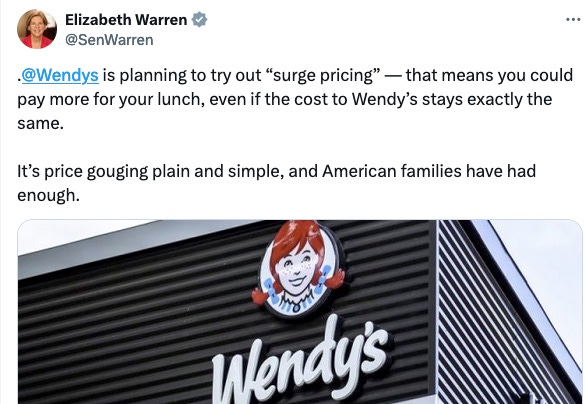
One of the most recent and egregious examples of this came from Senator Elizabeth Warren, Democrat of Massachusetts, who took to social media
to denounce the fast-food chain Wendy’s. “.@Wendys is planning to try out ‘surge pricing’ — that means you could pay more for your lunch, even if the cost to Wendy’s stays exactly the same. It’s price gouging plain and simple, and American families have had enough,” Warren tweeted.
Senator Robert Casey Jr., a Democrat of Pennsylvania, wrote Wendy’s CEO a letter: “At a time when American families are seeing higher prices on everyday items, including food, I am concerned about the substantial impact this decision will have on families’ budgets. Further, this decision comes as Wendy’s is reporting increased sales and profits. In line with my work investigating greedflation—the practice of large corporations using inflation and economic pressures as an excuse for raising prices and inflating profits—I seek to understand why Wendy’s executives opted to shift to surge pricing.”
“A Frosty costs Wendy’s the same regardless of the time it is ordered, and it should cost customers the same as well,” Casey wrote. He went on, “After intense public backlash, Wendy's is now claiming it will only use dynamic pricing to lower pricing during slower traffic times.10 The company’s announcement to backtrack on this demonstrates widespread public concern and raises questions about the company’s original intent. What assurances can Wendy’s give the public that it will not simply raise base prices to a new high level, and then offer varying misleading "discounts" throughout the day?”
The Warren-Casey contention that because food ingredient costs to the producer are constant, retail prices must also be constant doesn’t match the reality of a free market economy. That wool sweater cost the retailer the same in October when it is selling at full price as it did in February when it has been marked down for clearance. Hotels near colleges raise prices during commencement and reunion season, or on weekends when there are big sporting events, and cut them during weeks when school is out of session. Even on Amtrak, which the government runs and which is one of President Biden’s favorite ways to travel, your seat on the Acela costs more or less depending on how far in advance you book and how high or low the demand is at that particular day and time. So why pick on Wendy’s?
Wendy’s put up a blog post clarifying that its digital menuboards “could allow us to change the menu offerings at different times of day and offer discounts and value offers to our customers more easily, particularly in the slower times of day.”
Capitalism works better when prices are easily adjustable, because they help supply meet demand and also transmit information. Setting the right price is a kind of small miracle of capitalism that, through experimentation and testing, tends to wind up in the place where there is a voluntary exchange of mutual value between the buyer and the seller. That tends to happen best without a lot of government involvement, which might explain why Senators Warren and Casey are so eager to obstruct the process by inserting themselves into it. If they really want to protect consumers from inflation, they’d be better off curbing Congress’s spending binge or exercising their constitutional power to strengthen the dollar, rather than hassling restaurant companies trying to use technology to offer customers, employees, and shareholders the best possible deal.
Moody’s on Harvard brand “erosion”: On March 1, Moody’s assigned an Aaa rating to two proposed series of taxable bonds with a “stable” outlook. That’s good news for Harvard. But the announcement from Moody’s did list “factors that could lead to a downgrade of the ratings,” including, “over an extended period of time, long-term endowment underperformance that diminishes the university’s financial strength relative to peers; gradual erosion of brand or competitive position relative to other existing and rising elite universities globally.”