



The long-term trends on marriage in the United States have been dismal. That’s disappointing for those who believe on religious grounds that marriage and family formation is a kind of holy covenant involving God. And it’s also troubling for those who believe on evidence-based utilitarian grounds that marriage is, on a net basis and as a general matter (two important caveats), better for health, wealth, and some other outcomes than the alternative options.
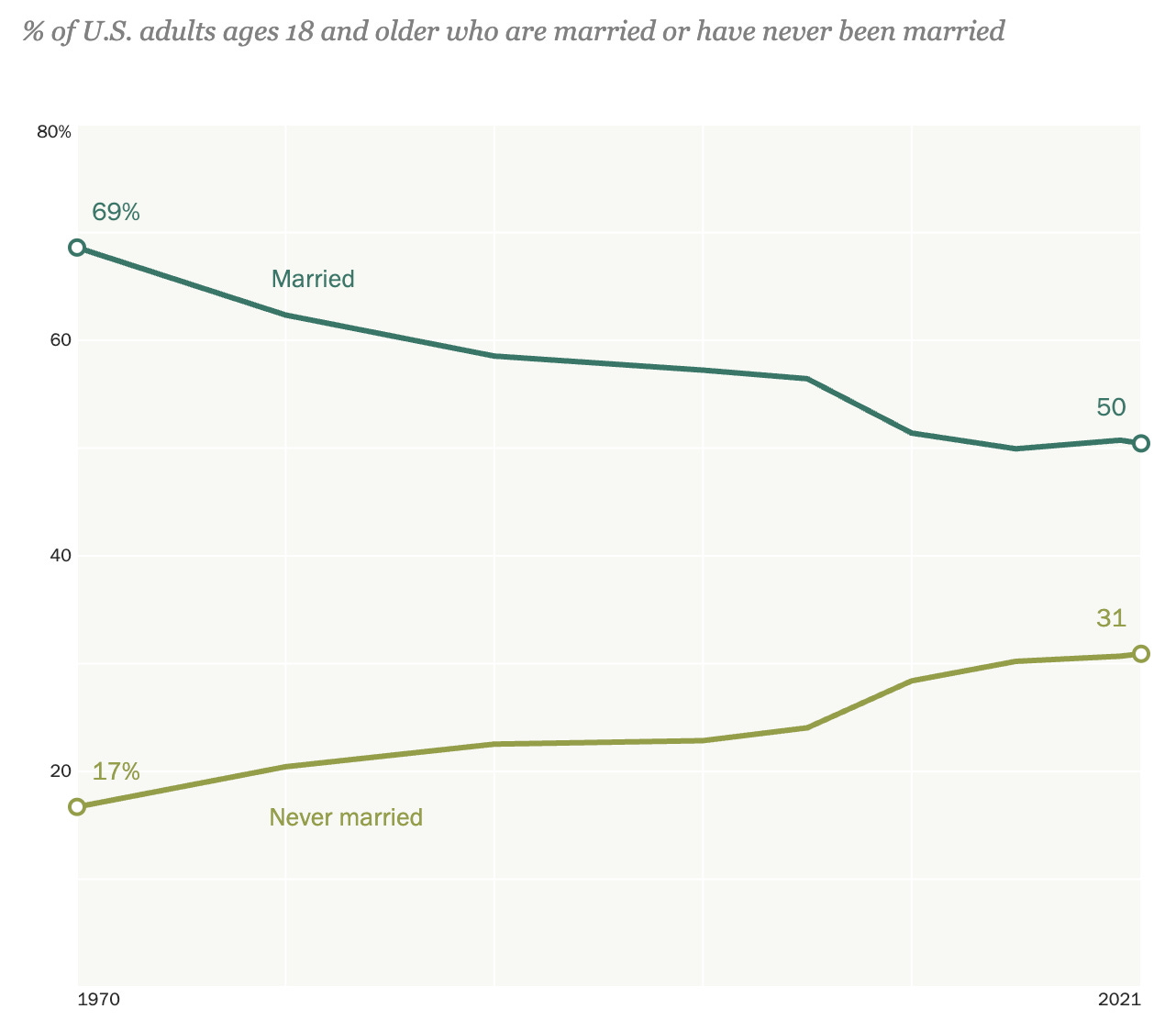
The Pew Research Center has a chart based on census data, showing of U.S. adults ages 18 and older who are married or have never been married. “Married” declines to 50 percent from 69 percent from 1970 to 2021, and “never married” increases to 31 percent from 17 percent.
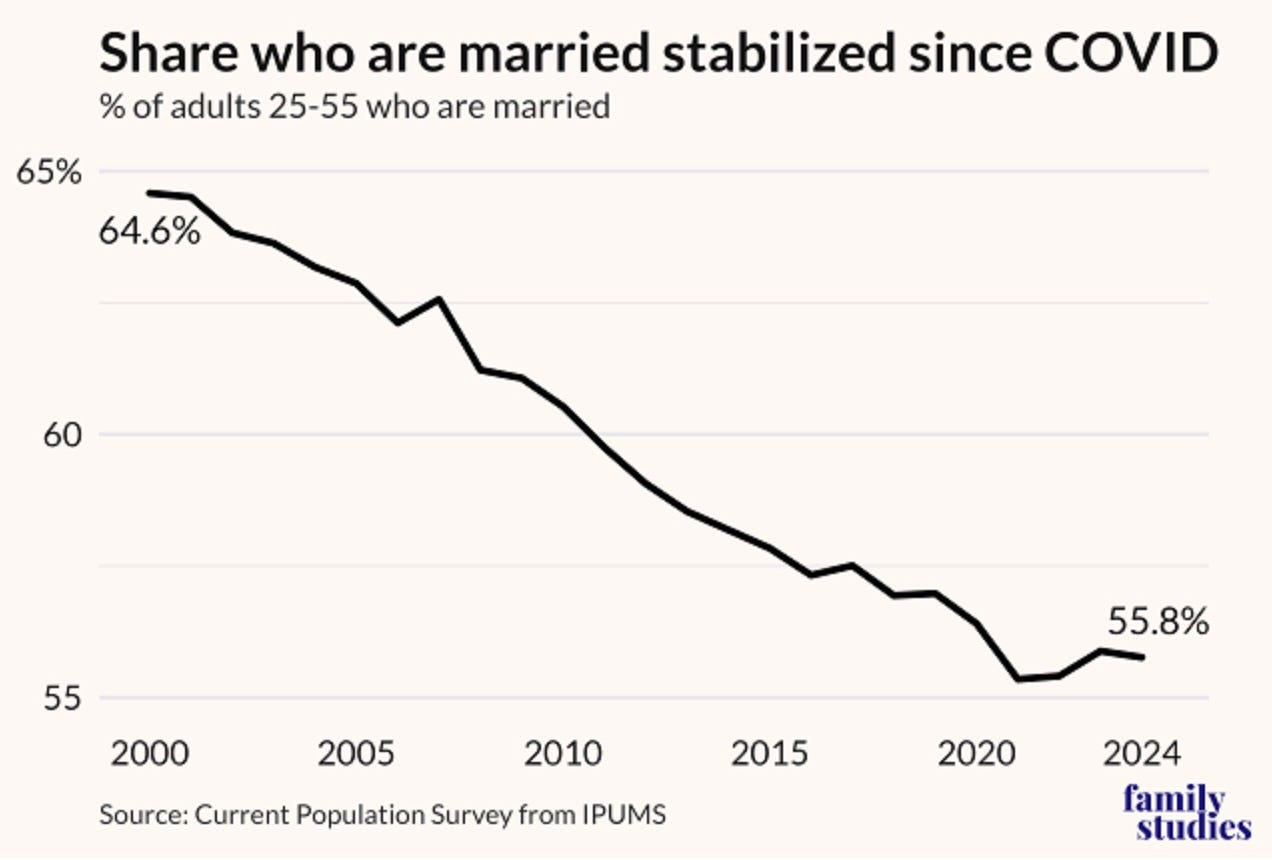
The American Enterprise Institute, in a July 30, 2025 piece headlined “Is Marriage Back?” has a chart of the percent of U.S. adults aged 25 to 55 who are married. “Married” declines to 55.8 percent in 2024 from 64.6 percent in 2000. The authors of that piece—Brad Wilcox, Lyman Stone, Wendy Wang, and Grant Bailey—report “It is not clear to us if marriage trends for adult men and women have reached a nadir or will begin falling again in short order.”
They say, “The Institute for Family Studies estimates that record shares of today’s young adults—about 1-in-3—will never marry and never have children—about 1-in 4. Indeed, one reason that marriage and families are stabilizing in the United States is that family formation has become more selective for the kinds of men and women who have the economic resources and cultural commitments to succeed at family life. But this also means that historic levels of young men and women are not likely to go on to form families.”
How do Taylor Swift and Travis Kelce fit with the trend?
Engaged at 35, they track the pattern of marrying later. Swift, a phenomenally successful musical performer, and Kelce, a pro football player, do have the “economic resources.”
Marriage, like having children, is a personal decision and also one with consequences for the surrounding community.
Wilcox, a sociologist at the University of Virginia, wrote a book that came out in 2024 titled, “Get Married: Why Americans Must Defy the Elites, Forge Strong Families, and Save Civilization.”
The public-policy types look to levers—tax policy, mainly—to encourage marriage. That makes some sense, especially because years of misguided tax and welfare policy—the “marriage penalty,” welfare benefits that are more generous for unwed mothers and that phase out for two-income families—helped contribute to the decline of marriage.
But culture matters, too. If Taylor Swift can make a pop hit out of “happily married” on the scale she has from her previous breakups, the benefits might approach that of tinkering with the tax code or welfare policy. So the well-wishers for Swift and Kelce may extend beyond fans of music or football or celebrity to all those who appreciate the institution of marriage.
“I wish them a lot of luck,” President Trump yesterday said graciously (especially because Swift endorsed Kamala Harris for president) when asked about the engagement. That’s one where Trump is channeling the feelings of a great many Americans all across the political spectrum.
Press fuels a panic over firing a Fed governor: For particularly comical example of press negativity bias, check out the lead news article in today’s New York Times. “Trump’s Bid to Control Fed May Roil Global Economy,” the headline says. “Experts Warn of Inflation and Bond Chaos if Effort to Fire a Governor Succeeds.”
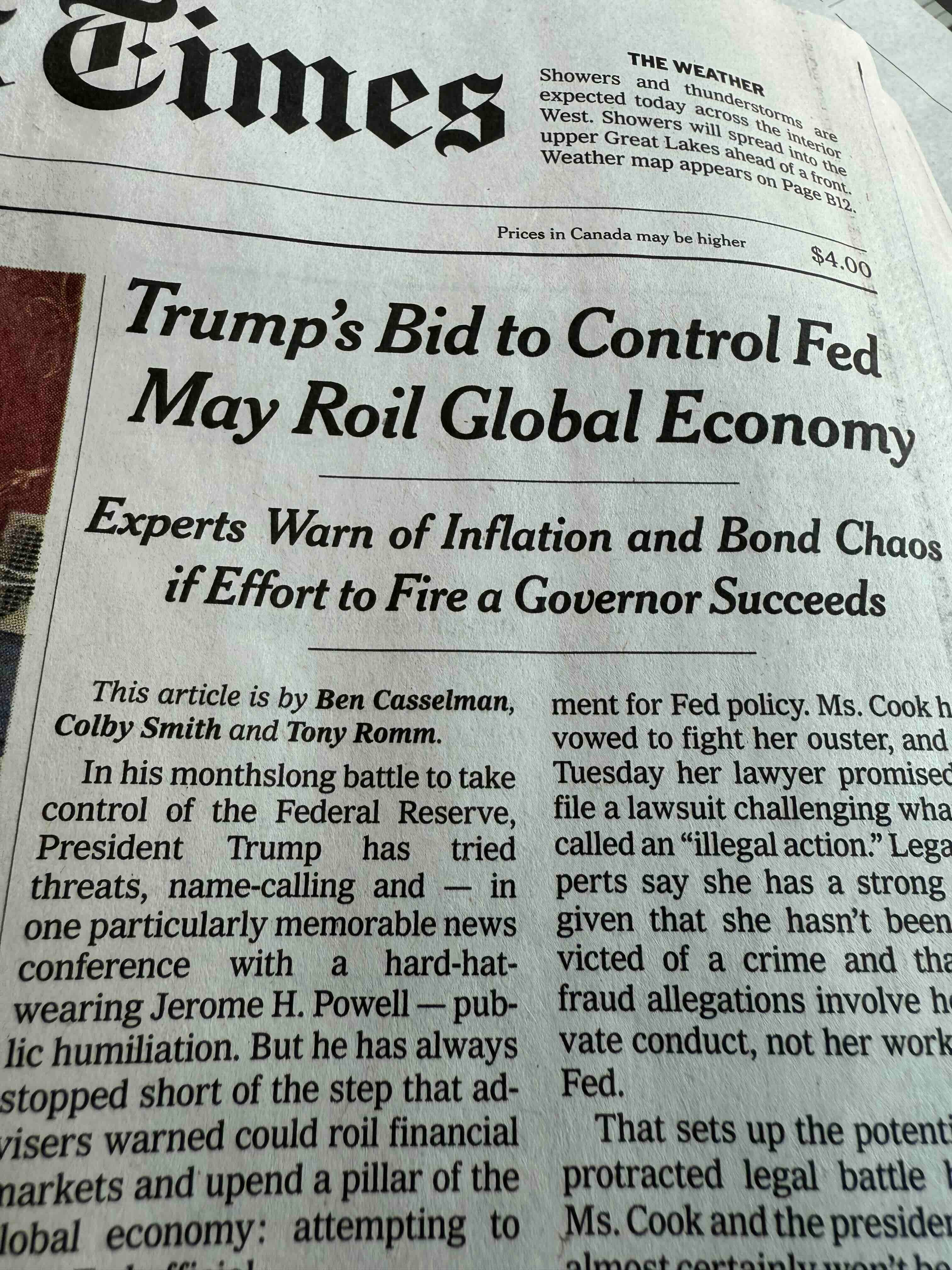
It’s comical because this is the Wednesday New York Times. Trump fired Cook Monday evening. Tuesday and Wednesday morning in the markets was not roiling, it was fairly humdrum. CNBC and Bloomberg attempted some headlines about 10-year or 2-year Treasury yields, but it was basically a nothingburger. Because markets price-in forward expectations, the “if effort…succeeds” bit is nonsensical. When Trump threatened to fire Chairman Powell, there was a negative market move based just on the threat, not conditional on the success. Lisa Cook, the Fed governor Trump is removing, is one of 12 members on the Fed Open Market Committee. If removing just one member of a 12-member committee is such a big threat to the economy, then the Times’ “experts” must think that economy is a lot more fragile than do most of the market participants.
The Wall Street Journal editorial page, which is frequently useful as a counterweight to “expert”-based New York Times hysteria, and which has been publishing some fine opinion pieces recently on the Federal Reserve issue (see “Criticism of Fed Goes Increasingly Mainstream,” August 20, 2025), writes, “if Mr. Trump prevails, he will essentially control the FOMC because he will then be able to fire other board members at will, and the board can fire Fed regional bank presidents on the committee. This will please the constitutional purists who think the Fed shouldn’t be independent of presidential power. Yet this isn’t a prudent fight for Mr. Trump to pick—and it isn’t in the best interests of the country.”
The phrase “constitutional purists” made me smile. What’s the opposite of a constitutional purist? How are the politicians who swear an oath to the Constitution, or the judges charged with interpreting it, supposed to know which parts to be pure about, and which parts they can safely disregard on the basis of prudence and “the best interests of the country”? Where in the Constitution is the “best interests of the country” override clause? If people think letting Trump fire a Fed Governor is part of the path toward lawlessness on the order of Erdogan’s Turkey or Nixon’s White House, try for comparison getting your mind around the concept that the Constitution can or should be be safely ignored on the basis of a “best interests of the country” exception. Instead of rule of law, it’d be rule of “best interests of the country.” If one thinks about it long enough, one might approach the conclusion that a purist approach to the constitution is entirely congruent with the best interests of the country.
The constitutional purist view here at The Editors is not that “the Fed shouldn’t be independent of presidential power” but rather that the Constitution gives the monetary policy power to Congress (the Article I power to coin money and regulate the value thereof). Congress wrote the Federal Reserve Act. It can revise it, repeal it, or hold hearings on whether it is working. If Congress thinks Trump is encroaching, it has levers that it can use to enforce its will.
Meantime, the notion of a financial panic or Argentina-style or Nixon-era inflation triggered by Trump firing a single Fed governor is the material of media fantasies.
That doesn’t mean markets can’t be spooked by presidential or congressional or judicial overreach. But what’s the bigger threat to prosperity and to stable financial markets? Is it constitutional, politically accountable monetary policy? Or is it a Federal Reserve run by mistake-prone and ideologically uniform anti-Trump technocrats so thoroughly insulated from political feedback mechanisms that they’ve abandoned the ideological and methodological diversity that once made the Fed respected and effective?
Thank you: We don’t yet have as large an audience as Taylor Swift, but we are growing nicely. If you know someone who would enjoy or benefit from reading The Editors, please help us grow, and help your friends, family members, and associates understand the world around them, by forwarding this email along with a suggestion that they subscribe. Or send a gift subscription. Thank you!
Making marriage great again is a very sound point
Lower taxes, lower electricity and fuel prices, lower food and shelter costs all will help family formation. These should be the goals of every politician. People could have more children. Citizens are assets to a Republic!