

Tariffs Alone Are Not a China Strategy
The threat is the Communist regime, not the electric cars

If America’s polarized political discourse has an area of consensus, it’s that tariffs should keep cheap but good electric cars out of our country. President Biden and President Trump have both publicly proposed and backed such tariffs.
That may make sense on national security grounds—who wants Communist China to be able to block traffic in America abruptly by suddenly immobilizing the cars?—but it seems like not an adequate substitute for a strategy on what to do about the emerge of Communist China as a global strategic competitor to America.
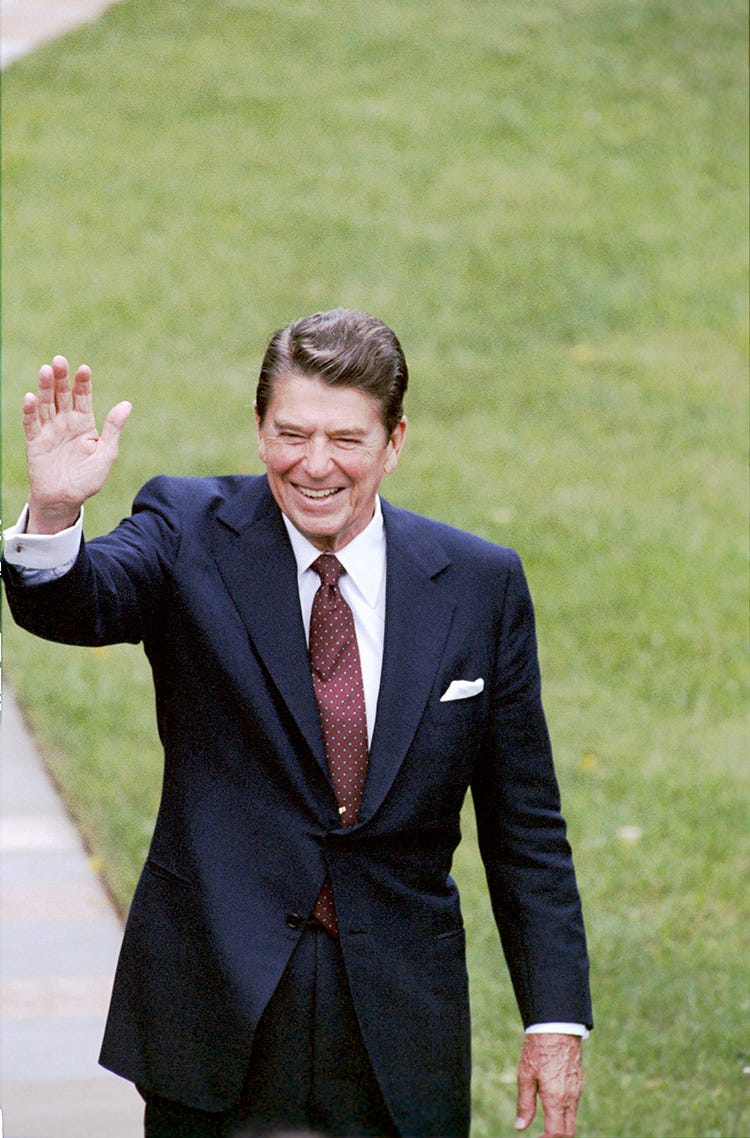
Imagine if, during the Cold War, rather than setting out to defeat the Soviet Union and bring down the Berlin Wall, Ronald Reagan had merely settled for imposing high tariffs on Russian goods. The Berlin Wall would probably still be standing, with the nations and people of Eastern Europe still captive to Moscow.
The main threat of Communist China today isn’t that it might undercut the American electric car industry. The main risk is that, like all dictatorships, it will try to distract its people from their own lack of freedom by directing aggression at external enemies, threatening American partners like Japan, Australia, South Korea and Taiwan and aligning with Iran, North Korea, and Russia to set back American allies and interests around the world.
Neither Biden nor Trump has yet articulated that danger or defined for the public a strategy for victory the way Reagan did in the Cold War. That could be because they don’t have a strategy, or it could be that they do have a strategy and prefer to pursue it in secret. Secretary of State Blinken talks about building closer U.S. relations with Australia and some of the other Pacific nations. Trump talks about the threat of Chinese men of fighting age coming over the border as illegal immigrants. Yet “prevent China from invading Australia” and “prevent China from invading America,” while worthwhile goals, seem closer to “prevent China from dominating the U.S. electric vehicle industry” than anything more ambitious, like “free China” or “help China free itself from Communist Party rule.”
It may be that Trump and Biden have both rejected “help China free itself from Communist Party rule” as a goal that is unachievable, or too similar to “help Iraq free itself from Baath Party rule,” so ambitious that it is likely to end badly and with unintended and costly consequences. Or perhaps they think it is a goal whose public delineation would be counterproductive.
But without saying something about that goal or something like it, the electric car tariffs don’t make a lot of sense. No one is seriously suggesting high tariffs on electric cars that are imported from Germany, Japan, or South Korea, though such cars are ineligible for the tax subsidies that have speeded adoption of American-made electric vehicles. The threat isn’t imported electric vehicles, the threat is the hostile, unfree regime that they are being imported from. To focus on the vehicles rather than the regime is to miss the point.
Some of this is interest group politics. There’s an organized lobbying group (U.S. electric vehicle manufacturers) that has a financial interest in keeping the Chinese electric cars out of America. There may be lobbying groups interested in freeing China, but they are not as well organized, and they face countervailing lobbying from the many U.S. businesses with interests in the Chinese Communist status quo.
It’s a media failure, because when you look at the front page of the New York Times or the equivalent, you see lots of news articles about the Israel-Hamas war and lots of articles about tariffs on Chinese electric vehicles, but you don’t see many articles at all about what plan Biden or Trump has for containing or rolling back China, even though in many ways that’s a more important, and not unrelated, story. Trump sometimes touches on it in his rally speeches when he notes that Iran is selling vast amounts of petroleum products to China, and that without those funds, Iran’s capacity to make mischief against Israel and America in the Middle East by funding Hamas and Hezbollah would be lessened. But Chinese petroleum trade with Iran, while significant, is like Chinese electric vehicle sales to America or Chinese penetration of the U.S. biotech industry. They are epiphenomena, not the core issue.
As the electric vehicle tariffs show, there’s broad political consensus that Communist China is a threat and that the U.S. needs to take steps to counter it. The next step, idea-wise, is conceptually defining what Washington would like to see happen. The alternative is that we all wind up driving more expensive cars while China keeps making trouble. Maybe someday the regime in Beijing will collapse on its own of the internal contradictions that defeat many dictatorships. Yet Reagan’s genius with the Soviet Union was finding a way to speed its demise along in a way that liberated so many stuck behind the iron curtain and simultaneously made America so much more secure and prosperous. With the right American leadership, it could happen again.
Recent work: “‘Israel Is Not Jewish People,’ New York Times ‘Daily’ Guest Really Wants You to Know” is the headline over my latest column for the Algemeiner. The Times represents Jews as being split 50-50, with one normative Jew and one Jew chanting “there is only one solution, intifada revolution.” Please check the full column out over at the Algemeiner if you are interested in that sort of thing.
Thank you: If you’ve been appreciating The Editors, please consider helping us to spread the word by telling your friends and colleagues about us and encouraging them to sign up.
The Editors are not funded by U.S. electric vehicle manufacturers or by business interests wedded to the U.S.-China status quo. We are sustained by the many paying readers whose support makes this possible. Thank you! If you are not yet a paying subscriber, please do your part by becoming one today.
President Reagan was a true capitalist. Half or more of our American politicians are globalists and socialists bordering on communists. They don’t look at the Chinese threat ideologically.