

Richard Cheney’s War
“We’re the kind of country that fights for freedom,” he said.

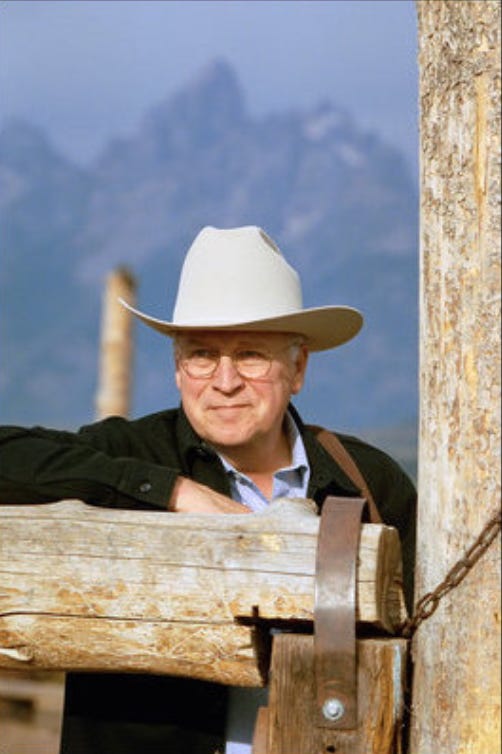
When Vice President Cheney met with the editorial board of the New York Sun, I gave him a gift: a custom-embroidered CHENEY-Bush 2008 baseball cap, with the word Cheney on top, first, and larger than the word Bush. I told Cheney that as vice president of the New York Sun, I somewhat understood what it was like to be no. 2, and I said I thought that the then-governor of Florida, Jeb Bush, would make a fine running mate for Cheney.
For better or worse, the idea that Vice President Cheney, who died Monday at 84, should have run for president is something that I’m somehow publicly associated with. I was quoted in the New York Times about it in April 2004, described as a member of the “media elite.” Okay, here is the entire Times item:
Q: What do the media elite talk about at sophisticated book parties?
A: So we were at a party the other day for RON CHERNOW’s new biography of ALEXANDER HAMILTON. Saw JAMES ATLAS, BILL BUCKLEY, the usual crowd. And there by the mantel was IRA STOLL, managing editor of The New York Sun. Pardon us, Mr. Stoll, but we were just mulling: head to head, who would win, DICK CHENEY or COLIN POWELL?
‘’Well, that’s hard,” he said, “because Powell has the New Yorker thing, but Cheney has the Wild West thing. And Powell is a former general, but Cheney is the more hawkish one now. My money is on Cheney.”
In July 2007 I reviewed for the Sun a 578-page biography of Cheney by Stephen Hayes, “Cheney: The Untold Story of America’s Most Powerful and Controversial Vice President.”
That review began, “Of all the editorials The New York Sun has run, the one that attracted the most response was the one under the headline ‘Cheney’s Chance.’ The editorial, suggesting that Vice President Cheney would be an attractive presidential candidate who would bring a lot to the race, caused a furor in the blogosphere and led to the production of an entire segment on CNN. It also led to several dinner party conversations of friends or relatives of the editorial writer devoted to whether the writer had finally lost his mind.”
The review went on:
Mr. Hayes’s account describes a vice president who has lived the American dream. The son of a man who worked for the federal Soil Conservation Service, Mr. Cheney lived for several months as a child with his family in a friend’s unfinished basement. In exchange for a scholarship to Yale, he had to work as a busboy in the freshman cafeteria. Eventually, he flunked out, earned a living stringing electricity lines across Wyoming and Utah, developed a three-pack-a-day cigarette habit, and amassed two arrests in less than a year for driving under the influence of alcohol.
Yet when America figured him out, it handed him up high. By age 34, he was White House chief of staff in the administration of President Ford. In that capacity, he devoted a considerable amount of time to stemming the influence of Vice President Rockefeller. “You’ve got to watch vice presidents,” Mr. Cheney tells Mr. Hayes. “They’re a sinister crowd.”
Elected to Congress from Wyoming, Mr. Cheney and his wife, Lynne, won praise from the Washington press corps that would later scorn him. The Washington Post’s David Broder called the Cheneys “perhaps the most literate couple in town” and, when Mr. Cheney was nominated by George H.W. Bush as defense secretary, wrote, “Cheney is smart, he is tough and he is totally trustworthy.”
When Mr. Cheney and the first President Bush left Saddam Hussein in power after defeating Iraq in the first Gulf War, Mr. Cheney explained, “The question in my mind is how many additional American casualties is Saddam worth? And the answer is not very damned many.” He warned that America might have gotten “bogged down in the problem of trying to take over and govern Iraq.”
For stopping short of Baghdad and leaving Saddam in power, the first Bush administration was attacked by the Democratic vice presidential candidate, Albert Gore, who accused the Bush administration of “a blatant disregard for brutal terrorism, a dangerous blindness to the murderous ambitions of a despot.”
As vice president in the administration of George W. Bush, Mr. Cheney spent much time after the terrorist attacks of September 11, 2001, at a “secure, undisclosed location,” which Mr. Hayes discloses was most often the presidential retreat at Camp David, but also was a hunting retreat in South Dakota called Paul Nelson Farm.
Some of the most illuminating material in the book comes from an interview with President Bush, who describes Mr. Cheney to Mr. Hayes as, “hard core free market. Hard core.”
“Look, we don’t sit around psychoanalyzing each other,” Mr. Bush says. “He’s from that western stock that’s kind of the quiet — there’s strength in quietude, in a way. That’s the opposite of me. I’m an emotional guy. I cry, I go to see the fallen and spend hours with them weeping, laughing, hugging.”
“Cheney is not a hugger. But he loves deeply,” Mr. Bush says.
Mr. Hayes even manages to draw Mr. Cheney out into some reflection himself. The vice president acknowledges to Mr. Hayes that in ousting Saddam, “I think we should have probably gone with the provisional government of Iraqis from the very outset, maybe even before we launched. I think the Coalition Provisional Authority was a mistake, wasted valuable time.”
…While generally friendly to Mr. Cheney, this account doesn’t flinch from his unpopularity. The Washington Post’s polling expert, Richard Morin, noted that at 18% approval, Vice President Cheney was less popular than Michael Jackson after he was tried for child abuse and O.J. Simpson after he was tried for murder. Mr. Hayes quotes Mr. Morin as reporting that Mr. Cheney was “less popular with Americans than Joseph Stalin is with Russians.” The Huffington Post printed a Thanksgiving Day prayer for Mr. Cheney’s death, which, it said, would “rid the planet of its Number One Human Tumor.”
A couple of lesser-known elements of Cheney’s story stand out for me. The first is his role in supply-side economics. He was present at the creation of the Laffer Curve, when Arthur Laffer drew the picture on a napkin showing that at some point, cutting tax rates would increase revenues, and raising tax rates would diminish them.
Here is how former Wall Street Journal editorial board member Jude Wanniski tells it in one of his Polyconomics “memos on the margin,” from July 2000:
Cheney also understands and appreciates supply-side economics better than any of the other veep candidates, having been present at the Creation, so to speak. I would not call him a supply-sider, because he is not that confirmed in his policy views, but it would be much easier with him on the team to persuade a President Bush to name someone like Steve Forbes to be Treasury Secretary. This would be necessary to force badly needed reforms of the IMF and World Bank.
By the way, the Laffer Curve was first drawn by Laffer to demonstrate to Dick Cheney, then deputy White House chief of staff to Rumsfeld, in December 1974, that tax rates could be lowered without loss of revenue. I was sitting at the table at the Two Continents Restaurant with Laffer and Cheney, saw the Curve sketched on a cocktail napkin, realized its importance, and subsequently named it the “Laffer Curve.” At the time, the message got through to Cheney at least to the point he and Rumsfeld persuaded President Ford to drop his push for a tax increase and switch to a tax cut, albeit one poorly designed by the Treasury. It was actually a “tax refund,” with no supply-side effects.
Wall Street Journal editor Robert Bartley, in his book “The Seven Fat Years,” writes, “Wanniski says Laffer first drew the curve in a paper napkin in a meeting with Dick Cheney, then White House deputy chief of staff, at the Two Continents Restaurant in Washington. Neither Laffer nor Cheney remembers the incident, and Martin Anderson has noted that the restaurant used cloth napkins. Mundell thinks it was first drawn at Michael I. I believe Wanniski; the napkin was in the bar, not the restaurant itself, he says, and it is precisely the kind of detail a good journalist would remember.”
Another is Cheney’s August 2004 answer to a question about gay marriage. He said then, “With respect to the question of gay marriage, Lynne and I have a gay daughter, so it’s an issue that to our family’s very familiar with. We have two daughters and we have enormous pride in both of them. They’re both fine young women.” In that he was ahead of Barack Obama and Hillary Clinton and Joe Biden, all of whom ran for president in 2008 opposing gay marriage. Biden only endorsed it in 2012, forcing Obama to follow.
Cheney was also admirably loyal to his people. He fought hard, though without success, to get George W. Bush to pardon Scooter Libby, clemency that was granted in the end eventually by President Trump.
The media focus will be on Cheney’s role in the Iraq War, or, more broadly, the global war on terror or against Islamofascism that America and its allies fought in response to the terrorist attack on America of September 11, 2001. The Sun has a news article about Cheney’s death that sums up the contemporary conventional wisdom “He was a driving force behind the Bush administration’s 2003 invasion of Iraq, which was justified by intelligence — later discredited — claiming that Saddam Hussein possessed weapons of mass destruction.”
Nothing against the Sun, but that doesn’t quite fully do the situation justice. For one thing, Saddam did have a weapons of mass destruction program, and he moved some of the weapons to his fellow Baathist in Syria. For another thing, the weapon of mass destruction was Saddam and his dictatorship.
That 2007 New York Sun editorial urging Cheney to run for president quoted Cheney’s March 2007 speech to the American Israel Public Affairs Committee.
The speech is worth re-reading in full. It’s highly relevant to the current iteration of the war. Cheney said, “As we get farther away from 9/11, I believe there’s a temptation to forget the urgency of the task that came to us that day and the comprehensive approach that’s required to protect this country against an enemy that moves and acts on multiple fronts.”
Cheney said:
The terrorists don’t expect to beat us in a standup fight. They never have. They’re not likely to try. The only way they can win is if we lose our nerve and abandon our mission and the terrorists do believe that they can force that outcome.
Time after time, they have predicted that the American people do not have the stomach for a long-term fight. They cite the cases of Beirut in the 1980s and Somalia in the ‘90s. These examples, they believe, show that we are weak and decadent and that if we’re hit hard enough, we’ll pack it in and retreat. The result would be even greater danger to the United States because, if the terrorists conclude that attacks will change the behavior of a nation, they will attack that nation again and again.
Believing they can break our will, they will become more audacious in their tactics, ever more determined to strike and kill our citizens, ever more bold in their ambitions of conquest and empire.
He went on, “a precipitous American withdrawal from Iraq would be a disaster for the United States and the entire Middle East.”
Cheney said, “An enemy that operates in the shadows and views the entire world as a battlefield is not one we can fight with strategies used in other wars. An enemy with fantasies of martyrdom is not going to sit down at a table for negotiations. Nor can we fight to a standoff -- (applause). Nor can we fight to a standoff, hoping that some form of containment or deterrence will protect our people. The only option for our security and survival is to go on the offensive, facing the threat directly, patiently and systematically, until the enemy is destroyed. (Applause.)
The war on terror is more than a contest of arms and more than a test of will, it is also a battle of ideas. We know now to a certainty that when people across the Middle East are denied freedom, that is a direct strategic concern of all free nations. By taking the side of moderates, reformers and advocates for democracy, by providing an alternative to hateful ideologies, we improve the chances for a lasting peace and we advance our own security interests….”
Also worth a look, and striking similar themes, is Cheney’s March 2007 speech to the Republican Jewish Coalition Leadership: “We serve a cause that is right, and a cause that gives hope to the oppressed in every corner of the Earth. We’re the kind of country that fights for freedom, and the men and women in the fight are some of the bravest citizens this nation has ever produced. (Applause.) The only way for us to lose is to quit.”
Anyway, people may have forgotten, but the Iraq War was not driven by discredited claims that Saddam Hussein possessed weapons of mass destruction. It was driven by the terrorist attack of September 11, 2001 and also by the belief, described in the Declaration of Independence,” that all men are created equal, that they are endowed by their Creator with certain unalienable Rights, that among these are Life, Liberty and the pursuit of Happiness.” In other words, that the desires for freedom, democracy, and rule of law are universal.
America has a painfully-earned new humility about its ability to foster those objectives in faraway lands. As the current vice president of the United States put it just last week, “the American people are done with American troops dying in unnecessary foreign conflicts.” Yet Cheney’s essential claim, that, “We’re the kind of country that fights for freedom…The only way for us to lose is to quit”—well, that claim is not discredited. It was Cheney’s war and ours, and it is Israel’s and America’s too.
Thank you: The Editors is a reader-supported publication that relies on paying customers. If you know someone who would enjoy or benefit from reading The Editors, please help us grow, and help your friends, family members, and associates understand the world around them, by forwarding this email along with a suggestion that they subscribe today. Or send a gift subscription. If it doesn’t work on mobile, try desktop. Or vice versa. Or ask a tech-savvy youngster to help. Thank you to those of who who have done this recently and thanks in advance to the rest of you.
The Iraq War was driven by the terrorist attacks of 9/11…..which were perpetrated by Saudis ??