

RFK Jr. Blames “Neocons” for Ukraine War
Trump runs as peace candidate, against “globalist warmonger donors”

Robert F. Kennedy Jr.’s decision to suspend his presidential campaign in swing states and encourage his supporters to back Donald Trump got plenty of press attention, but most of the media coverage omitted entirely or downplayed one of Kennedy’s most outlandish claims.
Kennedy’s speech included this passage: “I want to say a word about the Ukraine war. The military industrial complex has provided us with a familiar comic book justification like they do on every war, that this one is a noble effort to stop a super villain, Vladimir Putin, invading the Ukraine and then to thwart his Hitler-like march across Europe. In fact, tiny Ukraine is a proxy in a geopolitical struggle initiated by the ambitions of the US neocons for American global hegemony. I’m not excusing Putin for invading Ukraine. He had other options, but the war is Russia’s predictable response to the reckless neocon project of extending NATO to encircle Russia, a hostile act. The credulous media rarely explained to Americans that we unilaterally walked away from two intermediate nuclear weapons treaties with Russia and then put nuclear-ready Aegis missile systems in Romania and Poland. This is a hostile, hostile act…”
Kennedy went on, “Judging by her bellicose, belligerent speech last night in Chicago, we can assume that President Harris will be an enthusiastic advocate for this and other neocon military adventures.”
Kennedy used the term “neocon” six times in the speech. He did not name any individuals or institutions.
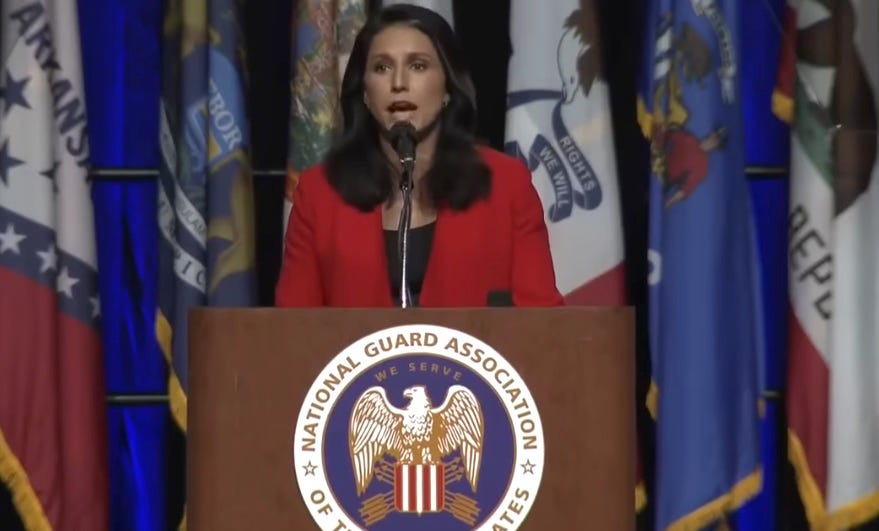
Tulsi Gabbard, a former Democratic member of Congress from Hawaii and a former Democratic presidential candidate, endorsed Donald Trump for president this week. She used her speech, with Trump looking on, to speak about how Trump, in his first term, “not only didn’t start any new wars, he took action to de-escalate and prevent wars.”
Nor is it only Kennedy and Gabbard expressing these views. Trump himself, on February 22, 2023 issued a video declaring, “here in America, we need to get rid of the corrupt globalist establishment that has botched every major foreign policy decision for decades…Take a look at the globalist warmonger donors backing our opponents. That’s because they’re candidates of war. I am the President who delivers peace.”
At the Republican National Convention, Republican donor and J.D. Vance friend David Sacks, in a speech from the podium, described Trump as “A president who will stand up to the warmongers, instead of empowering them.”
Whether the term is “neocons” or “globalist warmonger donors,” the idea that the war in Ukraine is the fault of those persons, rather than of Putin, is delusional. Aegis is a missile defense system. The sites in Romania and Poland are designed to protect Europe against attacks from Iran as much as from Russia, which has way more nuclear missiles than Aegis could handle.
Trump argues that his first-term foreign policy record was better than the disaster than has been the Biden-Harris presidency. Even Americans who are open to that argument, though, may find themselves wondering whether Trump II would be a peace-at-any-price administration.
What America can really use is not a president who will stand up to the neoconservatives or “globalist warmonger donors,” but a president who will stand up to our enemies in Iran, Communist China, and Russia.
If Harris, despite her record, is sounding more tough than Trump is, it may help to account for the traction she seems to be getting in the public opinion polls.
Trump may figure that “neocons” and “globalist warmonger donors” are unpopular with the voters he is hoping to win over. But surrendering to Iran, Communist China, and Russia isn’t popular, either.
Voters are shrewd enough to know that retreat and disarmament won’t make America any safer. What really causes wars isn’t American neocons or “warmongers,” but implacable enemies who mistake America’s love of peace for weakness and lack of resolve.
The foreign policy “blob” has generated no shortage of costly failures, but they’ve come from the realist and establishment camps just as much as, or more, than from the neoconservative camp. “Neoconservative” has increasingly become a term like “neoliberal,” an epithet that signals the person throwing it around is looking for scapegoats rather than solutions.
If Trump wants to win the election and preside over a peaceful second term, his campaign might consider spending less time whipping up American sentiments against neocons and warmongers, and more time educating Americans about the genuine threats that America faces from Moscow, Tehran, and Beijing.
Trump may recall running successfully as a peace candidate in 2016 against the Iraq War. But he also ran that year as someone who, unlike the Democrats then in power, would crush ISIS. Gabbard and Kennedy are prominent peaceniks. They are also losing presidential candidates, which should be cause for some caution about their messaging. It’d be one thing if Trump were running for president against some opposing figure who might be plausibly described as neoconservative. But depicting Kamala Harris as Jeane Kirkpatrick doesn’t make sense. Harris’s national-security flaw isn’t that she’s a warmonger, it’s that she and Biden have allowed Iran, Russia, and China to push America around.
For all of Kennedy’s whining about “American global hegemony,” the alternative to it is letting Putin’s Russia, Khamenei’s Iran, or Communist China accumulate more power and influence, right up to America’s doorstep and even on American social media and college campuses.
Crime in American cities, destruction of American families by welfare policy, and defeat of America in Vietnam and in the Iran Hostage Crisis fueled the rise of neoconservatism in the 1970s and 1980s. The original neoconservatives were Democrats who backed Ronald Reagan. Trump and anyone trying to help his campaign would be better off spending less time and energy demonizing neoconservatives, and more time and energy attempting to inspire and win over a new generation of them.
The idea that defensive missile systems in Poland and Romania are for protection against Iran just as much as for Russia is not reasonable. There is no long running historical conflict between Iran and Eastern Europe. The missile system is to provide defense against a limited attack by Russia, such as what Ukraine faces today. Stronger defensive systems encourage stronger offensive systems. I don't fully support RFK, but arming Russia's neighbors with even defensive weapons is not a neutral act.