

Republicans Press Harvard on China Ties as New Details Emerge
Harvard Business dean serves on Beijing advisory board, met Communist Party officials in October 2024

The Trump administration and Republicans in Congress are stepping up pressure on Harvard related to its dealings with China, even as new and previously undisclosed details about those dealings are emerging.
Yesterday’s announcement by the Department of Homeland Security that it is terminating Harvard’s certification to host foreign students and scholars faulted Harvard for its dealings with the Chinese Communist Party.
“Harvard’s leadership further facilitated, and engaged in coordinated activity with the CCP, including hosting and training members of a CCP paramilitary group complicit in the Uyghur genocide,” a Homeland Security press release said. Usually the only genocide that gets much attention on the Harvard campus is the one Israel is falsely accused of perpetrating in Gaza.
“This administration is holding Harvard accountable for fostering violence, antisemitism, and coordinating with the Chinese Communist Party on its campus,” Secretary Kristi Noem said in the release.
The release listed a series of China-related issues:
Harvard hosted and trained members of the Xinjiang Production and Construction Corps (XPCC), a CCP paramilitary group complicit in the Uyghur genocide, even after its 2020 designation on the U.S. Treasury’s Specially Designated Nationals List, with engagements continuing as recently as 2024.
Harvard researchers collaborated with China-based academics on projects funded by an Iranian government agent and partnered with Chinese universities tied to military advancements, including aerospace and optics research, using U.S. Department of Defense funds.
Harvard partnered with individuals linked to China’s defense-industrial base, including conducting robotics research with military applications.
In addition to Noem’s action, which a federal district judge in Boston today temporarily ordered restrained at Harvard’s request, Congress has been active on the Harvard China issue.
On May 15, Senator Tom Cotton, a Harvard graduate, sent a letter to Secretary of State Rubio and to Treasury Secretary Bessent, urging them to investigate. Cotton wrote:
According to a recent business intelligence firm report, Harvard renamed its Public Health School the “Harvard T. Chan School for Public Health” after receiving a $350 million donation from the Chan family and its Morningside Foundation in 2014, which has significant ties to the Chinese Communist Party (CCP). Harvard engages in activities that glorify China’s Cultural Revolution and is linked to the China’s Thousand Talents Program. Most troublingly is the report that Harvard trained XPCC personnel and other senior Chinese officials on healthcare financing.
In 2020, the Trump Administration imposed human rights sanctions on XPCC under the Global Magnitsky Human Rights Accountability Act for XPCC’s involvement in severe human rights abuses. The Act prohibits any contribution of funds, goods, and services, to XPCC. Harvard University’s actions appear to violate these sanctions.
On May 19, a second letter to Harvard, from the Chairman of the Committee on Education and the Workforce, Tim Walberg; the Chairman of the Select Committee on the Chinese Communist Party, John Moolenaar, and the Chairwoman of the House Republican Conference, Elise Stefanik, demanded from the university “all communications between Harvard (all schools) and any individual who is a member or affiliate of the CCP” and also “A detailed list in native Microsoft Excel of all projects in which an individual affiliated with Harvard received funding from any entity within the DoD that included a PRC-based collaborator.”
The members of Congress wrote of “serious concerns about whether Harvard adequately protects taxpayer funded research and U.S. national security, and whether it takes sufficient steps to ensure that its activities do not further the CCP’s ongoing genocide or bolster the PRC’s military capabilities.”
I’ve unearthed some new information on this front.
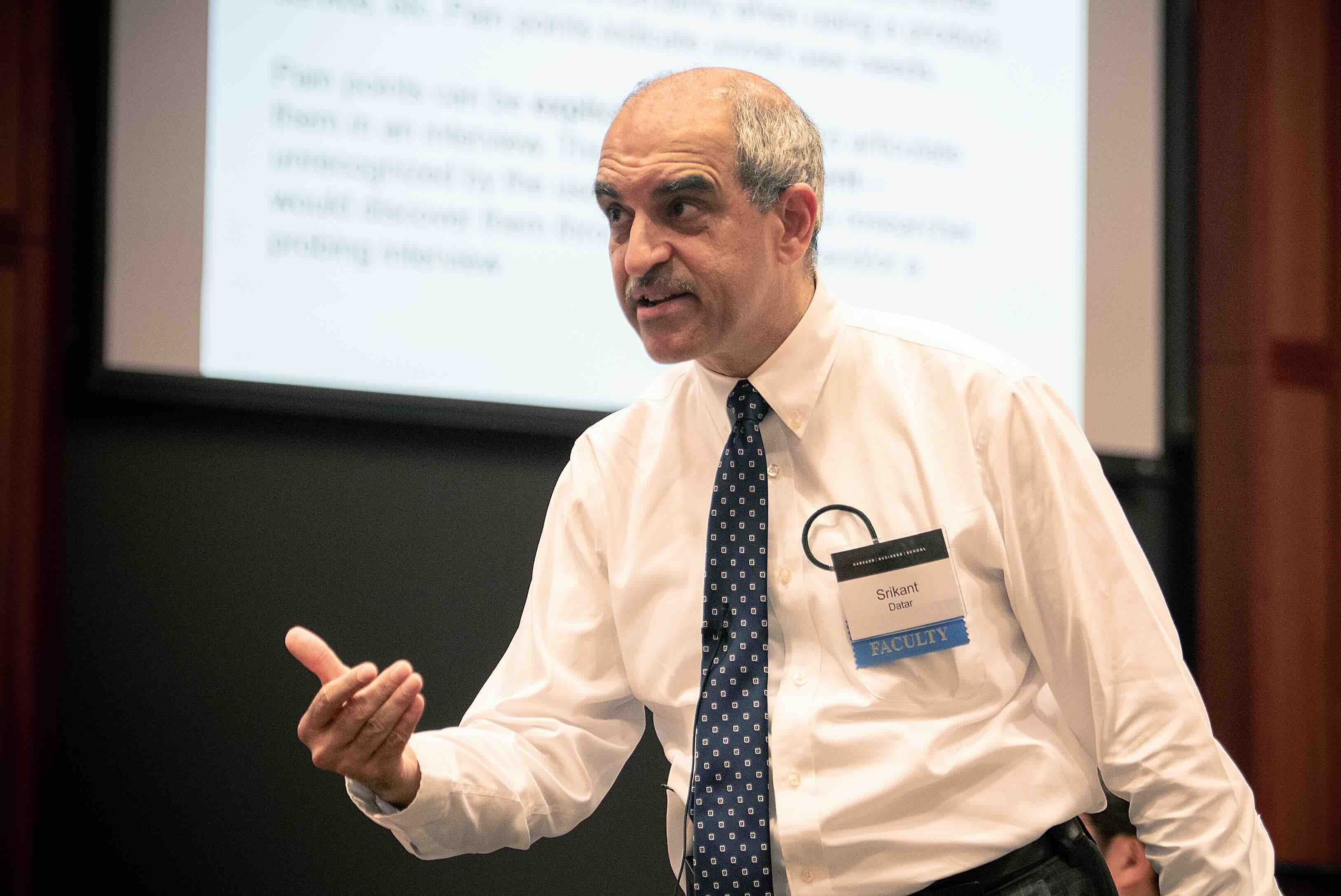
On October 25, 2024, the Dean of Harvard Business School and George F. Baker Professor of Administration, Srikant Datar, was in Beijing where he attended an advisory board meeting of the Tsinghua University School of Economics and Management. A list of members of the advisory board includes him as a member of the group.
An account of the meeting on the Tsinghua website says it included a meeting with Chinese Vice Premier Ding Xuexiang at the Diaoyutai State Guesthouse. Ding is a member of the Standing Committee of the Political Bureau of the Communist Party of China Central Committee and “expressed hope that the advisors would continue to actively provide suggestions and support the development of China's economy and education system.” Also in attendance were Qiu Yong, secretary of the CPC Tsinghua University Committee and Yu Xiaoxiao, deputy secretary-general of Tsinghua University and director of the Office of the CPC Tsinghua University Committee. “CPC” stands for “Communist Party of China.”
Harvard has been more reticent than NYU or Yale when it comes to opening campuses or centers based in China. Maybe Datar was there to advise the Chinese Communists they should embrace political and religious freedom along with economic freedom, and that they should free all the people they have arrested in Hong Kong, including publisher Jimmy Lai. I called the dean’s office, and was referred to the Business School press office about the trip. I haven’t yet heard back. It certainly would be ironic if, while Harvard is suing to protect what it describes as its own First Amendment freedoms, one of its top leaders is simultaneously serving on an advisory council of a Chinese communist-controlled institution.
Separately, but relatedly, one of the pieces of U.S. goverment-funded research that Harvard has been publicly touting in support of its legal and public relations bid to keep the $700 million a year in U.S. taxpayer money flowing is a study by Alberto Ascherio, professor of epidemiology and nutrition at the Chan School of Public Health, about a possible link between ultra-processed food and Parkinson’s Disease. Here’s how the Harvard-published Gazette reported it: “Researchers at Fudan University in Shanghai, China, in collaboration with Alberto Ascherio at the Harvard T.H. Chan School of Public Health, worked with the self-reported diet data from more than 40,000 health professionals, tracked since the mid-1980s.”
If you click through to the May 7, 2025 article in Neurology there are 12 named authors (if you think byline inflation is a thing in journalism or social science, you haven’t seen anything yet). The first one is a professor at Fudan University in China with funding from the “China Postdoctoral Science Foundation.” Two of the Harvard-based researchers, Ascherio and Kjetil Bjornevik, list U.S. Department of Defense funding in the “disclosures” section of the article online. Another China-based author-researcher, Xiang Gao of Fudan University in China, lists support from the National Natural Science Foundation of China. What gets my attention on this is the data used for this is the famous Harvard nurse’s study data. I guess if the Chinese can help prevent or cure Parkinson’s, it’d be a good thing, and open access to data is good for scientific progress and health. Yet it’s somewhat surprising that data accumulated with U.S. government funding at great expense over many years is so readily made available to China-based researchers, and that there are no restrictions that apply to or are enforced against using U.S. Defense Department funding for collaboration with China-based researchers. Anyway, of all the projects to put front-and-center in Harvard’s public relations defense, one in which the lead researchers are China-based using U.S. patient data developed over decades with U.S. taxpayer dollars seems an odd one. Maybe I am missing something.
Good reporting....thanks.