


President Reagan’s chief speechwriter, Anthony R. Dolan, died earlier this month. The chairman of the Ronald Reagan Presidential Foundation and Institute, Fred Ryan, issued a statement crediting Dolan for work on the iconic “Evil Empire” speech, delivered by President Reagan in March 1983. Sam Roberts did his usual sensitive and solid work on the New York Times obituary.
It sent me back to an interview Dolan did on June 26, 1997, for the journal Rhetoric and Public Affairs:
Reagan grievously embarrassed America's expert class. They said he couldn’t be elected. First they were astonished by every manifestation of conservative political power, whether it was Goldwater's nomination, the rise of the New Right, or Reagan's near win in 1976 against an incumbent president. They said he couldn’t be elected. When he did get elected, they said he would never get his economic program through without a major compromise. He did. They said he could never achieve anything in foreign policy as long as he kept speaking that way about the Soviets. He kept speaking that way about the Soviets and he did achieve his goals. They were wrong, wrong, wrong. They said the economy was going to go down the drain. It didn’t. It became the greatest peacetime boom in history, and if you are a member of the expert class and you are grievously embarrassed by some conservative ex-actor, you’ve got to explain why that happened.
Meanwhile, here in Massachusetts, I got an email this afternoon from Rachel White, the CEO of Byggmeister, a design-build firm based in Newton. She likens the current Trump administration to the early days of the Covid pandemic. “We now find ourselves in a similarly frightening time without precedent or guide for how to respond,” she writes. “We are horrified by the actions of the administration. This isn’t solely or even primarily about policy differences, although many of the administration’s actions — from tariffs to gutting federal agencies — directly threaten our business and conflict with our mission to serve as exemplary stewards of existing homes and to help build a more equitable and sustainable future.”
“Like all businesses and institutions of civil society, we rely on a stable, functional federal government. We rely on the government to serve the public good. We rely on the government to uphold the rule of law. We rely on safety for everyone in our community. And we rely on the freedom to live our values and express our opinions without fear of retribution,” she writes. “It’s hard to believe that we can no longer rely on these things, but this is our new reality – incompetence, cruelty, chaos and corruption on a massive scale.”
On Martha’s Vineyard, South Mountain Company builder John Abrams, now operating a firm that offers help with “finance” and “business transitions,” encouraged participation in a “24 hour economic blackout.” He writes, “As I struggle with the uncertainty of what to do in the face of the crushing assault on democracy, it has occurred to me that an economic response to Trump and his broligarchy could be valuable.” He writes, “there is a movement slowly building towards a general strike, with a goal of 11+ million participants.”
And at Stanford University’s Hoover Institution, the William L. Clayton Senior Fellow, Larry Diamond, writes, “The United States now faces the grave and imminent danger of democracy decaying into a hollow shell of ‘competitive authoritarianism.’” Diamond calls for “nonviolent civil resistance. …not just marches but strikes, consumer boycotts, and civil disobedience.”
“To constrain or defeat authoritarian projects outside of elections, Hardy Merriman observes, citizens must withhold obedience, and to do so effectively, they must coordinate. Civil resistance movements succeed to the extent they muster unity, planning, and discipline on a large scale,” Diamond writes. “The American public simply does not realize how aggressive, ambitious, far-reaching, and extreme is the Trump administration’s assault on independent institutions…American democracy is facing a rapidly gathering authoritarian challenge.”
Diamond urges, “Stop buying products from business oligarchs who are profiting from proximity to this authoritarian project. If you own stock in their businesses, think about selling it.”
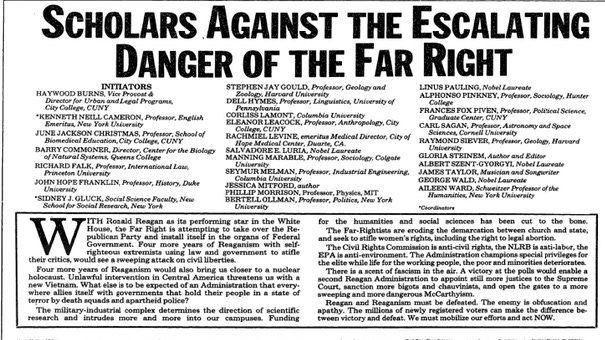
It’s nice to see small businesses using their corporate free political speech rights (the same ones that they and President Obama wanted to deny under Citizens United). But Dolan’s reminder of how the expert class got Reagan “wrong, wrong, wrong” sent me back to one of my favorite documents, a November 2, 1984 New York Times ad signed by a lot of faculty members and warning that four more years of Reaganism would “bring us closer to a nuclear holocaust.” The ad said “There is a scent of fascism in the air,” warning that a second Reagan term would “open the gates to a more sweeping and more dangerous McCarthyism.”
I could be wrong myself. This isn’t a blanket endorsement of everything the Trump administration is doing. If individuals and organizations want to push back on particular issues, the system allows for that. There’s nothing wrong with vigilance in defense of democracy and freedom. Trump has yet to put himself in Reagan’s league, and perhaps he never will.
But to me the talk of general strikes, large scale civil disobedience, and economic boycotts in response to a ”crushing assault on democracy” seems now as overwrought as the 1984 talk of “fascism” and “nuclear holocaust.” A dozen years in the future, someone else like Dolan may look back again at how the experts were “wrong, wrong, wrong.” By then the “frightened” class on the east and west coasts will have found someone else to whip up worry about.
Proof that TDS is a crippling mental illness. Did any of these people sound any comparable alarms during the Biden administration? Or was that iteration of "democracy" more to their liking? Good luck with that strike, Mr. Diamond. And always remember the prescient words of Paul "Mr. Opposite" Krugman, when asked when financial markets would recover after Trump's win in 2016: "A first-pass answer is never."
It is less newsworthy to point out instances in which the Expert Class was more sensible, but it is worthwhile to do so to gain some perspective.
A good example is the 1975 Harvard petition on the UN Zionism-Racism resolution that I wrote together with my classmates Daniel Benson and Martin Kernberg: https://segal.org/docs/zion/
Our 1975 petition in the Harvard Crimson had a bunch of Experts at least as good as the 1984 petition in the NYT. Of note is that one person signed both: George Wald.