

Pro-Israel Protester Is Charged After Newton Shooting
Plus, House committee passes school-choice bill; Sept. 11 plea deal, and more

“You are sick, you are defending genocide,” a man is heard on video obtained by the Daily Wire’s Kassy Akiva saying to pro-Israel demonstrators in Newton. The video then shows the man running across the street and tackling one of the pro-Israel demonstrators.
When one of the pro-Israel demonstrators allegedly shot the man, the Middlesex County District Attorney, Marian Ryan, announced she was charging the alleged shooter, Scott Hayes, 47, of Framingham, with assault and battery and violation of a constitutional right.
It’s sad to see the violence in Israel and Gaza spilling over into violence in America, fueled by the false accusations of genocide that are almost inescapable on campuses and in the media.
Law professor David Bernstein notes in a social media post: “I don’t want to see anyone shot, but the ‘victim’ attacked the shooter, and seems to have been attacking him when shot. How is this not clear self-defense, with the ‘victim’ who started the fight the only one in legal jeopardy?”
An online fundraising campaign for Hayes says, “Scott Hayes is an American Iraq War Veteran, who was attacked at a pro-Israeli Protest. On September 12, 2024 at the end of a pro-Israeli protest Scott was about to leave. A man wearing a Palestinian flag pin started shouting from the other side of the street to Scott and other protests in the area. This person suddenly ran across the street, charged Scott, attacked him and tackled him to the ground. Scott was wrestling with him when a gun went off. Even though Scott is not Jewish he has defended the Jewish people and its right for self determination ….”
Ways and Means Passes School Choice Bill: The House Ways and Means Committee approved the Educational Choice for Children Act, which would create a tax credit for donations to organizations granting scholarships to students for a variety of expenses, including tuition at an elementary or secondary private or religious school. There are lots of choices and details, some of them arcane, in crafting this sort of policy. Can everyone get a scholarship or is eligibility capped at a certain income level? How much government regulation is imposed on the schools where the tax-credit scholarships are used?
The chances of a Democrat-controlled Senate or of President Biden defying the teachers’ unions and enacting this between now and the November election are somewhere between slim and none, but the legislation does offer a starting point for Republicans if they take control of Congress and the White House in November.
Rep. Adrian Smith, the bill’s lead sponsor, said it “would change the educational landscape for families across the country.”
“We have seen through the success of school choice initiatives across the country how empowering parents gives them – not the government – the freedom to decide where to send their children to school and to tailor their children’s education to their specific needs,” Smith said.
Betsy DeVos, a longtime school choice champion who served as secretary of education in the first Trump administration, called the committee’s passage of the bill “a big win for kids.”
The September 11 Plea Deal: “Secret Plea Deals Reached With September 11 Defendants” was the headline here back on August 1. We wrote then that “People have a range of views on the death penalty, but among the possible cases for which it is warranted, the September 11 attacks would seem to rank high among them. For Vice President Harris, who is running as a tough-on-crime prosecutor, it could be a politically troubling issue to get saddled with leniency for alleged September 11 perpetrators.”
Sure enough, after an outcry from members of Congress and from President Trump, Secretary of Defense Austin, on August 2, ordered the deals scrapped. Now lawyers for the government and for Khalid Shaikh Mohammad, Walid Muhammad Salih Mubarak Bin 'Attash, and Mustafa Ahmed Adam al Hawsawi are fighting over whether Austin has the power to scrap the plea deals.
The New York Times has some coverage of the situation: “In this case and in military justice in general, a judge can dismiss a case or the death penalty as a possible punishment for even an appearance of ‘unlawful influence’ to restore faith in the process and the independence of the judiciary.”
It seems to me that “independence of the judiciary” makes more sense in the context of the federal courts established by Article III of the Constitution than it does in the context of the military commissions that are part of the Defense Department. To have something that is “independent” yet also within the executive branch is the sort of unaccountable, administrative-state stuff that has expanded over the years to the point at which it is generating some significant pushback, and deservedly so.
If the military judge, Colonel Matthew N. McCall of the U.S. Air Force, rules that Austin lacks the power to cancel the plea agreements, Austin could try firing him. If McCall rules that Austin lacks the power to fire him, Austin could try to fire him again. Eventually the dispute might find its way into an Article III court, which might have a tough time squaring with the Constitution a set-up that involves government officials in the executive branch that are so remote from accountability to the elected president.
Housing costs: “The monthly payment on a purchase of a median-priced home in July with an average mortgage rate was $3,010, according to real-estate firm Redfin. In December 2019, it was $1,566,” the Wall Street Journal reports. The assumptions and factors that explain all that are not spelled out. A Pew Survey conducted August 26 to September 2, 2024 found “The share of Americans who express a high degree of concern over the cost of housing has risen 8 percentage points since April 2023, from 61% to 69%.” The partisan gap is “72% of Republicans, 66% of Democrats” who say they are “very concerned” about the cost of housing.
In a separate but related development, the Census Bureau released a story headlined “Largest Annual Increase in Gross Rental Costs Since 2011,” reporting the results of the 2023 American Community Survey. The story described the 3.8 percent increase as a “large spike.” You might wonder why it takes the federal government nine months into 2024 to report what happened in 2023. There are lots of private data companies with faster reporting.
And a related Census press release released today found “Over 21 million renter households spent more than 30% of their income on housing costs in 2023, representing nearly half (49.7%) of the 42.5 million renter households in the United States for whom rent burden is calculated.” The same release found “Median household income increased in three states (Florida, Nebraska and Vermont) and decreased in four states (Alaska, Delaware, Georgia and Pennsylvania) from 2022, after adjusting for inflation. Forty-three states, the District of Columbia and Puerto Rico showed no statistically significant differences.” Georgia and Pennsylvania are swing states in the presidential election.
“The District of Columbia’s median household income ($108,210) was the highest in the nation.” Lots of taxpayer-funded jobs, and jobs lobbying for more taxpayer funding, there.
Race in admissions: From Harvard’s disclosure of the racial breakdown in the Class of 2028, the first class admitted after the Supreme Court’s decision barring racial preferences in college admissions: “Eight percent of students in the Class of 2028 did not disclose race or ethnicity, compared with 4 percent last year.” Maybe the applicants figure why bother to list it, given that it’s no longer legally possible for it to provide a boost? Maybe they don’t consider it to be that relevant, and maybe that’s a healthy development? Harvard reports the racial data but not religious or political identity data, which all sends certain signals about what the decisionmakers consider important.
“How a Cultural Shift Favors Harris”: A headline guaranteed to get New York Times readers to click is the one over David Brooks’ latest column: “How a Cultural Shift Favors Harris.” I thought he might be writing about declining religious services attendance and church membership, given that religiously unaffiliated voters back Harris over Trump, 68 percent to 28 percent, while Christians who attend religious services monthly or more back Trump 63 percent to 35 percent, according to the latest Pew survey.
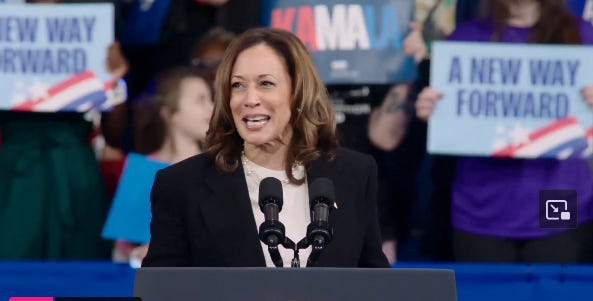
Instead Brooks claims of Harris that, “Her good cheer and compassion contrasts with the atmosphere of bitterness and indignation that has enveloped us for a decade….People can be up in arms for only so long. The wearier we grow with American carnage catastrophizing, Trump seems not just monstrous but, worse, stale.”
Has David Brooks watched Harris speak on the campaign trail? There is no shortage of indignation or catastrophizing.
Recent work: “Harris Insults the Troops,” is the headline over my latest New York Sun column. It focuses on the claim Vice President made in the presidential debate that, “As of today, there is not one member of the United States military who is in active duty in a combat zone in any war zone around the world, the first time this century.”
"“Her good cheer and compassion" is, I suppose, one way of describing her. In the debate, I found her fake indignation, fake eye-rolling dismissiveness, her fake laughter and smirks utterly lacking in good cheer and compassion. I'd prefer Nurse Ratched's honesty.
Ways and Means Passes School Choice Bill
A tax credit could eliminate the entire effective cost of a private school education, while leaving the price per student far greater than the public school alternative.
The government would be writing blank checks to private schools.