

Powell Brings Some Positivity Absent from the Press
The Wall Street Journal news section imagines a “lose-lose scenario”

The news section of the Wall Street Journal previewed today’s Federal Reserve Open Market Committee meeting with a news article that began, “The haphazard rollout of President Trump’s tariff policy threatens to put the Federal Reserve in a lose-lose scenario: Navigate a recession or manage a period of stagflation.”
The Journal’s chief economics correspondent, Nick Timiraos, even went on CNBC to declare that “the Fed is off the hook for being blamed for a recession.” He said the blame would go to President Trump for his tariffs. Trump earlier this week called the Journal a “rotten newspaper” that “has truly gone to hell.”
Before moving on to assigning blame for a recession, maybe wait for one to happen?
Maybe it hasn’t occurred to Timiraos or his editors at the Wall Street Journal, but there’s a scenario ahead for the American economy that doesn’t include either a recession or stagflation. That scenario involves economic growth and stable prices.
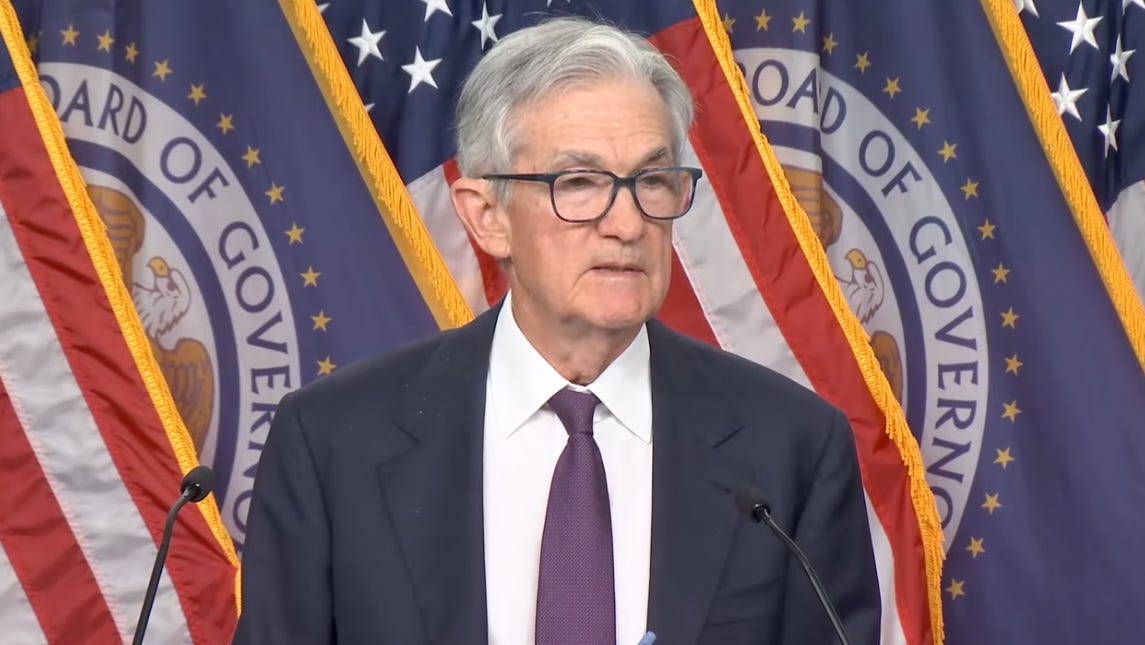
The Federal Reserve Chairman, Jerome Powell, explained it in his press conference yesterday afternoon. “The economy is doing fine,” Powell said. “Consumers keep spending, credit card spending. It’s still a healthy economy albeit one that is shrouded in some very downbeat sentiment.”
“People are feeling stress and concern, but unemployment hasn’t gone up. Job creation is fine, wages are in good shape. People are not getting laid off at high levels. …The economy itself is still in solid shape,” Powell said.
Some of that may be rationalization for keeping interest rates as high as they are, but there’s a kernel of truth to it. I’m not denying that either inflation or stagflation are possibilities. Some of Powell’s press conference was indeed devoted to gaming out how the Fed might navigate between those two risks. But Powell also stressed that we aren’t there yet.
Inflation in March was pretty much nonexistent.
If the only two scenarios one can imagine are inflation or stagflation, one risks being a loser if the actual outcome is a third one, the one Treasury Secretary Bessent outlined in his remarks May 5 at the Milken Conference: “The U.S. economy is unstoppable….The United States is entering a new Golden Age of economic prosperity for both Main Street and Wall Street.”
I don’t know for sure whether Bessent is right. I’m not here to cheerlead for Trump or the tariffs. But neither, for sure, is Jay Powell. And Powell says the economy is doing fine. He could be right.
Tariffs can increase inflation by increasing the cost of imported goods.
Tariffs can reduce inflation by causing a recession.
Tariffs can increase inflation by increasing domestic manufacturing at higher prices.
Low energy prices can reduce inflation.
It is possible to imagine many ways this will play out. Given the uncertainties on all these factors it is not surprising that the Federal Reserve is taking a wait-and-see attitude, and will act depending on the relative magnitude of tariff and energy effects.
Like Powell was right about inflation being transitory? I wouldn't be so sure.