

Norman Podhoretz
Brilliant son of Brownsville, pugnacious patriot

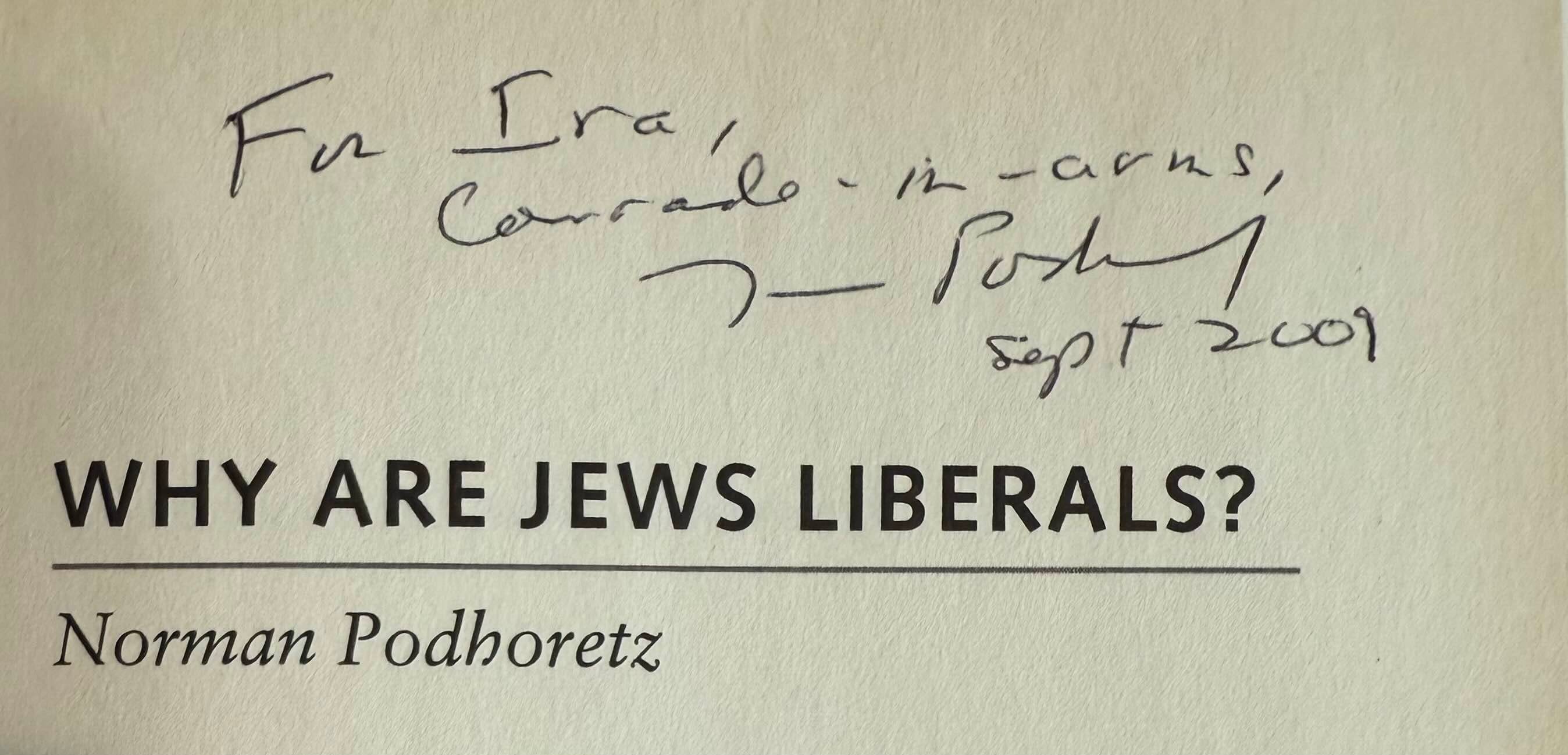
News of the death, at 95, of the editor, writer, thinker and intellectual combatant Norman Podhoretz—a great American—sent me to the bookshelf where I keep the signed volumes. I pulled Norman Podhoretz’s “Why Are Jews Liberals?” off the shelf. It was inscribed, “For Ira, Comrade-in-arms…”
Leave it to the giant of a writer and editor to sum up the relationship and the world situation in three well-chosen words.
Podhoretz, unlike me, had served in the actual U.S. Army, and in 2009 when the book came out we were both writers. The “arms” were computer keyboards. But he understood we were in a fight—a war, even. The clarity of that understanding put him way ahead of a lot of the rest of the intellectual class.
He understood, too, that fights were best won not alone but together with allies, friends, comrades, with a movement of fellow combatants. I consider myself blessed to have been a very minor one.
I picture Podhoretz arriving at the world to come and being greeted by Midge Decter and Lally Weymouth and Ken Bialkin and maybe even Pat Moynihan, Irving Kristol, Bob Bartley, James Q. Wilson, Bill Buckley, Michael Ledeen.
My hope for this world is that Podhoretz’s death will lead to a resurgence of interest in his ideas, which are true and relevant and needed today as much as ever.
A few examples may suffice. The first is an article from the September 1963 issue of Commentary, “Hannah Arendt on Eichmann.” It was scathing—and unbelievably prescient. He writes of “the inordinate demands she is always making on the Jews to be better than other people, to be braver, wiser, nobler, more dignified—or be damned. …This habit of judging the Jews by one standard and everyone else by another is a habit Miss Arendt shares with many of her fellow-Jews.” The piece concludes, “The Nazis destroyed a third of the Jewish people. In the name of all that is humane, will the remnant never let up on itself?”
Another is from the April 2002 issue of Commentary, “The Return of the Jackal Bins,” a version of the remarks he delivered at the American Enterprise Institute dinner on February 13, 2002:
How well I remember the late John Roche, a political scientist then working in the Johnson White House, being quoted by the columnist Jimmy Breslin as having dismissed the radicals as a bunch of “Upper West Side jackal bins.” Jackal bins? What were jackal bins? As further investigation disclosed, Roche had said “Jacobins,” a word evidently so unfamiliar to his interviewer that “jackal bins” was the best he could do with it in transcribing his notes.
Much ink has been spilled, a few gallons of it by me, in the struggle to explain how and why a great “Establishment” representing so wide a national consensus could have been toppled so easily and so quickly by so small and marginal a group as these “jackal bins.”...the stench emitted from the groves of academe has long since penetrated into all our nostrils….My contention is that September 11 will have given rise to a genuine transformation only if, once again, the military forces we deploy are undergirded by an equally formidable intellectual campaign….
We need to realize that the answer to the plaintively asked question, “Why do they hate us?,” is not for whatever crimes we may have committed, but for our accomplishments and our virtues.
Correlatively, we need to understand more clearly that these accomplishments and virtues have their source in the institutions designed by our founding fathers—institutions that have, just as they hoped, conduced to “the preservation of the blessings of liberty” for their posterity. Which is to say, us.
I for one pray that our victory in this war—World War IV—will result in the creation of conditions under which the same blessings can be heaped upon as many countries as possible. And I pray that it will set Islam onto a path of reformation from within. Both Judaism and Christianity began undergoing such a process centuries ago. Why should Islam alone remain forever exempt?
In Steven Weisman’s book of Daniel Patrick Moynihan’s letters is a May 25, 1973, letter from Moynihan to Nathan Glazer. Moynihan recalls having lunch with Podhoretz during the Nixon presidency, just after news of the My Lai massacre, “Over and again Norman would tell me that the administration would someday be ruined by its seeming relentless insistence on incurring the hostility of men who simply outclassed it….I was musing to Norman that it was a bad break coming just as it did when the president seemed to be having some success with his peace moves. ‘Bad break my ass,’ said Norman. ‘You think it is a bad break that this one story broke. Good God, there are fifty men—five thousand and fifty men—out there digging for stories such as My Lai, and everyone of them is five times smarter than anyone who would even consider working as a flack for the Nixon administration.’”
Norman Podhoretz was about ten times smarter than most of his peers, and about ten times a better writer, too. He’ll be missed. His legacy, not only in words but in friends and family, is enduring.
Love this post—without doubt there’s a shared spirituality even among the most secular Israelis, who still live according to the jewish calendar, observe basic religious customs and rituals, spend Shabbat with family and not working, center lives on community and children, and almost universally believe in Gd and Gds hand in current events, even if they reject Halacha.
Beautifully put about a great American.