

New York Times Editor Falsely Claims China “Has Taken The Lead” Over the West
“It’s obvious,” Joe Kahn says after reception in Shanghai

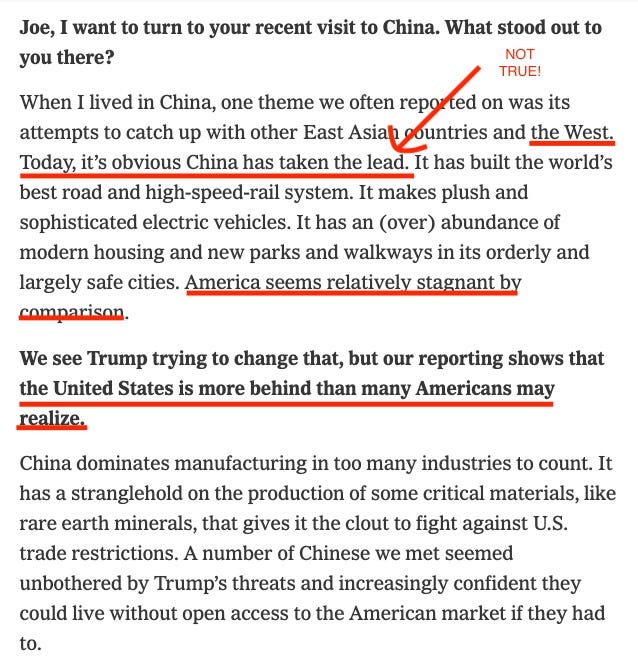
The executive editor of the New York Times, Joe Kahn, has returned from a visit to mainland China and announced to Times readers that “today, it’s obvious China has taken the lead” over other East Asian countries and the West. Kahn praises China’s “orderly and largely safe cities.” Kahn says that “America seems relatively stagnant by comparison.” Kahn’s interviewer, the assistant managing editor for standards and trust at The Times, Patrick Healy, replies, “We see Trump trying to change that, but our reporting shows that the United States is more behind than many Americans may realize.”
I’d been noticing this theme recently in Times news and opinion coverage (see “New York Times Pushes Chinese Communist Party Line,” December 3, 2025.) It escalates the matter to a new level, though, to have the editor of the paper and the “assistant managing editor for standards and trust” collaborating to push this narrative, which is in line with Xi Jinping’s communist triumphalism but not an accurate portrayal of the current reality.
Since the Times is being untruthful with readers about the reality of the situation, let The Editors supply some facts missing from the Times account. Those facts show that, in fact, the West, and the U.S. in particular, maintains “the lead” over China, at least in a lot of significant dimensions.
One important measure where the U.S. leads China is freedom. Freedom House, which tracks political rights and civil liberties, rates the U.S., along with Japan and Western Europe, as “free.” The U.S. scores 84 out of 100 on the Freedom House scale, with China, at 9 of 100, “not free,” and lagging far behind.
Another measure where the U.S. leads China is economic prosperity—not surprising, because in the long term, freedom contributes to prosperity. The World Bank has a list of countries ranked by Gross Domestic Product for each person, according to official statistics. China’s official statistics are as notoriously inflated as Hamas health ministry death counts, but even if you accept the statistics from China, the Chinese GDP per capita is at $13,303, while the U.S. is at $85,810. Seems pretty obvious to me that on that dimension, the U.S. has the lead.
Another measure where the U.S. leads China is military capability. The U.S. has 1,770 deployed nuclear warheads to China’s 24, according to the Stockholm International Peace Research Institute, which notes that “even if China reaches the maximum projected number of 1500 warheads by 2035, that will still amount to only about one third of each of the current Russian and US nuclear stockpiles.” The U.S. Navy has 11 aircraft carriers while China has three, according to Popular Mechanics.
Olympic medals? At the 2024 games in Paris, the U.S. won 126 medals, while China won 91. Even at the 2022 winter Olympics in Beijing, the U.S. took 25 medals compared to China’s 15.
Nobel prizes? China didn’t win any this year, while the U.S. and Japan had multiple winners.
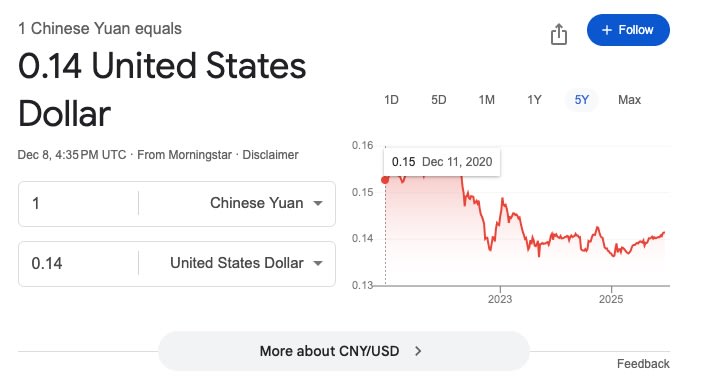
Currency? A Chinese Yuan is worth 14 U.S. cents, down from the 15 or 16 cents it bought in 2021 or 2022.
Research universities? U.S. News ranks the best global universities. Not a single Chinese institution is in the top ten. The Times of London does its own rankings of world universities. It, too, does not list a single Chinese institution in the top ten.
As for the investment in high-speed rail that Kahn is touting, even China’s own expert is now publicly describing those projects as overbuilt: “Projects that should never have been approved were nonetheless launched; irrational and even illegal ventures were pushed through; and substandard materials and workmanship were overlooked. Bribery and graft lay at the root of these failures, while the exposure and concealment of quality problems were the consequences.”
As for China’s “orderly and largely safe” cities they are “safe” unless you are a journalist critical of the government or an individual organizing religious or political assemblies that the government disapproves. People who fit those descriptions, will be thrown in jail, like Jimmy Lai, or Ezra Jin, or worse, just vanish.
On November 4, the National Endowment for Democracy honored individuals and organizations confronting the Chinese Communist Party’s repression of speech and belief. Among those honored were “Pastor Wang Yi, imprisoned leader of China’s house church movement,” and “the 11th Panchen Lama, Tibet’s abducted spiritual leader.” The New York Times did not cover that news, just like it didn’t cover the China Forum convened by the Victims of Communism Memorial Foundation.
The Times does, however, report that the 100th anniversary of its bureau in China was “marked” with “a reception.” It doesn’t say who attended the reception, or provide any photographs.
The more sophisticated news organizations have figured out that the big story in China right now is the limits of central planning. See, for example, the Financial Times report on “How Shanghai’s ambition to be the ‘future of finance’ fell apart”: “More than 15 years after China pledged to turn Shanghai into an international financial centre, the port city has failed to live up to its early promise…American law firms, once participants in huge cross-border financial flows, have left the city as foreign investment plummets. No western bank has participated in a single IPO on Shanghai’s stock market this year, and, in a domestically-focused market, the need for foreign staff is increasingly unclear.”
Sometimes that truth is permitted to peek through in the New York Times. For example, Dan Wang, author of Breakneck: China’s Quest to Engineer the Future, did a video interview with Times opinion writer Ross Douthat in which the Times transcript (which doesn’t identify which of the two is speaking) reads in part, “If we take a look at the wealthy, the rich, the politically connected, still, many Communist Party senior members have their kids in the U.S. or the U.K. somewhere abroad because they’re not quite sure that they’re going to be purged….the average best and brightest in China would happily accept American citizenship tomorrow…many Chinese entrepreneurs have decided that life in Japan, in Singapore, in the U.S. is much easier, that if you moved to the U.S., the state leaves you alone. If you move to Texas and Florida, people aggressively leave you alone.”
In political and religious and economic freedom, in property rights, in press freedom, in rule of law, America has the lead. Texas and Florida are not stagnating, they are booming. Perhaps the Times is angling for some business expansion in China and this all is part of that pitch. Or perhaps Kahn, who like his colleague Times editorial page editor Kathleen Kingsbury spent years in China as a reporter, genuinely believes this stuff. Perhaps he just spoke carelessly. Whatever the reason, it leaves Times readers with a misleading impression. As I wrote the other day, “It’s a subtle distinction between using the threat of a rising China to motivate improvement by the U.S.—just as the U.S. did with the threat of the Soviet Union during the Cold War to motivate investment in education, interstate highways, defense, and foreign aid—and reporting that leaves the incorrect impression that China has already outpaced us, or that crudely depicts China as excelling without acknowledging China’s flaws. Yet it’s a distinction worth guarding.”
I’m not trying to start a war between the U.S. and China. Joe Kahn probably knows more about China than I do; I’ve never been there. I’ve been invited to Taiwan a few times but have never made the trip. I do know some things about about America, though. One of those things is that when someone comes back here from some Communist Party-ruled country to describe it as some sort of paradise that’s outpacing the U.S., to be skeptical, and to do a rigorous check of the facts. Maybe the Times will run a correction?
Thank you: The Editors is a reader-supported publication that relies on paying customers to sustain its editorial independence. If you know someone who would enjoy or benefit from reading The Editors, please help us grow, and help your friends, family members, and associates understand the world around them, by forwarding this email along with a suggestion that they subscribe today. Or send a gift subscription. If it doesn’t work on mobile, try desktop. Or vice versa. Or ask a tech-savvy youngster to help. Thank you to those of who who have done this recently and thanks in advance to the rest of you.
Remember "I have seen the future and it works"?
Don't hold your breath waiting for a correction in The Times.