

New D.C. Center Celebrates the American Dream
Steps from White House, now find Michael Milken’s “prosperity formula” and George W. Bush’s paintings of immigrants

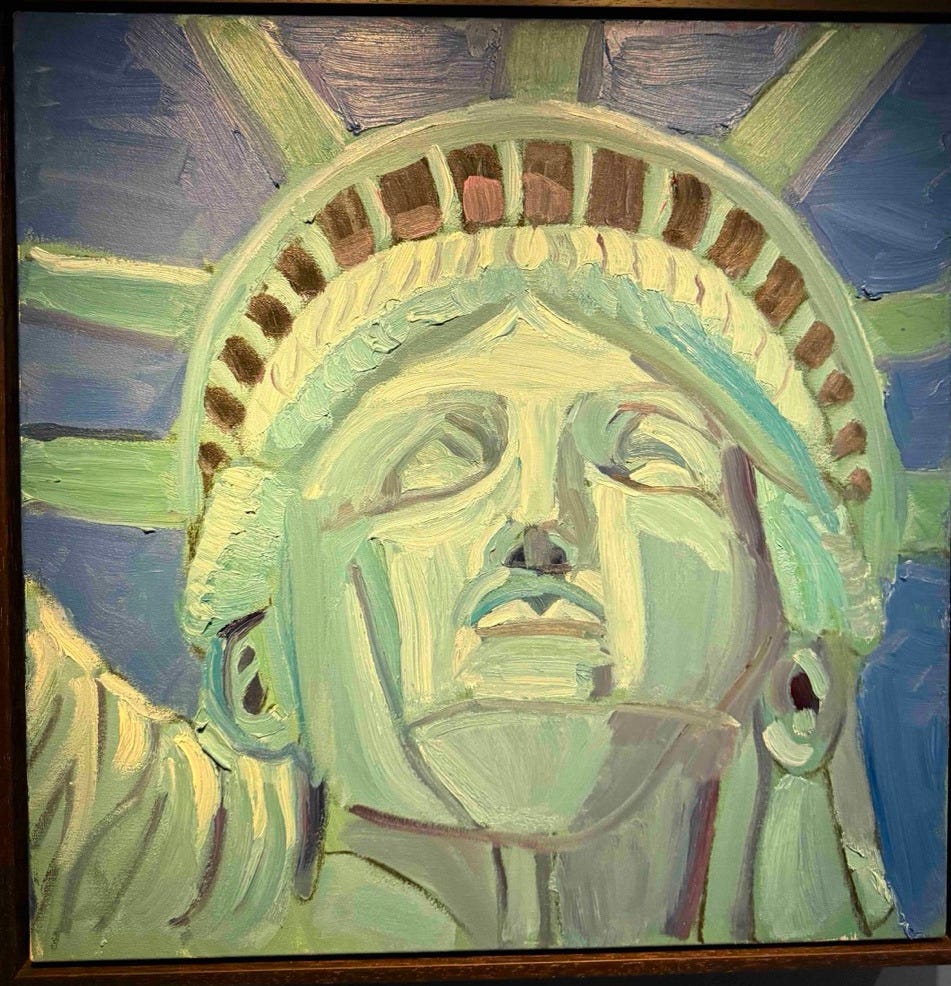
For decades it seems as if almost every new museum in Washington has featured something terrible. The United States Holocaust Memorial Museum, which opened in 1993, tells the story of the Nazi murderous war against European Jewry and of America’s failure fully to open its doors to refugees seeking to flee the persecution. The National Museum of the American Indian, which opened in 2004, tells the grim story of Indians facing disease, removal, dispossession, and poverty. The National Museum of African American History and Culture, which opened in 2016, tells the “unvarnished truth” of the transatlantic slave trade in all its cruelty.
Sure, those three museums also include stories of resilience, courage, achievement and, in some cases, progress. Unlike them, though, the Milken Center for Advancing the American Dream, which opened to the public a few weeks ago in a former Riggs National Bank building steps from the White House and the U.S. Treasury, is not a government project. That may account in part for its thoroughly sunnier outlook.
The “hall of dreams” on the first floor of the center, along with a high-tech moving-cloud display, includes posters with quotes. Billionaire businessman Warren Buffett says, “In its brief 232 years of existence…there has been no incubator for unleashing human potential like America.” Singer Gloria Estefan says, “In the United States, if you believe yourself and you’re determined and persevere, you’re going to succeed.”
Facts and figures on display elsewhere in the museum convey a similarly upbeat story.
“Sometimes technology drives down prices faster than inflation drives them up,” one exhibit panel explains. “In 1970, a long-distance phone call from the United States to England cost $12 a minute. Today, the same call would cost less than ten cents a minute.” The same panel reports on how the Securities and Exchange Commission’s putting an end to fixed brokerage commissions means that the transaction cost of selling $500,000 of IBM stock, $7,500 in 1974, has gone to $0 today.
Worldwide life expectancy increased to 73 in 2023 from 31 in 1900, a sign of progress in nutrition and against disease, and a much more rapid increase than in the millions of years before.
A movie theater on the lower level shows a video highlighting individual and family successes. An ex-criminal became regional manager of a car-wash chain. Michele Kang immigrated to the U.S. from South Korea and owns the Washington Spirit soccer team. Alan Hassenfeld, whose grandfather left Poland for America, runs the Hasbro toy company. Virginia Ali, 91, owns and operates Ben’s Chili Bowl restaurant in Washington. Another character in the movie is a Catholic-school principal.
Exit the center through a gift shop that sells books including Ayn Rand’s Atlas Shrugged, Ken Langone’s “I Love Capitalism!” and Sam Walton’s “Made in America.”

As an example of museum craftsmanship, it’s well-done, a mix of high-technology—holograms, touch-screens—and old-fashioned paper and pencil participation—“share your family’s journey towards the American Dream.”
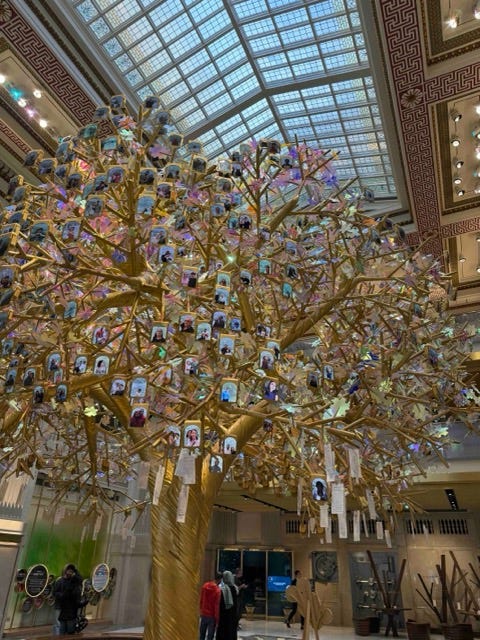
The museum includes at least two art galleries.
One is full of portraits of “unsung heroes,” a project of the Lowell Milken Center for Unsung Heroes. An artwork titled “There is no bread,” celebrates journalist Gareth Jones, who exposed the Ukrainian Holodomor. A sign in the gallery describes that as “Stalin’s engineered and state-induced famine that killed millions of Ukrainians.” The opposite of the progress of American capitalism was the starvation produced by Soviet Communism.
Another gallery includes George W. Bush’s oil paintings of immigrants—Madeleine Albright, Henry Kissinger, Arnold Schwarzenegger, Yuval Levin. In a video near the gallery entrance, Bush says that while “fear dominates the discourse,” it’s also worth remembering the “profound and positive influence of newcomers.”


“When immigrants advance in our society, they renew our spirit, revitalize our economy, and add to the unity of the nation,” Bush says.
It was an uplifting way to spend a morning in Washington. The political headlines and so many other museums are full of negativity. Leave it to Michael Milken—a prostate cancer survivor, pardoned by President Trump in 2020, who had spent 22 months in prison after a plea bargain in a case characterized by Rudolph Giuliani’s prosecutorial overreach—to help give Americans a timely reminder of our country’s progress and potential.
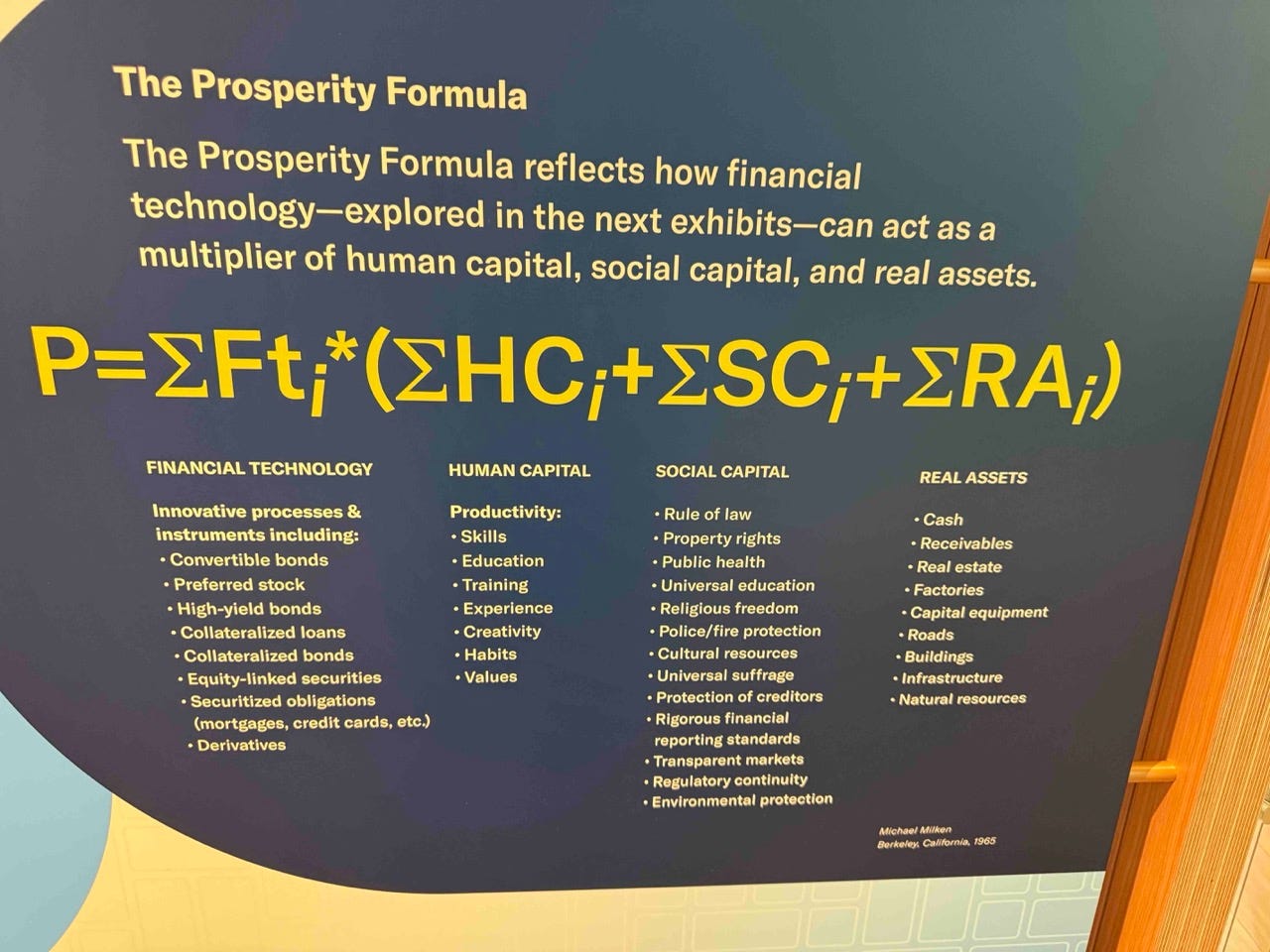
Milken’s 1965 “prosperity formula,” on display in the center, describes how financial technology “can act as a multiplier of human capital, social capital, and real assets.” In this case, the human capital—Milken’s experience, creativity, and values—and the real asset—the building in Washington—are helping to educate those who visit.
As a monument to the American dream, in my view nothing quite competes with Ellis Island. But if you are in DC with some time to spare, consider stopping in at the new Milken Center for Advancing the American Dream. After a visit, you might, like me, walk out into the sunshine with a smile.
Thank you: This is a reader-supported publication that relies on paying customers. If you know someone who would enjoy or benefit from reading The Editors, please help us grow, and help your friends, family members, and associates understand the world around them, by forwarding this email along with a suggestion that they subscribe today. Or send a gift subscription. If it doesn’t work on mobile, try desktop. Or vice versa. Or ask a tech-savvy youngster to help. Thank you to those of who who have done this recently and thanks in advance to the rest of you.
What a breathe of fresh air! Thank you for sharing.