

Never Read Just One Newspaper
On bank earnings, New York Times and Wall Street Journal tell different stories

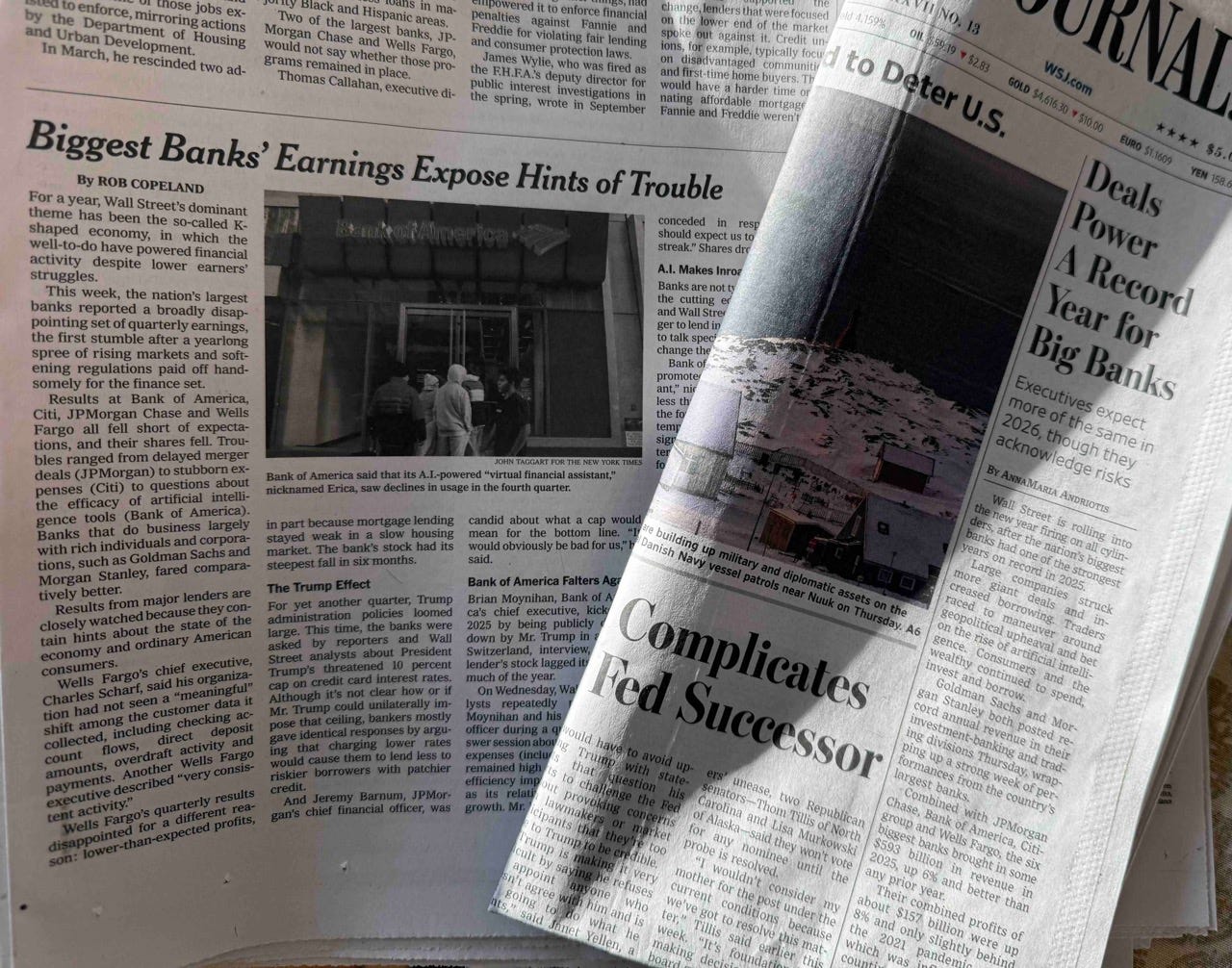
A reminder of why it frequently makes sense to rely on more than just a single source of news comes in today’s coverage of bank earnings.
The lead news article in the print Wall Street Journal emphasizes the positive news. The article begins, “Wall Street is rolling into the new year firing on all cylinders, after the nation’s biggest banks had one of the strongest years on record in 2025. … Goldman Sachs and Morgan Stanley both posted record annual revenues in their investment banking and trading divisions Thursday, wrapping up a strong week of performances from the country’s largest banks….the six biggest banks brought in some $593 billion in revenue in 2025, up 6% and better than any prior year.” The print headline is “Deals Power a Record Year for Big Banks.”
The New York Times offers an almost 180-degree opposite take. The print headline is “Biggest Banks’ Earnings Expose Hints of Trouble,” and the online headline is “Cracks Begin to Appear at the Nation’s Biggest Banks.” The story says, “This week, the nation’s largest banks reported a broadly disappointing set of quarterly earnings…Results at Bank of America, Citi, JPMorgan Chase and Wells Fargo all fell short of expectations, and their shares fell.” Whose “expectations”? The editors at the New York Times? The Times buries its good news at the way, way bottom of its article: “The sky is not falling. There are reasons for optimism on Wall Street….Investment bank traders took advantage of strong financial markets to bolster profits. A rise in mergers and acquisitions, exemplified by the $100 billion bidding war between Netflix and Paramount for Warner Bros. Discovery, is also a boon to Wall Street dealmakers. And for all of this week’s angst, large bank stocks are up strongly over the past 12 months, even after the recent stumble.”
The Journal’s view of it is probably closer to the overall truth, though I’m not a bank stock analyst and don’t pretend to be one. While the Journal article and subheadline acknowledge some potential risks ahead and the Times article acknowledges reasons for optimism, the main thrusts of the two articles are completely different, even though they are based on the same earnings announcements and calls. The Times emphasizes “trouble,” while the Journal emphasizes “record year.”
One approach is to read both papers and use the additional perspective to reinforce your own informed skepticism. Another is to skip them with the knowledge that what the papers are really supplying is their own interpretive frameworks, not the underlying facts, which you can get from the SEC filings or the earnings calls or the stock prices, if you are interested. A third approach is to realize and remember that if the papers are this opinionated and full of spin when it comes to something seemingly straightforward like a bank earnings story, imagine the level of judgment and choice and, potentially, bias and inaccuracy that can creep into articles about topics such as immigration enforcement or the Arab-Israeli conflict or U.S. electoral politics.
And it applies to more than just newspapers. Television news is structured so that you can only watch one program at a time (unless your television has a split screen function, but even then the sound gets complicated). Plenty of classrooms have only a single instructor, and religious institutions a single preacher. If you find yourself in a one-newspaper situation, even of the non-newspaper variety, it can be useful to recognize it and seek out a different perspective to help understand how the single perspective might be wrong or missing something. At least with newspapers you can hold them up side by side and compare them, and file them away with a note to remember to check in on the banks in a year and see who had a better read of the situation, the Times or the Journal.