

National Review Institute Fundraises Against Neoconservatives, Lincoln
The bitter nostalgia camp lashes out

An unfortunate recent trend by right-of-center writers and institutions is a tendency to fling around the word “neoconservative” as a kind of vague insult.
An online operative of the Daily Caller, the former Tucker Carlson vehicle, tweeted a picture of Vice President Vance introducing Elbridge Colby at Colby’s Senate confirmation hearing with the words, “Neocons hate this.” I asked, “What do you mean exactly here by “Neocons”? Can you name some individuals, organizations, publications? Thank you.” I got no response.
The editor of the New Criterion, Roger Kimball, posted, “don’t miss RaheemKassam excellent piece on the Trump-Vance doctrine at NationalPulse.” The piece, which is not actually excellent, contends that “The neoconservatives, neoliberals, and globalists” are “not cheering Trump and Vance’s efforts because, quite simply, they were always more interested in war than peace, conflict over resolution, and cash piles from their lobbyists in Arlington, McClean [sic], and Chantilly, Virginia….The elites want war. …fearing an end to a decades-long gravy train, the defense industry is now jerking its knees, triggered by the only horror that could ever force them to wince: peace.” This is an example of the horseshoe phenomenon in which the far right sounds like the far left, denouncing the defense industry and offering a crude Marxist analysis.
Also joining the bashing of neoconservatives, alas, is the National Review Institute.
A fundraising email I received recently from the Institute offered a tribute to M.E. Bradford, who died on March 3, 1993. The email described him as “one of the most important intellectual figures among the group of twentieth century American conservatives known as ‘paleoconservatives’ or Southern conservatives. This group sought to balance two sets of legitimate claims—those of individual freedom and those of community discipline and social order.” It said, “Bradford thought Lincoln a liberal revolutionary who had radically altered the American Constitution.”
The email says, “In 1981, Bradford was on the short list for President Reagan to be appointed the head of the NEH, the National Endowment of Humanities, but despite his credentials as a distinguished historian, some influential neoconservatives helped to block his potential nomination. Bradford lost out to William Bennett despite the support of Buckley and Harry Jaffa, Bradford’s old friend and sometimes adversary on the subject of Abraham Lincoln.”
Oh, those “influential neoconservatives.” It sent me back to do some reading on the issue. A New York Times dispatch from September 1981 quoted Irving Kristol:
'It's always hard to measure influence,'' said Irving Kristol, a leader of the neoconservatives, who is a co-editor of Public Interest magazine. ''I don't know whether I have influence or not.''…
Although Mr. Kristol refuses to discuss the matter, Administration officials say he has indicated his opposition to M.E. Bradford, who emerged recently as the leading contender for the chairmanship of the National Endowment for the Humanities. Mr. Bradford, a political theorist from Texas, supported former Gov. George C. Wallace of Alabama for President in 1972.
Mr. Kristol's opposition apparently has raised little concern among Mr. Reagan's top advisers. ''There are people here who feel we owe very little to the neoconservatives,'' said a senior White House official who declined to be named. ''What did they do for us? Do we automatically faint every time they say so-and-so should be named to the National Endowment for the Humanities and so-and-so shouldn't?''
Another piece in the Times quoted Bradford as conceding, “I am in some ways critical of Lincoln's rhetoric, which was inflammatory….in 1860, I would have been a Stephen Douglas Democrat.”
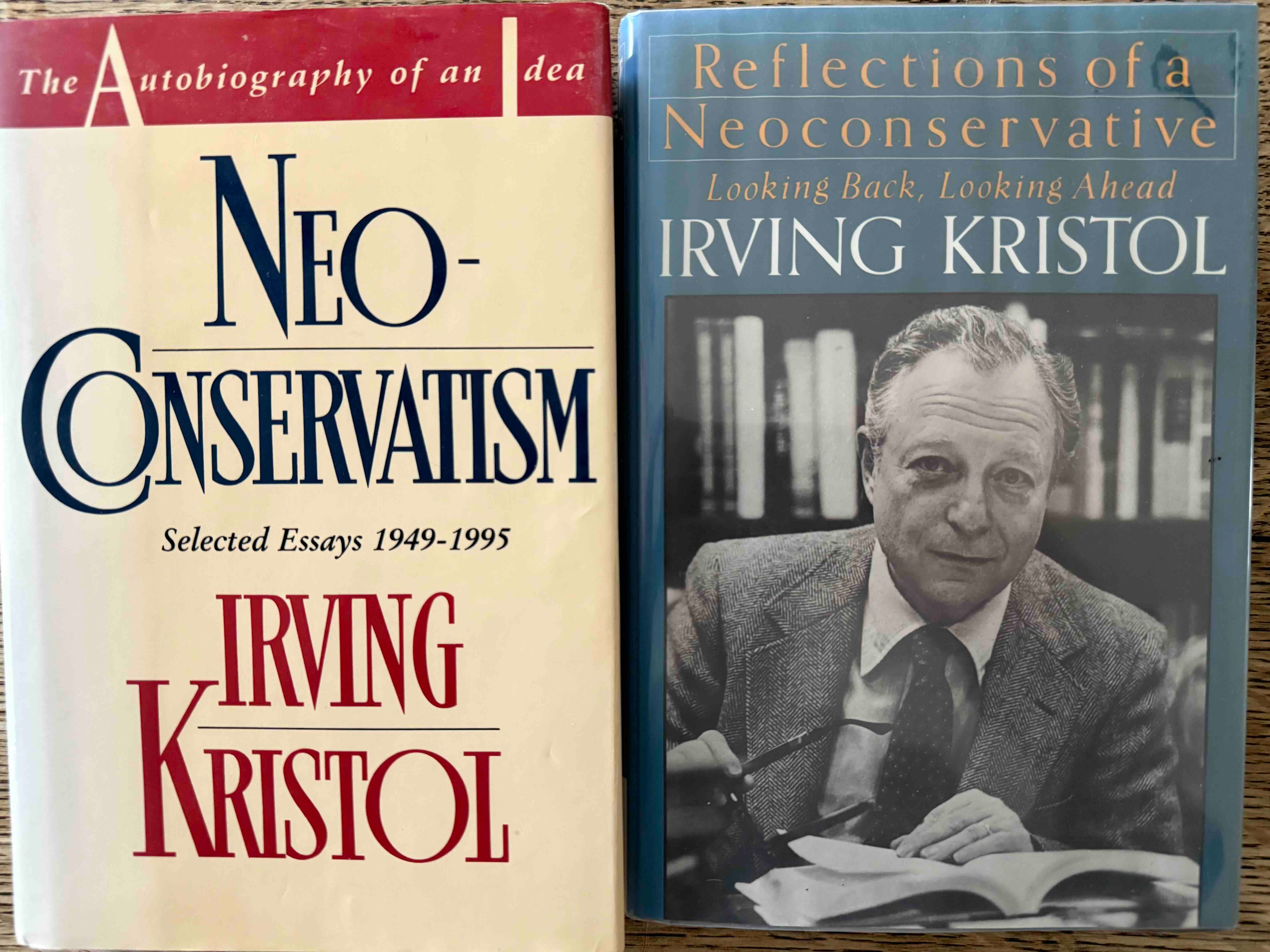
The National Review Institute has honored a lot of people I respect and admire, so it’s concerning to see it piling on with the bashing of neoconservatives. Enough with the namecalling. Debate policies or ideas or politics or personnel choices or presidential candidates, sure. I’d take Bill Bennett over M.E. Bradford, and Lincoln over Douglas, any day, no doubt. Are there not enough real enemies out there—Communist China, Iran and its proxies, Putin, the far left, the Hamas allies on college campuses—that today’s right needs to stir up animus against neoconservatives? Who, specifically, do they even mean? Irving Kristol died in 2009. His book “Neo-Conservatism” credits the movement for modernizing the Republican Party, describing Reagan as “the first Republican president since Theodore Roosevelt whose politics were optimistically future-oriented rather than bitterly nostalgic or passively adaptive.”
To my eyes—and maybe I wasn’t the intended target audience—that National Review Institute email about the “brilliance” of M.E. Bradford falls on the wrong side of Kristol’s dichotomy between bitter nostalgia and optimistic future-oriented. That analytical framework from Kristol remains relevant and helpful, as is the rest of the neoconservative legacy.
Trump’s big speech: President Trump’s speech to Congress last night started too late for an East Coast audience and went on far too long for my taste. I thought the strongest part was the ending, which the president raced through in delivering as it approached 11 p.m. Eastern Time. As transcribed by the New York Times (the White House is really slow to update its remarks page), here it is:
From the patriots of Lexington and Concord to the heroes of Gettysburg and Normandy, from the warriors who crossed the Delaware to the trailblazers who climbed the Rockies and from the legends who soared at Kitty Hawk to the astronauts who touched the moon, Americans have always been the people who defied all odds, transcended all dangers, made the most extraordinary sacrifices and did whatever it took to defend our children, our country and our freedom.
And as we have seen in this chamber tonight, that same strength, faith, love and spirit is still alive and thriving in the hearts of the American people. Despite the best efforts of those who would try to censor us, silence us, break us, destroy us, Americans are today a proud, free, sovereign and independent nation. That will always be free, and we will fight for it till death. We will never let anything happen to our beloved country. Because we are a country of doers, dreamers, fighters, survivors. Our ancestors crossed a vast ocean, strode into an unknown wilderness and carved their fortunes from the rock and soil of a perilous and very dangerous frontier.
They chased our destiny across a boundless continent. They built the railroads, laid the highways and graced the world with American marvels like the Empire State Building, the mighty Hoover Dam, and the towering Golden Gate Bridge. They lit the world with electricity, broke free of the force of gravity, fired up the engines of American industry, vanquished the communists, fascists and Marxists all over the world, and gave us countless modern wonders sculpted out of iron, glass, and steel.
We stand on the shoulders of these pioneers who built the modern age. These workers who were there swept into the skylines of our cities, these warriors who shed their blood on fields of battle, gave everything they had for our rights and for our freedom.
Now it is our time to take up the righteous cause of American liberty. And it’s our turn to take America’s destiny into our own hands and begin the most thrilling days in the history of our country. This will be our greatest era; with God’s help over the next four years, we are going to lead this nation even higher, and we are going to forge the freest, most advanced, most dynamic and most dominant civilization ever to exist on the face of this Earth.
We are going to create the highest quality of life, build the safest and wealthiest and healthiest and most vital communities anywhere in the world. We are going to conquer the vast frontiers of science, and we are going to lead humanity into space and plant the American flag on the planet Mars and even far beyond. And through it all, we are going to rediscover the unstoppable power of the American spirit, and we are going to renew the unlimited promise of the American dream. Every single day we will stand up, and we will fight, fight, fight for the country our citizens believe in and for the country our people deserve.
My fellow Americans, get ready for an incredible future because the golden age of America has only just begun. It will be like nothing that has ever been seen before. Thank you, God bless you, and God bless America.
The "horseshoe phenomenon in which the far right sounds like the far left" is based on a one-dimensional model of political views in which there is far left, far right and a spectrum in-between. However, using this model it is difficult to explain why the far right is similar to the far left.
A better model is the two-dimensional Nolan Chart (https://en.wikipedia.org/wiki/Nolan_Chart). Using 2 axes of personal freedoms and economic freedoms one gets a 2D map of the views of Liberals, Libertarians, Conservatives and Authoritarians. What we call far right and far left are Authoritarians of the right and of the left. On the 2D map, they are both in the Authoritarian quadrant, and there is no paradox as to why they are similar.
As soon as the words from President Trump's speech quoted above began, I announced "Here is the peroration". But even the peroration was much longer than is usual.
Even though President Biden's final State of the Union speech was considered to be very spirited, Trump's speech was far more effective in showing someone in charge.
Trump reading from the letter from President Zelensky was very reassuring, as was Commerce Secretary Lutnick's announcement on Wednesday of moderation of the trade war with Canada. These convey an atmosphere of turbulence with good sense prevailing. In contrast the vibe of PM Trudeau's speech (https://www.youtube.com/watch?v=83f47jIS_D8) was whiney. The most memorable line was "It’s not in my habit to agree with The Wall Street Journal, but Donald, they point out that even though you’re a very smart guy, this is a very dumb thing to do". But once again Mexican president Sheinbaum did better by postponing any action until Sunday.
One soon won't have Justin Trudeau to kick around any more, though I don't know how soon Mark Carney, the expected winner of the Liberal party leadership race, can become prime minister after the race concludes on Sunday. Carney is not a member of parliament.