


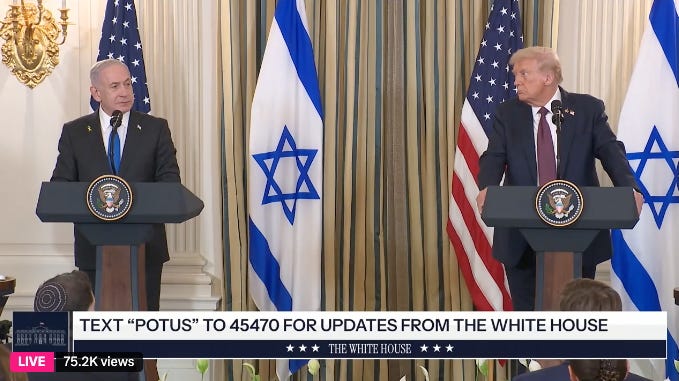
There’s something missing from the 20-point “President Donald J. Trump’s Comprehensive Plan to End the Gaza Conflict.” Two things, actually: democracy and rule of law.
I mention that with some reluctance. From the relative safety of America, I don’t want to second-guess or slow Israelis or for that matter Gazans who want the war to end without additional complications.
But recent Middle East history is littered with attempts to put peacemaking ahead of democracy and rule of law. None of those efforts—even the “Aaahb-raa-haahm Accords,” as Trump pointedly pronounced them this week—has fully lived up to their potential. Some of them have even been counterproductive.
The only reference to freedom in the Trump Gaza plan is that those who wish to leave Gaza “will be free to do so and free to return.” Democracy and rule of law are totally omitted.
What’s in the plan instead? There are two references to “experts.” Gaza, the plan says, will be governed by a “technocratic” committee including “international experts.” An economic development plan will also involve “convening a panel of experts.”
What would we do without experts?
Which “experts” will be called in? The same ones who told everyone that Netanyahu’s decision to invade Gaza was doomed to failure, that his expansion of the war to Lebanon was a quagmire in the making, that Trump’s tariffs would cause another Great Depression, that missile defense would never work, that Trump’s criticism of the Federal Reserve would crater the global economy?
One reason Trump and Netanyahu have been so popular with voters is their skepticism about know-it-all “experts.” So it’s surprising to see them racing to embrace government-by-expert in a place—the Middle East—where the so-called experts have frequently been wrong.
None of this is to say the Trump plan is a total disaster. If the president and Prime Minister Netanyahu can achieve the return of all the hostages from Gaza and the disarming of Hamas diplomatically with the plan, it’ll be an achievement to celebrate.
If Hamas rejects the deal or fails to comply and Israel then responds by achieving its war aims with further military action, that will also be a win of sorts, because it’ll be even clearer than ever that the fault rests with Hamas, not Israel or the U.S., for prolonging the hostilities.
A best-case scenario would be that all the expert panels work as a bridge toward a longer-term effort to build civil society in a way that eventually leads to democracy and rule of law. Maybe Trump and Netanyahu’s experts will be better than the typical ones. Technocracy would be an improvement over Hamas rule or over an active combat zone, though the Israel Defense Forces have already basically established clan management as a kind of self-rule for Gazans in the cities of Khan Younis, Rafah, and Beit Lahia. The track record is that once the central planners get control, they are reluctant to yield power voluntarily back to the people.
There was, after all, no shortage of “experts” in Gaza on October 6, 2023—all those doctors looking the other way at the Hamas terrorists in the hospital basements, all the United Nations technocrats whose schools were cover for terror tunnels.
The last time Israel was on the verge of withdrawing from Gaza, in 2004, an Israeli minister, Natan Sharansky, quit the government in protest after trying, he later recalled, to convince his fellow ministers “that the road to peace is paved with freedom.” That quote is taken from Sharansky’s book, “The Case for Democracy,” co-authored with Ron Dermer, who is now Israel’s minister of strategic affairs.
Why, two decades later, risk repeating the error by again downplaying democracy and rule of law? Critics of Trump and Netanyahu will suspect it is because those two themselves are would-be authoritarians. A more realistic explanation relates to the countries that Trump is relying on to try to get Hamas to accept the deal. Its rollout was welcomed by a joint statement from the foreign ministers of Qatar, Jordan, UAE, Indonesia, Pakistan, Turkey, Saudi Arabia and Egypt. Not a single one of them is a free country. They reaffirmed their commitment to regional “stability.”
Some of the local rulers probably fear that if they had to face an election, the people would replace them with Hamas or some similar Muslim Brotherhood-style extremists. It’s a reminder that dictatorships are inherently unstable. Policy that prioritizes “stability” rather than freedom, democracy, and rule of law winds up undermining all those goals and creating security threats, too. That is one piece of advice for Gaza’s future that is unlikely to be heard from the “international experts.”
Remembering Lally Weymouth: My world and Lally Weymouth’s intersected between about 2001 and 2010 when I was helping run the New York Sun and she was a star journalist. We had a common friend in Kenneth Bialkin, who was the lawyer that helped create the company that operated the Sun. At the time I was a term member of the Council on Foreign Relations so would see her there sometimes. She was a formidable figure. Bialkin had high standards and so did Weymouth, who was for all her Washington Post-family-owning wealth and glamorous appearance a fiercely competitive and ambitious working journalist. With her carefully researched questions directed at world leaders, she managed to convey a set of values—American leadership, freedom, democracy, rule of law, economic growth, the security of the U.S. and of Israel—as coherent and articulate in their way as any Washington Post editorial, and not necessarily shared by everyone else in journalism or in the Council on Foreign Relations crowd. When she rose to address a question to some visiting potentate, she did it as a kind of equal—not just because of her physical stature, but out of what seemed to be a conviction that a representative of the free press in America outranked, or at least was on par with, any visiting monarch. Some of the obituaries credit her with launching Donald Trump’s presidential ambitions by inviting him as her guest to the White House correspondent’s dinner.
I was sorry to hear that she died. Ken Bialkin and Lord Weidenfeld will be glad to have her as a current-events conversation partner in the world to come.
Trump suggests a Harvard deal is near: Answering questions from reporters at an executive order signing event this afternoon, President Trump briefly sketched a deal with Harvard in which the university would set aside $500 million, the interest of which would fund trade schools to educate technical workers for U.S. factories or artificial intelligence. “I think we have a good chance of getting that closed,” he said. Those terms might be more palatable to Harvard, especially if Harvard doesn’t actually surrender the $500 million, but rather keeps control of it and agrees to allocate the income stream from it to Trump-favored projects. The Trump administration’s deal with Brown includes Brown “payment of $50 million in grants over 10 years to Rhode Island workforce development organizations, which is aligned with the University’s service mission,” so maybe the proposed Harvard deal is along those lines.
Thank you: If you know someone who would enjoy or benefit from reading The Editors, please help us grow, and help your friends, family members, and associates understand the world around them, by forwarding this email along with a suggestion that they subscribe. Or send a gift subscription. If it doesn’t work on mobile, try desktop. Or vice versa. Or ask a tech-savvy youngster to help. Thank you to those of who who have done this recently (we see the results, and they are encouraging) and thanks in advance to the rest of you.
"The hardest part of establishing the rule of law is the first 500 years"
--Gordon Brown
Nothing is missing from Trump's plan: democracy and rule of law are for peoples that have internalized Western values. in the Middle East this is strictly limited to Israel. All the Arab and Muslim countries in the region, whether ruled by military men, presidents, kings, emirs share one common trait: absolute disdain for democratic values.
Sharansky's book is especially at fault because he seems to have convinced the Bush Administration that after toppling Saddam Hussein, it should embark on a nation-building project to turn Iraq into a functioning,modern democracy. That failure cost 15 years of US military losses for no benefit at all.
The alternative in Iraq was the tried and true: topple Saddam Hussein, select a pro-Western Sunni Arab general to replace him as the new dictator and leave, 4 months of work at the most.