

John Kerry Discovers the Power of the Private Sector
Plus, Jared Kushner at the ADL, Ken Weinstein on grand strategy, and the Jeffries guys on how to keep succeeding

John Kerry is 80 years old and has spent at least 50 years working for the government, so it’s somewhat amusing to see him belatedly discovering and appreciating the real power of the private sector.
Here is Kerry in a farewell interview with National Public Radio about his service as the first United States Special Presidential Envoy for Climate. “That’s one of the reasons why I’m transitioning out of this particular job, because I think that now the private sector is gonna be the key to our ability to be able to win this battle.”
Kerry explained about his future plans, “I’m gonna be directly involved in trying to help deploy the financing which will accelerate this transition. All the finance reports say, if you want to achieve Net Zero 2050, then it’s gonna cost about 2 and a half to 4 and half, five trillion dollars a year for the next 30 years. No government in the world, no government in the world has that money to put on the table, but the private sector does.”
The NPR reporter didn’t press Kerry on how precisely Kerry was going to “deploy the financing”—as a loan officer at a bank? As a portfolio manager at a venture fund? Investing his family money?
Kerry sounded similar themes in an exit interview with the Associated Press. From the AP dispatch:
Putting into action plans to reduce the use of fossil fuels and increase renewable energies is key and won’t be done so much by the public sector, where Kerry has spent nearly half a century, but instead by the private sector, he said.
The world needs to spend $2 trillion to $5 trillion a year combatting climate change in various ways. However, finding that amount of money won’t be easy.
“That’s one of the reasons why I am so focused on the private sector,” Kerry said. “The private sector does have — manages — trillions of dollars.
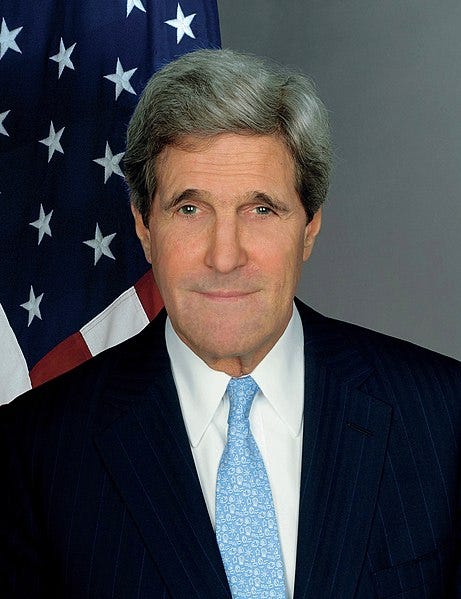
In both the AP and NPR interviews, Kerry dismissed the idea Trump beating Biden in the 2024 election would be an insurmountable setback for the climate. To NPR, he noted that during Trump’s first term, mayors and governors adhered to clean-energy goals. “No one prime minister, one king, one president anywhere in the world is able to stop what the marketplace of the world is now moving towards,” Kerry told NPR.
The AP said, “Kerry said he assures leaders of other countries that even if a candidate like Trump, who is running for re-election, were to win, ‘no one person can reverse what the world is doing now.’” If the Trump campaign is clever, it might consider using this clip in messages targeted at climate-concerned voters. It could help neutralize the issue.
Anyway, there’s an additional point here that goes beyond the politics of it or even how the power of markets can outweigh that of governments. Humans have a tendency to want to be what they’re not. The rich businessmen like Howard Schultz, Michael Bloomberg, and Tom Steyer want to become politicians. The politicians want to quit and go into business. Anyway, it’ll be interesting to see whether Kerry starts his own fund or joins up with some large outfit, and, either way, how the financial returns and social returns stack up when and if they become available. One positive sign about his risk-analysis ability, notwithstanding his claim that it’s all Trump-proof, is that he’s leaving to go do this now rather than after the November election.
Jared Kushner at ADL: Jared Kushner gave the keynote address at the Anti-Defamation League’s big convention. It was about antisemitism, but it contains some more widely applicable general advice:
“The first step in solving a hard problem is always to define what success looks like. It doesn’t mean that’s where you’ll end up, but having a stated goal is critical. One of my favorite quotes is from the Cheshire Cat in Alice in Wonderland, who says to Alice, ‘if you don’t know where you are going, it doesn’t matter which path you take.’”
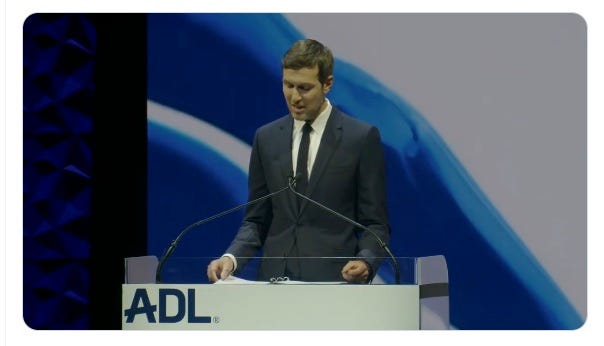
Kushner called the Jewish people “the most successful minority in the history of the world.”
He said he thought the Abraham Accords have the potential to expand to include “Saudi Arabia, Pakistan, Indonesia, and many, many, more to come.”
Kushner also talked about relations between Jews and Evangelical Christians. “I was very disturbed recently when I saw a Pew Poll that said that Evangelical perception of Jews was a plus 40 and Jewish perception of Evangelicals was a negative 40. I had never met an Evangelical, living in New Jersey and New York, until I went on the 2016 campaign, and I can assure you, they were much different than what I imagined. When you have a people that likes you so much, we should be making more effort to get to know them, to get to understand them, and to build those relationships further. We can all do better by keeping an open mind, an open door, and an open heart.”
Ken Weinstein on grand strategy: The Hudson Institute’s Kenneth Weinstein is out with a new paper from the Hoover Institution under the headline “The Growing Limits to Formulating US Grand Strategy in an Ever More Complex World.” I net out more optimistic and perhaps ambitious than he does, but I thought the paper was useful for two reasons. First, it identified a key issue that relates back to Kushner’s point above about defining success:
In the U.S., we now recognize the China challenge but have yet to come to a common understanding of what a desired end-state with our principal strategic adversary might look like. Do we seek the defeat of the Communist Party as some have suggested, or a slightly more liberal China that more willingly complies with international norms? Or, as I would assert, a far weaker, less autocratic regime that might be more easily pressured not to harass its neighbors?
Second, it draws a connection between the home front and foreign policy:
The American electorate has rarely been more divided on fundamental issues as we are today, with deep implications for America’s global leadership. A significant number of Americans do not accept either American exceptionalism or the principles of the American Revolution – a result, in part, of the pernicious impact of culture relativism and anti-Western, post-colonial theories promoted, in part, by our strategic adversaries.
Part of the blame for the current crisis at our southern border can be placed on these ideologies, with a firm refusal of many in the United States to accept the primacy of the rule of law (seen in the outright rejection of the term “illegal alien”) or the critical importance of national borders as essential to national security. This crisis -- and the potential exploitation of our Southern border through foreign penetration – distracts from our capability to make strategic decisions away from our homeland, as the chorus of “money for our southern border not Ukraine” shows.
Rich Handler and Brian Friedman on March forward: The CEO of Jefferies Financial Group, Rich Handler, and its president, Brian Friedman, have a “March Forward” memo to their team on “what we need to do to keep succeeding.” Among the points, “have a heightened awareness that we can never let a drop of arrogance or complacency seep into Jefferies” and “Everyone at Jefferies deserves a prompt response to every call or email, regardless of seniority. If you don’t know what to write, then please pick up the phone and call your colleague. Not responding or responding in an untimely manner is unfair and wrong.”
The skill of writing good memos isn’t always the same as the skill of running a durable, great company, but there is certainly plenty of overlap. What struck me about a lot of the points was that at its best, capitalism can reinforce virtue. The virtues—courtesy, humility, industry, hustle—arguably have their own intrinsic value beyond being required for business success. That is what I read Handler and Friedman to be getting at when they use language like “unfair and wrong.”
Thank you!!: We are marching forward here, with your help. Many, many thanks to all the new readers and paying members. If you find this work valuable, please consider helping to spread the word by telling a friend about The Editors.