

Israeli General on What U.S. Can Do to Free the Hostages
Plus, Columbia’s deal; New York Times whitewashes Zohran Mamdani

In today’s newsletter: An influential Israeli general on the one thing the U.S. can do to win the release of not just some, but all of the hostages in Gaza. Also, Columbia’s deal with the Trump administration, and how the New York Times whitewashes Zohran Mamdani’s hate for Israel.
If you aren’t yet a paying subscriber to The Editors, please become one today. This is a reader-supported publication, and paying subscribers help make this newsletter possible. If you already are one, thank you!
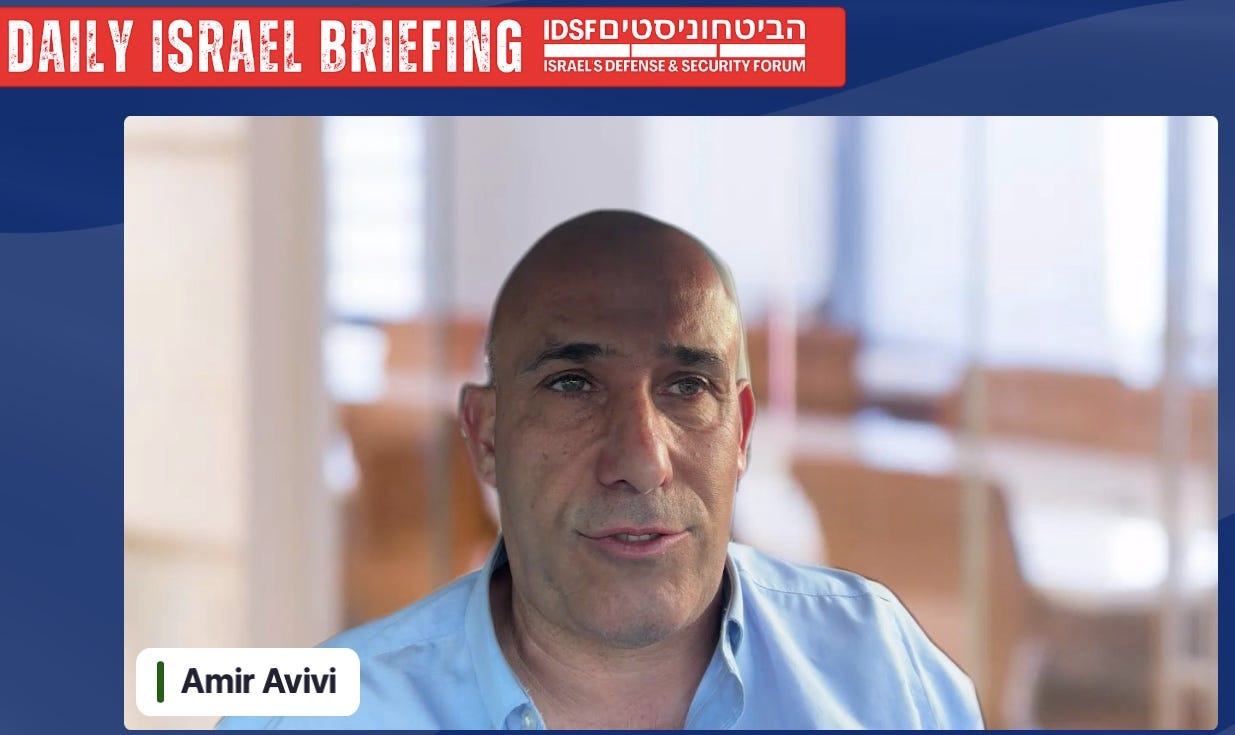
An influential Israeli general has an outside-the-box idea on how to win release of not just some, but all, of the remaining hostages being held in Gaza.
He says it’s not Hamas in Gaza that is making the decisions about the hostages, but Hamas leaders in Qatar—and that those leaders in Qatar are the ones who should be subject to stepped up pressure.
“We’re not putting enough pressure on Hamas in Qatar. These guys need to be taken out. They need to be extradited. We need to arrest them. They’re not under pressure. They don't care what’s going on in Gaza. They don’t care how many people die and how much area the IDF is controlling. They are taking the decisions. It’s not Hamas Gaza that’s taking the decision,” the Israeli reserve brigadier general, Amir Avivi, the founder and chairman of Israel’s Defense and Security Forum, said this week.
Avivi has been a generally reliable analyst in predicting past developments in the war, including Israel’s move into Rafah and into Lebanon and an earlier ceasefire and hostage release.
Avivi said Israel could kill the Hamas leaders in Qatar on its own, but that extraditing and imprisoning them would require American assistance. “If we’re talking about eliminating them, we can do it alone,” he said. “If we are talking about telling the Qataris to arrest them and send them to Guantanamo, for this we need the US. We need to US to demand extradition of all this leadership, and I think this is the right way to do it.”
“I mean if there is one thing the US can do that will completely change the reality and release not half of the hostages, release all of them, it is arresting the leadership of Hamas,” Avivi said. “Now people say to me, you know, Amir, it’s not relevant. I mean, the administration has good relations with Qatar. Okay, I’m not asking them to do something bad to Qatar. I’m asking them to arrest the leadership of Hamas. They have killed Americans. They have kidnapped Americans. I don’t see it as something that undermines the Qataris. But really, if we want to move forward in winning this war, we want to shorten it, we want to save the hostages, if we want to move towards regional peace agreements, we need to get serious about this leadership and do something about it. And I think the U.S. has a big role in really pushing this and helping release the hostages.”
“Decision making is done by the leadership of Hamas in Qatar,” Avivi said. “Now this leadership is living in five star hotels or in 10 stars hotels. They’re billionaires. They don't care at all what's going on in Gaza and they’re not being pressured by what’s going on in Gaza, so they refuse to release the hostages, and the negotiations are very very problematic, and if this doesn't change, we need to change strategy and start taking them out.”
“We think that the US should extradite all this leadership, send it to some dungeon in some jail and then put pressure on them to release the hostages. While they're sitting in five stars hotel, I don't see enough pressure to really achieve what we need to achieve. This is the release of our hostages. So now we’re in the point where we need to enhance, more and more, the pressure,” Avivi said.
There are about 50 hostages left in Gaza of which about 20 are thought to still be alive.
In March 2025, the U.S. Justice Department announced “Joint Task Force October 7 (JTF 10-7), an initiative that will seek justice for the victims of the Oct. 7, 2023, terrorist attack in Israel and address the ongoing threat posed by Hamas and its affiliates.” The announcement said the task force “will focus on targeting, charging, and securing for prosecution in the United States the direct perpetrators of the October 7 attack — the terrorists on the ground that day who murdered and kidnapped innocent civilians. JTF 10-7 will also assume responsibility for the pending charges against Hamas leadership relating to the October 7 attack and other acts of terrorism, and to bring those criminals to the United States to face justice for their reprehensible role in these atrocities.”
Avivi said that Israel is also weighing its next moves in Gaza. “Everybody agrees that we need to achieve all goals of war and eradicate Hamas completely and bring the hostages and not have any more terror armies in Gaza,” he said. But as to the strategy how to do it, there are different views.
Avivi outlined three possible approaches. “One view says let’s completely clean the 75% and create a war of attrition on the remaining 25%. Meaning continue to degrade them all the time, kill the remaining leadership, attack again and again with the air force. So raids but not conquer all of it because we don’t want to control all the 2 million people. This is one approach.”
“Another approach is to move all the Gazans to Rafah in a zone controlled by Israel and then put a full siege on all areas of Gaza where Hamas stays in order to bring a complete surrender of Hamas without water, without food, and Gazans themselves in Rafah receiving humanitarian aid and also of course promoting relocation,” he said.
“And another strategy is to go into the city of Gaza with three divisions and completely the city of Gaza and completely clean the whole northern part of Gaza strip. No Hamas, no Gazans, everybody south of Netzarim and then have to decide what we do with North Gaza. What we should do is take it and annex it to Israel and really work with President Trump to create a completely different place in the north of Gaza and send a clear message: if you massacre us, there is a price to pay and it's not going to be only destroying Hamas, it's going to be land,” he said.
He said the various approaches each had benefits and drawbacks. “It’s just different strategies to achieve the same goal of eradicating Hamas as a governmental military entity and making sure there will be no army terror armies anymore and of course bringing back the hostages.”
“One thing is sure, all these talks about having a 60-day ceasefire and then it's the end of the war are completely disconnected from reality and from what is being planned. Israel is not going to stop until Hamas will be eradicated one way or another, and it’s just a matter of choosing the right strategy,” he said.
Columbia’s deal: Columbia and the federal government have reached a deal that will restore Columbia’s research funding and improve Columbia. It’s a 22-page agreement that gives some wins to both Columbia and the federal government.
Columbia gets its research funding back and the agreement says, “No provision of this Agreement, individually or taken together, shall be construed as giving the United States authority to dictate faculty hiring, University hiring, admissions decisions, or the content of academic speech.”
The Federal government gets Columbia to pay $221 million, and Columbia agrees to review its Middle East programs and “appoint new faculty members” who “will contribute to a robust and intellectually diverse academic environment.” The deal also includes a resolution monitor and “public semi-annual reports” for the agreement’s three-year term.
Columbia Jewish student leader Elisha (Lishi) Baker had a reaction, in part: “Getting federal funding back and committing to the work of positive reform within the university is a good thing. What people need to understand is that this deal is not the end of the story. It is an important start.”
My own reaction last night on X: “This actually looks overall like a reasonably good agreement for both the government and Columbia. Leaves the Pulitzer board untouched alas. Follow-up will be crucial.”
The Stand Columbia Society, a watchdog group that has been a constructive player, said, “The Stand Columbia Society believes this agreement represents an excellent outcome that restores research funding, facilitates real structural reforms, and preserves core principles of academic freedom and institutional autonomy. It delivered much of what the Stand Columbia Society has been advocating for since last summer, and which took on renewed urgency since the election. We have been steadfast and consistent on what is the right thing to do, and today, both Columbia’s leaders and the federal government deserve credit for achieving this result. At the same time, because funding resumes immediately while implementation will unfold over time, it is essential that Columbia be held to its commitments to deliver concrete, measurable, externally observable, and irreversible progress over the long term.”
New York Times whitewashed Mamdani: New York City has a socialist Democratic nominee for mayor, Zohran Mamdani, who wants to boycott Israel and arrest its prime minister, who calls Israeli’s child-killers, and who appeared at a May 2021 rally with a sign that said “There is only one solution, intifada, revolution.” The New York Times thinks the real scandal is that someone in Silicon Valley thinks this is maybe not such a great idea?
From a New York Times article about Sequoia Capital partner Shaun Maguire: “This month, Mr. Maguire posted about Mr. Mamdani after The Times published an article about how the mayoral candidate, a Muslim of South Asian descent who was born in Uganda, wrote that he was Asian and African American in an application to Columbia University. (He was not admitted to the school.) Mr. Mamdani had just won New York City’s Democratic mayoral primary on a progressive platform, emphasizing affordability and other cost-of-living issues, and had defended the rights of Palestinians.”
For the Times to frame Mamdani’s anti-Israel extremism as “defended the rights of Palestinians” is telling. The “rights” of the Palestinians to violently invade Israel and wipe it off the map? This is the same paper whose news columns lauded the Mamdani campaign as “optimistic” and “cheerful” and insists inaccurately that the democratic socialists merely want to rein in capitalism’s excesses rather than abolish it entirely. See “New York Times Joins the Mamdani Campaign in Its News Columns,” June 26, 2025.
Know someone who would enjoy or benefit from reading The Editors? Please help us grow by forwarding this email along with a suggestion that they subscribe. Or send a gift subscription:
The NYT is likely to think it does not have much to lose if Mamdani is elected mayor.
Imagine a room of 100 young Mamdani supporters to whom Mamdani promises lower apartment rent. Mamdani could deliver on this promise by destroying enough jobs such that 20 move out of NYC, reducing apartment demand and thereby reducing apartment rent.
These 20 young people likely have only online NYT subscriptions, they will likely keep subscribing from other locations, thereby not reducing NYT demand.
So 80 supporters do better, 20 are exiled, and the NYT is barely affected, except that it will interview the 80 and the 20 after the election and record them blaming their exile on billionaires.
Ah, to be young and carefree.
One of the deals that has been discussed is sending the Hamas Gaza leadership into exile. If Avivi's proposal of arresting Hamas leaders in Qatar is adopted, the Gaza Hamas leadership will want to go somewhere other than Qatar.