

Is “Gaza Riviera” a Use Case for Crypto?
It could help put a price on the probability of a policy outcome

Since selling half a Bitcoin in September 2014 for the grand sum of $234, I’ve steered clear of cryptocurrency. I understand the appeal of what Hayek called “Denationalisation of Money,” and I harbor no ill will toward anyone who has prospered by moving some funds out of dollars and into Bitcoin, Ethereum, or Tether. But in terms of putting my own money in, I just haven’t seen the case for it. Right now it looks like a missed opportunity, though if some future administration launches a regulatory crackdown, perhaps I’ll be glad to have gotten my dollars out when I did.
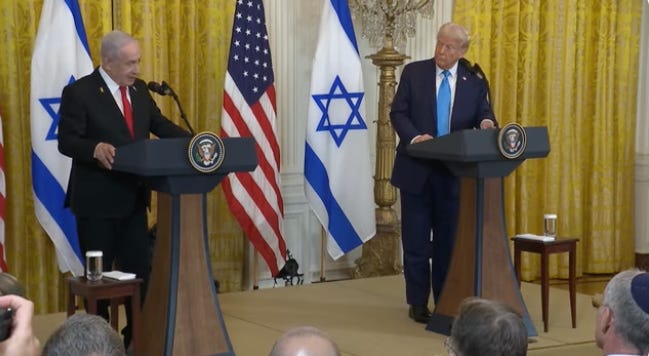
My thoughts went to cryptocurrency, though, in considering President Trump’s plan to turn Gaza into what he called “The Riviera of the Middle East.” Investing immediately in a Gaza real estate venture presents a lot of regulatory obstacles. There’s no clear title to the land. There’s a lot of political risk. There’s execution risk in being able to obtain a site and get construction materials and labor in to build. Anyone promoting such a venture, even in the context of a not-very-aggressive Trump administration enforcement and regulatory environment, would hazard getting in trouble with a state attorney general or the Securities and Exchange Commission or even with the investors themselves, like some early-20th-century seller of Florida swampland.
But the regulatory hurdles in launching a coin are much lower, at least with a crypto-friendly Trump administration in power.
Trump and Melania both launched meme coins in advance of the inauguration. Why not a “Gaza Riviera” coin that would make a U.S. takeover of Gaza an investable proposition? If it becomes a billion-dollar idea instantly, it helps to demonstrate that the concept has a chance to become reality, and is not merely a thought experiment by Trump designed to illuminate hypocrisy or elicit competing proposals. If “Gaza Riviera” winds up with a dollar value that is positive, and that is greater than what anyone is willing to invest in alternative plans, it could lend momentum to the idea and help it advance. Perhaps the funds could be used to make the site usable, or even eventually be convertible to a seaside apartment. Perhaps the Gaza land itself would eventually be sold, or leased, only to those who pay in “Gaza Riviera” coins. The advantage to this over an auction in dollars is that a coin offering could happen almost instantly, while an auction in dollars for Gaza land might not happen until years from now.
Trump’s first-term ambassador to Israel, David M. Friedman, has been touting the Gaza development as “a perfect investment for America’s new Sovereign Wealth Fund.” But the best beachfront developments typically aren’t government projects; they are imagined, built, and owned with private funds. The downside with crypto is that it has an air of a scam, a confidence game, the sketchiness of Sam Bankman-Fried, with his combination of political connections, irresponsibility, and pretensions to altruism and sophistication. Maybe one wouldn’t want to taint the Gaza Riviera idea with any of that, for fear of prematurely torpedoing a proposal with great potential. But if a “Gaza Riviera” coin were launched and immediately found a market valuation greater than, say, the market capitalization of the New York Times Company whose newspaper is insisting that the idea is impractical, it sure would make a statement.
Usually if someone wanted to go raise money for a real estate project, even one dependent on political approvals, they’d just go raise the capital for the real estate project. The twist here is that the investment is not just the real estate project, it’s the policy idea. And usually policy ideas either gain traction or peter out in the abstract marketplace of ideas, not in any electronic wallet. Anyway, given the overlap between crypto investors, the Trump crowd, and those with an interest in Middle East policy, someone more sophisticated or less risk-averse than me may already have a Gaza Riviera coin in the works. The roots of the Middle East conflict run deep into religion, culture, and history, but technology, capitalism, and private property rights may yet be a part of the solution.
Cambridge Historical Commission approves Harvard Chabad project: After a contentious meeting that lasted more than five hours, the Cambridge Historical Commission somewhat grudgingly gave Harvard Chabad permission to demolish one building and move another one to make room for a larger, expanded headquarters. “The community needs a home,” Rabbi Hirschy Zarchi told the commissioners. The project, revised after an earlier go-around with the Historical Commission, now will require additional approvals from the City of Cambridge having to do with zoning.
New York Sun on Trump’s Gaza plan: A New York Sun editorial praises President Trump’s plan to have the U.S. take over Gaza:
What we tend to think of is the potential upside of the gumption on Mr. Trump’s part to try another course. “Lech l’aza,” or “go to Gaza,” has, in Hebrew slang, become a kind of curse, like “go to hell.” Leave it to Mr. Trump to turn it into a blessing….
“God works in very strange ways,” Mr. Trump said at a prayer breakfast this morning. “With God, the scriptures tell us, all things are possible.” The Book of Kings I 5:4 says Solomon controlled the region “even to Gaza … and he had peace on all sides.”
The Gaza Coin model implements a key feature of Differential Diagnosis thinking:
https://www.wsj.com/opinion/whats-trump-trying-to-say-ask-a-doctor-understanding-policy-politics-ff8bad51
"We decide what further information would be useful to distinguish among these diseases, and we ask more questions, do a more-detailed physical examination and order lab tests accordingly."
The coin is analogous to a lab test in medicine - its result gives you information that helps clarify the understanding of reality.
“Lech l’aza” sounds much like “Lech l’azazel”, which does mean “go to hell”.