

Insurers Warn of Post-Election Rioting
Plus, Harvard ROTC students were advised not to wear uniforms on campus

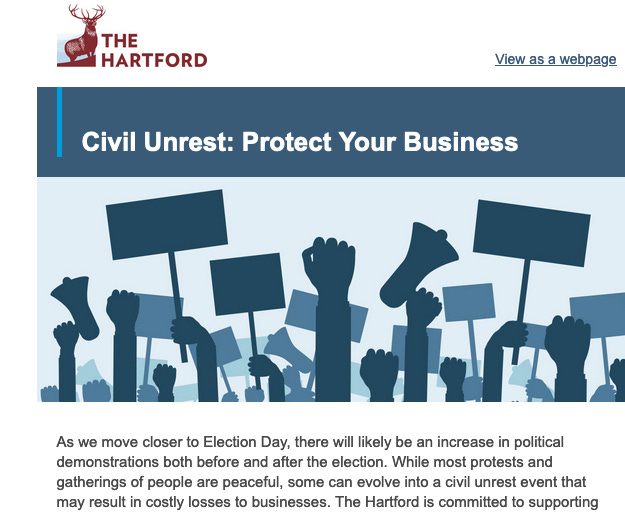
The Hartford, a property and casualty insurance company (HIG), is warning customers about the risk of riots after the U.S. presidential election.
“While most protests and gatherings of people are peaceful, some can evolve into a civil unrest event that may result in costly losses to businesses,” an email to customers says.
The email includes a preparedness checklist for businesses advising steps such as, “Use steel roll-down doors and shutters on windows where possible.” And “Have temporary supplies, such as fireproof and waterproof tarps and plywood, on hand to make emergency repairs if needed.”
Some of this may be an effort by the insurance companies to drum up business by harping on fears. Some of it, though, may be a prudent, market-based assessment of risk.
A report from another insurance company, Allianz, warned of what the report called “election related SRCC [strikes, riots, and civil commotion] events.” It advised, “Review your insurance policies. Property policies may cover political violence claims in some cases but insurers also offer specialist coverage via the political violence market.”
“Any unrest around the November election is likely to be focused on the battleground states as well as the capital Washington DC,” Srdjan Todorovic, Head of Political Violence and Hostile Environment Solutions at Allianz Commercial, is quoted as saying in the report. It warns, “A narrow result, combined with election laws that can lead to protracted counting processes, could inflame tensions.”
An October 28, 2024 client letter from Wood, Smith, Henning, Berman, a law firm, warned, “Businesses located near polling stations, government buildings, or in urban areas prone to political activity must carefully consider exposure to potential damage from protests or riots that could occur in response to election results.”
Harvard ROTC: The Harvard Salient, a conservative student publication, reports: “As recently as this past semester, ROTC cadets were advised not to wear their uniforms on campus due to concerns for their safety during pro-Palestinian protests. …While the university may celebrate the return of ROTC in official ceremonies, the reality is that military students remain a small and isolated group within a larger campus culture that often views them with suspicion, if not outright hostility.”
The passive voice “were advised” is suboptimal here, leaving unclear precisely who gave the advice and whether it was taken. A comment on the article by Michael Segal, the national coordinator of Advocates for ROTC, and a highly credible figure, says, “This advisory was not Harvard-specific, it came from the national ROTC commands, was based on information about possible violent protests, and was in effect for one week.”
If it is accurate that ROTC students nationwide were told to not wear uniforms on campus for a whole week, then it is a grim reminder of how the anti-Israel protests on college campuses disrupted normal educational activities not only for Jewish and Israeli students in the Ivy League but for many Americans on campuses all over the country. When it’s okay to wear a keffiyeh on a college campus but not to wear a U.S. military uniform, something is awry.
Presidential campaign highlights: A couple of moments from the national political conversation that may have gone under-noticed are worth mentioning here. Vice President Harris did a CNN Town Hall in Chester Township, Pennsylvania on October 23. From the transcript:
MR. COOPER: Do you believe Donald Trump is antisemitic?
THE VICE PRESIDENT: I believe Donald Trump is a danger to the well-being and security of America.
MR. COOPER: He has said that he — he’s casting himself as a protector of Israel. Do you believe you would be more pro-Israel than Donald Trump?
THE VICE PRESIDENT: I believe that Donald Trump is dangerous. I believe that when you have a president of the United States who has said to his generals who work for him, because he is commander in chief — these conversations, I assume, many of them took place in the Oval Office — and if the president of the United States, the commander in chief, is saying to his generals, in essence, “Why can’t you be more like Hitler’s generals” — Anderson, come on. This is a serious, serious issue.
And we know who he is. He admires dictators, sending love letters back and forth with Kim Jong Un; talks about the president of Russia. And then, most recently, the reports are that in the height of COVID, when most Americans could not get their hands on a COVID test — Americans were dying by the hundreds a day — he secretly sent COVID tests to the president of Russia for his personal use.
So, again, there — thi- — this election in 13 days is presenting the American people with a very significant decision. And on the one side, on this issue of who is going to model what it means to use the bully pulpit of the president of the United States in a manner that in tone, word, and deed is about lifting up our discourse, fighting against hate, as opposed to fanning the flames of hate, which Donald Trump does consistently — I — I’m going to tell you, we are an incredible country, and we love our country. You all wouldn’t be here unless we love our country. And there are certain things where we’ve just got to come together and realize that — that we do believe in the importance of healthy debate on real issues, but there are certain standards we’ve got to have.
And, you know, another point that even John Kelly talked about, I — I believe, and many have, is January 6th, where you have the president of the United States defying the will of the people in a free and fair election and unleashing a violent mob who attacked the United States Capitol. A hundred and forty law enforcement officers were attacked; some were killed.
And so, I say that to say: The American people deserve to have a president who encourages healthy debate; works across the aisle; not afraid of good ideas, wherever they come from; but also maintains certain standards about how we think about the role and the responsibility; and certainly not comparing oneself, in a clearly admiring way, to Hitler.
I thought it was interesting that, asked “Do you believe you would be more pro-Israel than Donald Trump?,” Harris didn’t say, “yes” or, “I’d be just as pro-Israel as Trump,” or “I’m going to be pro-American, and that means I’m going to back our allies like Israel” but instead pivoted to the topics of Covid tests and January 6.
Also, in an interview on the Tim Dillon show, Senator Vance volunteered that Israel’s interests and America’s sometimes diverge, and insisted, “Our interest, I think very much, is in not going to war with Iran, right?” He went on to accuse “American pro-Israel people, or people who fashioned themselves as pro-Israel,” of being “actually much more militaristic than the Israelis who were living in Israel.”
Vance seems unaware that Iran is already in a war with us; maybe he missed the briefing about how Iran is trying to assassinate Trump and a series of former Trump administration officials. The most generous interpretation is that it is a clever attempt to lull the Iranian regime into falsely thinking they are safe from an American offensive. A less generous interpretation is that the line about “militaristic” “American pro-Israel people” is just a sign that Vance is spending too much time hanging around Tucker Carlson, and not enough time with other people in Trump’s orbit such as Lee Zeldin, Governor Huckabee, or Senators Tim Scott and Tom Cotton.
Thank you: With a few more paying subscribers, The Editors might be able to purchase a steel roll-down door and fireproof plywood to protect our world headquarters from the impending post-election “SRCC [strikes, riots, and civil commotion] events.” If you know someone who’d enjoy or benefit from reading, please send a gift subscription.
It is worth remembering that in 2020 many stores boarded up their windows in the runup to the election. As soon as it seemed likely that Biden would be declared the victor, the boards came down, making it clear that the perception was that violence would come from Biden supporters. But as we learned on the following January 6th, concerns about pro-Trump mobs were justified as well.
The common thread is lack of confidence in election integrity among both Democrats and Republicans. On the day of the Biden inauguration I proposed a measure to improve election integrity: https://www.wsj.com/articles/america-needs-a-national-identity-card-11611183672
On the ROTC issue, I haven't asked national ROTC commanders as to the reason for the national one-week caution on wearing ROTC uniforms on campus, but I'm told it was based on specific "Force Protection" information "from higher headquarters about possible violent protests". I don't know the details, but one can imagine that if there was a perception that the National Guard would be called up to deal with the campus protests, students might have mistaken other students in ROTC for National Guard troops.
Michael Segal '76 MD PhD
National Coordinator, Advocates for ROTC
advocatesforrotc.org