

“If We Have To, We Will Fight With Our Fingernails,” Netanyahu Says
Israeli leader says he and Trump “see eye to eye on the Iranian threat”

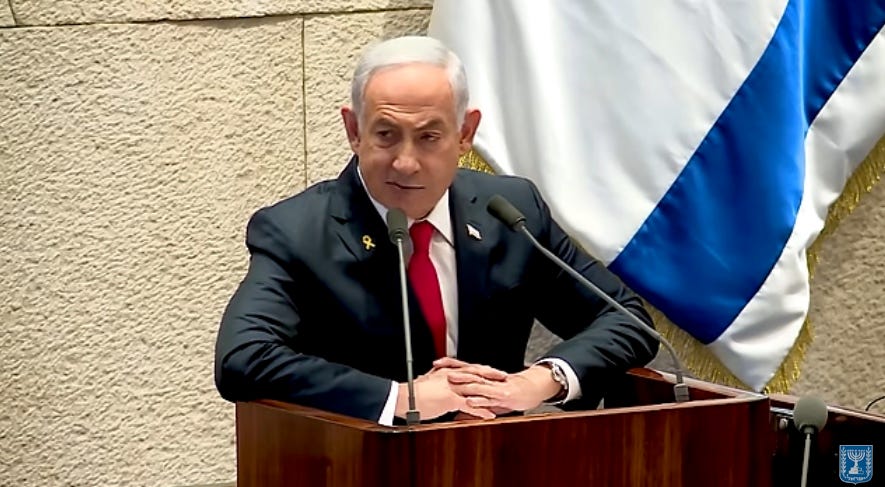
The prime minister of Israel, Benjamin Netanyahu, gave a speech in the Israeli parliament, or Knesset, on November 18. It went largely uncovered in the U.S. press. To my mind, it’s newsworthy, regardless of what one’s personal opinion is of Netanyahu. I consider it illuminating, not only about Israel, but about the U.S. press, which covers developments in Gaza and Lebanon and on American college campuses extensively, but which oddly can’t seem, at least in this case, to find the space to inform readers about what the Israeli prime minister is saying publicly.
The Israeli leader underscored his country’s determination for “absolute victory.” “What is the strategy? The strategy is victory!” he said.
He went public with details of how President Biden and Secretary of State Blinken tried to discourage Israel from going into Rafah, withholding weapons shipments. “I told him ‘Tony, if we have to, we will fight with our fingernails’ — we will fight with our fingernails,” Netanyahu said, comments that are newly relevant again in light of renewed ongoing efforts by some Senate Democrats to withhold more U.S. arms shipments to Israel.
Netanyahu also spoke publicly about Iran. “This war is against one factor first and foremost. This factor is Iran, whose regime has engraved our destruction on its flag,” Netanyahu said, following up on a series of recent public statements about Iran. (Please see, “Zan, Zendeghi, Azadi,” The Editors, November 14, 2024.) Netanyahu said that he had decided to hit Hezbollah leader Hassan Nasrallah, describing him in the speech as Iranian Supreme Leader Ayatollah Ali “Khamenei’s ‘beloved son.’”
And he spoke about U.S.-Israel relations, rejecting “no surprises,” which is sometimes suggested as a guide to the relationship: “If I had said "NO SURPRISES," then we wouldn't have eliminated Nasrallah, and we wouldn't have entered Rafah, or rather we wouldn't have done other things that we won't detail here. There are SURPRISES - we surprise the enemy, and we maintain our freedom of action, and we cooperate as much as we can with our friend the USA.”
Netanyahu said that in his conversations with President-elect Trump, “we see eye to eye on the Iranian threat.” A full, official English-language translation of the Hebrew speech isn’t yet available and, if patterns hold, may not be. Yet thanks to the magic of artificial intelligence a rough and unofficial translation of the complete text is presented here:
I want to begin by sending condolences to the family of our friend, MK Gadi Eizenkot, on the death of his nephew, Kfir Brigade soldier, Yugav Paz, may his memory be a blessing. This is not the first loss in the family. Gadi lost his son, lost a nephew, and this is the second nephew who has fallen. I ask to send from here, I am sure on behalf of all of you, condolences to all the families of our heroes who fell in defense of the homeland. I know what is happening to their lives, which have changed in an instant and will never return to what they were.
We are in a war of revival, and the revival of Israel is purchased by our sons and daughters who risk their lives for all of us, for the eternity of Israel. Since the first day of the war, I have emphasized again and again two powerful words that express everything - the basis of the struggle and the path to victory. The two words are ״יחד ננצח״, "Together we will win." Even if there are those in this hall who reject unity, I believe in togetherness, I believe in victory, and I believe that the two things are inextricably linked. But not only do I believe in togetherness. Not only do I believe in these two words. First of all, the people, most of the people, believe in them. Our heroic fighters believe in them. We all see them attacking with supreme heroism, shoulder to shoulder, on the enemy's strongholds, in Gaza, in Lebanon, everywhere else. They know that we are in a war of revival - a war for the existence of the state, a war for the future of the state.
I want to address from here the families of the abductees, whom, by the way, I meet with, with hundreds of them, all the time. Also with the families of the abductees, and with the bereaved families, and with the victims of the "Nova", who have not been treated properly until today, and we will establish a special administration for them. The efforts to return our abductees do not stop for a moment. The time now is 5:22 PM. Until 3 o'clock in the morning, I sat together with my friends in the small cabinet, ahead of the expanded cabinet, and discussed ways to overcome Hamas's refusal and bring everyone home. We will not give up on anyone, I will not give up on anyone. The more we do, and the less we talk about the details and the ways to return them, the better and the more we will advance their return.
Here is the simple truth, it's not pleasant to hear it, but listen to it: Contrary to what they say in the studios and what they say here in this hall today, Hamas - and not Israel - is the obstacle to a deal. Now everyone knows it. The Americans, who are well versed in every detail of the negotiations, say so. Here is Kirby, spokesman for the National Security Council; Brett McGurk, the US special envoy to the Middle East, says "Hamas is the obstacle." Kirby says "Hamas is the obstacle," the deputy head of the CIA says "Hamas is the obstacle." Only five days ago, US Secretary of State Anthony Blinken said: "Hamas has been the refuser in the contacts since the beginning of the war." "It would be good to see," he says, "real, sustained, and effective pressure on Hamas." And the National Security Advisor, Jake Sullivan, said just a week ago: "It's not Israel that's standing in the way of a hostage deal, but Hamas. It doesn't matter what Hamas says publicly," says Jake Sullivan, "what they tell the mediators all the time is one word - 'no'." "What needs to be done," says Sullivan, "is to get the rest of the world to put pressure on Hamas to agree to a deal."
Kirby, McGurk, the deputy head of the CIA, US Secretary of State Blinken, National Security Advisor Jake Sullivan. I want to confess to you, friends, maybe you don't know. They are not exactly members of the Likud. They are not exactly spokespersons on behalf of. They are telling the absolute truth, which you know. The only place where a false campaign is being conducted on the issue of the abductees - is here in Israel.
We are turning over every stone and trying every initiative, day and night, to return all the abductees, without exception. To date, we have returned 154, 117 alive, and another 37, unfortunately, not alive. We will bring everyone back. We are witnessing countless leaks and endless lies. Leaks from the cabinet, leaks from the negotiating team. And they say "there is a deal, everything is in there". But what do the American spokesmen say? "Likud spokesmen”? 'There is no deal, there was no deal, and Hamas is the obstacle.'" This is one big lie, and the lie continues all the time. It continued yesterday. The flood of leaks.
The US Secretary of State and his National Security Advisor say what we say; that maximum pressure must be exerted on Hamas so that it will withdraw from its impossible demands, which no responsible government can accept. We see the opposite. Yesterday - a leak: "The Chief of Staff, the head of the Shin Bet and the head of the Mossad say that Hamas is not expected to give up its conditions for a ceasefire and Israeli withdrawal from Gaza. Therefore, if the government is interested in a deal, it is necessary to re-examine Hamas's positions." Another "knowledgeable" source adds: "According to the security establishment's assessments, Hamas has not surrendered and Hamas will not surrender."
Now, what do you think this leak, like the other leaks, what do you think this leak does? Does it raise or lower Hamas's price? Does it help the negotiations or harm them? Does it bring the release of the abductees closer or does it distance it? This leak significantly harms the chances of reaching a deal for the abductees, for the release of the abductees. It distances the release of our abductees. Like this leak, there are countless leaks. Leaks that give enormous information to Hezbollah, to Iran, about the discussions, about the arguments, from within the war cabinet - I have not seen anything like this in the history of wars. Leak after leak after leak. I came and called time and time again for investigations into this matter. And I asked: "Why aren't they investigating? How are they not investigating these leaks that give golden intelligence, that cause enormous damage to the State of Israel?"
You ask "Why was there no investigation?" Why wasn't this investigated? Leaks that give information that cannot be described, during a war, to Iran, to Hezbollah, to Hamas? Our tactics in war, our tactics in negotiations, who can even imagine talking more than this? Why wasn't this investigated? I asked, after I claimed and claimed and claimed, and I was told "You must send a letter." So I sent a letter with a selection of terrible, criminal leaks, which harm and have caused enormous damage to Israel's security. I want to see, of course, if this will be investigated. But until this moment no one has been investigated, no one has been arrested, they haven't ruined anyone's life, I haven't found anyone who will say "Good, my death is from my life." They are ruining the lives of young people. One case! And what about the rest of the leaks, these leaks that cause enormous damage to Israel's security. Well, everyone understands what's going on here. Nobody's stupid, the public isn't stupid. We understand, you can say whatever you want. The people are not stupid.
I was asked here about the management of the war, and I ask to respond to the members of the Knesset and also to the public in Israel. This war is against one factor first and foremost. This factor is Iran, whose regime has engraved our destruction on its flag. Iran's power is based on three things: on the axis, on the missiles, and on the aspiration to obtain a nuclear weapon. This is what Iran constitutes. This is the threat. Regarding the axis, we experienced the attacks of Hamas, and the next day Hezbollah, and then the Houthis joined and then others also joined. Of course, the militias in Iraq, in Syria and Iran itself. We faced a fundamental question in the management of the war on October 11th.
The first decision we were required to make after we declared war on Hamas is how to manage the arenas, the convergence of the arenas that we saw, together with Hamas that attacked Hezbollah. The decision we made on October 11th is first of all to deal with Hamas. Not to get entrenched and bogged down in two arenas, where we would not achieve either one. This is what I believed, and this is how most of the cabinet members agreed with me, and this is what we did. With the thought that we could first of all cut off this arm, and then deal with the second arm, and say something else: this is what will be done to those who come and slaughter Jews in the greatest slaughter of Jews since the Holocaust.
Therefore, we set three goals: 1. Eliminating the military and governmental capabilities of Hamas 2. Creating the conditions for the release of the abductees, and I said the release of all
of the abductees, and 3. To ensure that Gaza will no longer pose a threat to Israel. To carry out these goals, we entered Gaza by land. I must tell you, members of the Knesset, that the US opposed, objected, also expressed opposition, it did not threaten, it did not impose sanctions, not at that time, it expressed reservations and suggested that we not enter by land. It said "It is possible to deal with this from the air," it sent experts. We decided to go according to our view and enter inside, a ground entrance.
The US also objected to the entry into Gaza City, to the Shifa Hospital, it objected to the entry into Khan Yunis, but first and foremost it strongly opposed the entry into Rafah. Not only did it oppose the entry into Rafah, President Biden told me: "If you enter, you will remain alone." He said even more than that, he also said that he would stop shipments of weapons, types of weapons that are very important to us, and so he did. A few days later, Secretary of State Blinken appeared and repeated the same things, and I told him in a wide forum, I told him "Tony, if we have to, we will fight with our fingernails" - we will fight with our fingernails.
In light of these difficult things, the US, which helped us a lot at the beginning of the war, President Biden came here, we will not forget that, they also helped us with arms shipments at the beginning, but when we faced such a thing, the question naturally arose: "Should we continue in the face of such difficult things?" And there were those who said we have absolute dependence on the US, and if there is no choice, then we will not enter Rafah. And there were also those who claimed that the war should be ended now "We can always come back". I thought that if we agree to this condition, we will lose all our independence as a state, we will not be able to do anything, every step we want to take, they will threaten us with stopping such weapons or another weapon item, and that this thing is impossible.
We must maintain Israel's independence. We brought this to a decision, and we decided to enter - and we entered and conquered Rafah, and we also conquered the Philadelphi axis and the Rafah crossing. The work has not yet been completed. We eliminated the organized battalions, I think there is one more. It is important. We eliminated a significant part of Hamas' military capability. We have not yet completed this, but we have made great progress. But we also have a goal to destroy Hamas's governmental capability. This thing is the continuation.
I asked the IDF to bring an organized plan to eliminate the governmental capability, which they also linked to the denial of their ability to distribute food, to distribute humanitarian aid. We want to ensure the distribution of humanitarian aid, that it will not be looted by Hamas and others, and of course we want to return the rest of the abductees. These are our tasks in the Gaza Strip. But beyond this, after we completed most of these tasks, and we have not yet finished them, we decided in the cabinet to turn north, and we defined in the cabinet's decision that our goal is to return the residents by significantly reducing Hezbollah's capabilities. How do you do this? When do you do this? My understanding is that it was also backed by one of the heads of the security arms, that we will have to open a powerful campaign, move from active defense to proactive attack in October.
This was the plan, this was the goal, but we were forced to bring it forward, when a special means of ours was about to be revealed. From the moment I learned that this was about to be revealed, I argued that we should act immediately. There were those who claimed that it was necessary to update the US on the move we intend to make. I argued that it is forbidden to update the US, because this thing could have led to either opposition or a leak, which is the same thing. A leak would have immediately revealed the effectiveness of the move. I rejected this outright - and we acted. Now the question was how to proceed. We were faced with three proposals. I thought we should go for a fourth option. To focus on one thing - the reduction of Hezbollah's rocket and missile capabilities. I must emphasize that we meant not only the capabilities of rockets in valleys, but we meant the huge array that Nasrallah built in the private homes of Lebanese citizens.
Nasrallah built a system where there are rockets in every garage and a missile in every living room. The IDF was asked to improve these targets. Within 4 hours, it brought not only an impressive improvement of the targets, it also brought something else - a plan to evacuate these citizens from their homes. We gave the order to go. This operation bore fruit in an exceptional way. Depending on which category we are talking about, but up to 70 even 80 percent of Hezbollah's rocket and missile array was hit, but impressive capabilities still remained, because we are talking about many thousands, but certainly it is not the same Hezbollah that it was before.
And now the question is - what's next? We hit important Hezbollah commanders in the chain of command, but I thought we should also hit Nasrallah. I thought we should hit him because during the process of reading material and delving into the subject, I understood something that I hadn't understood before: I understood that Nasrallah is not only the initiating engine, the driving spirit of the goal of destroying Israel and the thing that unites this organization that he built over 32 years. I understood another thing - I understood that Nasrallah is the axis of the axis. Not only did Iran activate him, he activated Iran. He was the second most important Shiite leader in Shi'ism, Khamenei's "beloved son", and a person who greatly influenced the plan to destroy Israel - to capture us in this ring of fire, to bring about simultaneous invasions and heavy fire on us.
Again, a legitimate debate arose here. A legitimate debate that such an action could of course lead to an expansion of the campaign. To problems that I will not detail here. I told the chairman of the Foreign Affairs and Defense Committee that I would be happy to detail them in the subcommittee. There was a completely legitimate debate, and there was also a second demand. The demand is to update, not to mention coordinate, this attack with the US. Again, with all due respect to our friend the US, I rejected this outright. But there was indeed a real discussion about the first question. This discussion continued for two cabinet meetings. The second meeting was the evening before my trip to the US. There were about 20 hours left until my speech at the UN. I interrupted the meeting, I said - the US, we will not do it. Regarding the second question, I ask to return to you.
On the "Wing of Zion" plane there is a communication system. After two hours I called the Minister of Defense and the Chief of Staff, and said that we need to thwart the man. When we landed in New York, we convened the war cabinet. There was an almost absolute majority. One person thought otherwise, but the entire cabinet mobilized, and we made the decision, it was carried out - and the rest is known. We have continued since then as well. We continue to bring down Hezbollah's towers of terror in Beirut. We continue to eliminate its commanders. We continue, and this is most important, with a ground operation to eradicate the underground strip that is adjacent to our border, which is huge. Every day we discover another part of it. It is huge not only in its dimensions, it is huge in weapons, in the means of warfare there, which are huge and numerous, and if Hezbollah had carried out its plan, we are talking about something that would have been several times greater than the disaster we experienced in Gaza. This thing was of course prevented. We are systematically eliminating this.
There is also a certain expansion on the ground side. We come first of all to take down this strip because it is a necessary condition, it may not be enough, but it is a necessary condition for the return of our residents in the north to their homes. We are currently talking about a possible negotiation for a settlement. The Americans are leading this. I say - this is only done under fire. It is done with a lot of fire. We demand the removal of Hezbollah beyond the Litani. We demand additional demands that I will not detail here, but the most important thing is not the paper, even if there is a paper. The paper, with all due respect, but we will be required in order to ensure security in the north through systematic action not only against Hezbollah attacks that may come, even if there is a ceasefire, no one says that it will last. So it's not just our response, a preventive response, a response following an attack, it's also the ability to prevent Hezbollah's build-up, and we are working on this first and foremost by taking action that prevents armament through Syria. We hit the border crossings. We hit targets inside Syria. We are determined not to allow Hezbollah to return to the state it was in on October 6th, and it is no longer there. But we want to maintain that it is not there and create a security reality that allows our residents to return to their homes.
I said that we are hitting the axis, and I will touch on the second thing - the missiles. Iran launched 300 ballistic missiles against us. This is the largest ballistic attack in history. After the first attack, with the help of our friend the US and several other countries, whose support I greatly appreciate, we were able to intercept the ballistic missiles. Most of the ballistic missiles were intercepted by our forces. Many drones were intercepted by the US and its allies. And again we were told by our friend - "There is no need to respond." "Take the win." Be satisfied with the victory. I said "This is not a victory." If they attack you, and they didn't manage to kill anyone, with the help of God, the fact that you sit and don't respond - that is certainly not a victory. There must be a response. We responded. I will not go into all the details, but we responded. You know the result - one of the four S300 batteries around Tehran was destroyed by us. This did not lead to Iran stopping the attacks on us, we received a second attack. The second attack that arrived, this time was 200 ballistic missiles. They did penetrate. Even here, with the help of God, no one was hurt. We convened again and decided on a combined attack, which includes both STAND OFF means, what are called missiles, and STAND IN means - the entry of planes. We reduced Iran's air defense capability. The three batteries around Tehran were destroyed. Other defense batteries were also destroyed, and we also significantly damaged Iran's ability to produce ballistic missiles, its ability to produce solid fuel, which is fundamental to their war plan and their weapons. In other words, we hit the axis, we hit the missiles. We have not completed this, but these hits are real.
Of course, Iran can respond. It can respond at any moment. Even at this moment. But these hits bring us closer to the goal. But Iran has another option that it is striving for - this option is nuclear armament. Nuclear armament can reverse all the great achievements we have achieved. A nuclear Iran in the Middle East is a huge threat to our very existence, to the peace agreements I believe we can achieve with more of our neighbors, to world peace. We will still be tested in our ability to thwart the nuclear program. It is no secret - it has been published. There is a certain component in their nuclear program that was damaged in this attack. But the program itself, its ability to operate here, has not yet been thwarted. We delayed it under our leadership for about a decade, Iran would have been in the place it is today ten years ago, if not for the actions we took both in the operational field and in the political field. But it has progressed. It has progressed in enrichment. It still has a long way to go in other areas, and the test is on us. On us - on the government of Israel, the State of Israel, on our friend the US. I have had quite a few conversations on this subject with both President Biden and President-elect Trump just recently. The test is on us. Because if we don't deal with the nuclear program, then all the other problems will come back and reappear both on the axis, and in armament, and in other things. Therefore, we are committed to doing this.
We have diverse goals in war. We are promoting them. The achievements are very great, but the challenges are still very great. One challenge that we will not give up on, and it depends on our strength, our cohesion, our determination, our intelligence - is how to extract from these murderers, from Hamas, how to extract from these tunnels the rest of our abductees, and I will not give up on this. Just as they did not believe that we would take out what we took out, and they kept asking "What is the strategy? You are entering Gaza, what is the strategy? Entering Khan Yunis, what is the strategy? Eliminating Rafah and taking over Philadelphi, what is the strategy?". The strategy is victory! The victory includes the release of the abductees, and we will achieve this as well. But there are those who try to crumble the simple truth of "Together we will win." I hear the weakening voices, who constantly sow doubts and gloom. From their point of view, it doesn't really matter, it doesn't matter what the government does, it doesn't matter if we bring - as I believe - we will bring dozens more abductees, I hope in the near future, and this is not a simple decision, because we will be required to make the decision, which I think we have already made. We made a decision that if you can release some - release them.
I thought I was laying out for you the canvas of the entire effort, and how everything fits together. And I also want to again express my great appreciation to the USA, and to say that in my conversations with the President-elect, Donald Trump, I must say - we haven't discussed courses of action, we haven't yet discussed policy. There is time, when the President takes office. But I can say that we see eye to eye on the Iranian threat. I also don't hide from you that even with our friend President Biden, I told you - I thought we needed to preserve our independent ability to act, and I never told him "NO SURPRISES." Because if I had said "NO SURPRISES," then we wouldn't have eliminated Nasrallah, and we wouldn't have entered Rafah, or rather we wouldn't have done other things that we won't detail here. There are SURPRISES - we surprise the enemy, and we maintain our freedom of action, and we cooperate as much as we can with our friend the USA. I say "yes" when possible, and I say "no" when necessary - and that's how we manage it.
We will bring back the abducted. I hear the voices that weaken, that constantly sow doubts and gloom, and you said it doesn't matter what we do. Even when we return them - "So why didn't you bring back more? Why didn't you bring them back sooner?" After all, there's no way to stop the criticism, which is endless and also based on a lie as if the government doesn't want to, or I don't want to bring back the abducted, or I'm not willing to do what's necessary. As if we didn't give the mandate five times, as if the truth that the most senior American representatives said here is that Hamas prevented the deal and no one else. All this truth, these facts don't interest anyone.
The criticism continues and will continue. But for our part, I still ask for togetherness. Maybe not from my friends here in the opposition, but from most sectors of the people. And regarding "we will win" - unfortunately, here too everything is wrapped in gloomy rhetoric, bitter rhetoric. "We won't win, it's impossible to win. What is victory anyway?" Members of Knesset, I adhere to the goals of the war. I adhere to the need to achieve absolute victory. I adhere to the return of the abducted, I adhere to the return of our residents in the north to their homes. I will never raise a white flag, as friends in this house and all sorts of former officials in the studios suggest we do. We have achieved very impressive achievements so far, and first and foremost we have achieved them because of the bravery of our heroes, because of the strength of our people, and also thanks to the perseverance and determination, the steadfastness on our interests and the rejection of pressures. Golani officer, Evri Dickstein, may his memory be a blessing, who fell a few days ago in battle in southern Lebanon, wrote in his heart's blood: "Many like me in the past and present, chose to enlist in the army, to protect the home, the family. We choose to give of ourselves - and like our predecessors - so we stand for the home. When the command 'Forward, charge' is heard - we will rise together. One from Kiryat Arba, one from Herzliya, one from New York and one from Netivot. And we will charge in a straight line without any personal consideration. We all have one country. History has taught us with tremendous pain that the Jewish people have only one place to live. I embrace the families of the fallen, I send a complete recovery to the wounded, I strengthen the families of the abducted. Do not fall into the trap of despair because we will not stop and we will fulfill. For my part, I salute all the regular and reserve soldiers and their wonderful families for their exemplary dedication, and I repeat and say: Together we will fight, and with God's help - together we will win."
The speech had the most impassioned tone I can remember from Netanyahu, which barely comes through in the transcript. This speech was aimed at a domestic audience, and the yelling from opposition Knesset members throughout the speech was remarkable.
As Netanyahu was giving this speech on Monday, I was visiting with friends in Tel Aviv, talking about the situation but not watching the speech. As I watched the video of the speech on Wednesday, it seemed eerily targeted at rebutting many assertions that my hosts were making. But not all - there was no mention of needing to stay in Lebanon until the missiles were eliminated. Then, in an ending that seemed right out of Michael O'Donoghue's "How to Write Good" (https://workableweb.com/_pages/tips_how_to_write_good.htm), as we prepared to leave for the airport for the nonstop flight to the USA, the sirens went off and we spent 10 minutes in the protected room of the apartment listening to the booms from nearby Bnei Brak of a rocket from Lebanon and its interceptors.
The translation was quite good; I checked one of the minor errors and it was not in the Hebrew transcript currently posted. I don't know if the Hebrew transcript was corrected or Google translate messed up.
The final words of Netanyahu's speech channel a fabulous song by Sarit Hadad from the 2014 Gaza war: https://www.youtube.com/watch?v=bfoalLqT45E. After an emotional speech addressing doubts about the leadership of the war, Netanyahu evoked the optimism and determination of this song that is so familiar to his audience.