

Harvard President Starts Academic Year With Talk of Talmud, Chutzpah
Anti-Israel protest at opening convocation as student paper urges boycott of Hillel

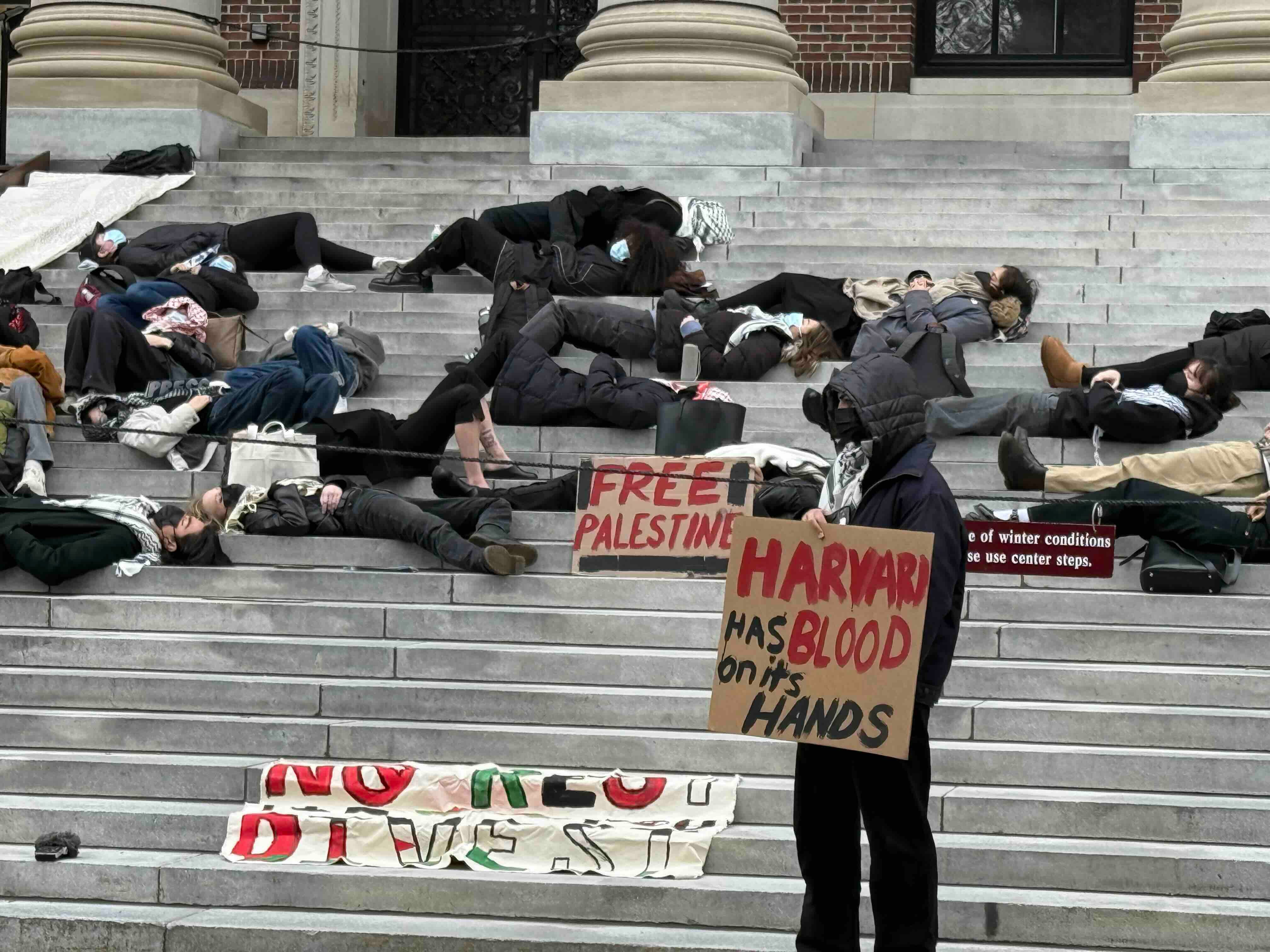
With the federal government withholding billions in research funding from Harvard in part because of the university’s antisemitism problem, the opening days of the new academic year have offered a window into the approach Harvard is taking in handling the issue—and also into that approach’s limitations.
Garber’s Remarks
The university’s president, Alan Garber, used a public-speaking opportunity at the start of the year to cite the Talmud—a foundational text of traditional Judaism—as a model for Harvard at its best. In September 2 remarks at morning prayers, Garber said:
My own religion, Judaism, is built on a foundation of debate and disagreement. The Talmud, at the center of rabbinical Judaism, is an era-crossing record of ongoing rabbinical debate over the meaning of the Torah and its application to every facet of life. In many ways, it is as important as the Torah itself. Following the destruction of the temple and exile, a process of communal discovery helped sustain a religion and an identity for millennia.
My own experience with Talmudic study is limited but illuminating. Learning with a partner, who is both guide and companion—in my case, always someone with far greater knowledge of Hebrew, Aramaic (which I had never learned), and the content of the Talmud—gave me rapid access to Talmudic reasoning, to the role of argument in advancing understanding, and to practices that build a community and bind its members. The patience of my partners taught me the value of persistence.
In remarks prepared for delivery on September 1 at the annual first-year convocation, Garber threw in, untranslated, a yiddishism, the word chutzpah. Recalling his own first year at Harvard College, Garber said:
Almost immediately after I settled into my seat at our first section meeting and we started to review the P-set, one of my classmates blurted out: “When are we going to get some real problems?”
I cringed. Here—in my section—was “that guy.” Was he a physics genius? How did he have the chutzpah to say such a thing?
For longtime observers of Harvard some of this will seem like weak beer. One of Garber’s predecessors, Larry Bacow, was incessantly talking about his Holocaust survivor mother and also had a rabbi deliver, in Hebrew, the priestly blessing at Bacow’s Harvard presidential inauguration. Yet on Bacow’s watch (with Garber as provost) the conditions for Jews and Israelis on the Harvard campus deteriorated while stifling ideological conformity worsened. And, skeptics might point out, some of Garber’s words may be performative, a way of trying to prove, publicly, that Harvard isn’t as antisemitic as its critics claim. After all, its president is publicly dropping Yiddish words and Talmudic references into his speeches. Skeptics might also observe that Garber is doing this while dodging, or artfully avoiding, or embracing institutional neutrality on, the issue where students and professors are genuinely ignorant, that is, Israel’s right to exist as a Jewish state and to defend itself against actually evil Hamas terrorists. And careful scholars might caveat that while the Talmud includes lots of examples of respectful debate, it also includes no shortage of cases where people were thrown out of the study hall or otherwise proscribed for exceeding the acceptable boundaries.
The Recent History
Harvard has a recent history of greeting Jewish and pro-Israel students arriving to campus with hostility rather than warmth.
Formal freshman convocation ceremonies in both 2022 and 2023 were interrupted by Palestine Solidarity Committee activists with an Israel-apartheid banner, setting the tone and giving arriving students a clear message about acceptable campus dialogue on Israel. (I served as a volunteer alumni marshal at the 2022 event and in previous years but have lately started declining that invitation, preferring to spend Labor Day working or relaxing with my family rather than subjecting myself to anti-Israel outbursts).
In April 2023, a Harvard senior, Sabrina Goldfischer, made public her government department senior honors thesis about antisemitism at Harvard College. It described how the First Year Urban Program, a pre-orientation program for incoming Harvard students, had planned a stop on a campus tour of the “bad parts of Harvard” — outside the undergraduate Jewish Center, Hillel. “The training guide instructed tour guides to say that Hillel was unwelcoming to Palestinian students,” Goldfischer reported in her thesis. (The Crimson reports that the First Year Urban Program, an optional pre-orientation program, was substantially overhauled this year to make it more academically research-focused and less activism-indoctrination focused. That’s my own characterization of the changes, not the Crimson’s).
This Year
This year, the anti-Israel activists did not loudly interrupt the speeches at the first-year convocation as they had in years past, but they did quietly hold up banners and pass out printed copies of the Harvard “Crimeson,” denouncing “Israel’s ongoing genocide” and urging students to “join the global student movement working towards a free Palestine, from the river to the sea.” In 2023, then-Harvard President Claudine Gay had said, “our community must understand that phrases such as ‘from the river to the sea’ bear specific historical meanings that to a great many people imply the eradication of Jews from Israel and engender both pain and existential fears within our Jewish community. I condemn this phrase and any similarly hurtful phrases.”
In addition, as the Harvard Class of 2029 gathered on the steps of Widener Library for a photograph, the anti-Israel activists stood in front of them with banners that read “no rest till you divest” and “Israel Bombs, Harvard Profits. Divest” and “All Eyes on Gaza.” There was no activism on display on any other foreign policy, political, or economic issue.
A student newspaper, the Harvard Independent, published an article urging students “do not attend or affiliate with” Harvard Hillel, the Jewish student organization. The article faulted Harvard Hillel for “uncritically supporting Israel, even as that nation-state commits internationally recognized genocide against Palestinians.” The article said of Harvard Hillel, “Unless it undergoes radical transformation, the institution must be avoided.”
I happened to be in Harvard Square over the weekend and Hillel appeared to be packed, so students seem to be ignoring the “do not attend” advice. Even so, it’s hard to imagine student editors publishing a piece urging students to avoid Catholic or Muslim institutions on the campus—or the publication of such a piece passing without widespread and public condemnation.
Harvard did also add new material on antisemitism and Title VI of the Civil Rights Act of 1964 to an online orientation module that has typically covered only Title IX of the Education Amendments of 1972.
Other Campuses
At Columbia, incoming students were greeted by a former encampment spokesman wearing a keffiyeh and holding up a sign that said, “Some of your classmates were IOF criminals committing genocide in Palestine.” “IOF” is a term anti-Israel people use instead of Israel Defense Forces, with the “O” signifying “occupying” or “offensive.” A social media account for Columbia Jewish and Israeli students, which posted a photo of it, called it “Unacceptable conduct from Columbia students on the first day of classes…Telling students to be automatically suspicious of Israelis is textbook discrimination.”
Columbia issued a statement saying it had “initiated investigation” and that “further actions designed to intimidate or harass specific groups of students will not be tolerated and will result in immediate action, including interim measures ranging from campus access restrictions to interim suspensions.”
At the University of Massachusetts in Amherst, the Louis D. Brandeis Center for Human Rights Under the Law sent U. Mass president Martin Meehan and Chancellor Javier Reyes a letter objecting to a November 2025 “Women in German” academic conference to be hosted on the campus with a formal policy that, as the Brandeis letter puts it, “effectively bars Israeli students and academics from attending and participating.” The Brandeis center said it “makes a mockery of the University’s professed commitment to welcoming students and scholars from around the world.” The U. Mass Associate Vice Chancellor for News and Media Relations, Emily Gest, replied to my query about that event with a statement that said in part, “The University of Massachusetts fundamentally opposes academic boycotts of any kind, including the BDS movement. As a public institution dedicated to the free and open exchange of ideas, the university does not condone view-point discrimination, nor does it exclude individuals from participation in academic conferences or events based on their beliefs. Consistent adherence to these principles means oftentimes hosting conferences and speakers with whose views some in our community may disagree.” Gest quoted Louis Brandeis himself, who said, “If there be time to expose through discussion, the falsehoods and fallacies, to avert the evil by the processes of education, the remedy to be applied is more speech, not enforced silence.”
A Trump Effect?
President Trump and his aides have been outspoken that antisemitism on college campuses must stop, and also that they want free speech rather than rigid ideological conformity. On at least some of the campuses that have been the highest-profile battlegrounds, it’s all a work in progress.
Trump is keen to measure progress against the universities by the headline amounts of the settlements. Improvements in campus climate and educational quality are harder to measure. You can look at survey data, but that’s only as good as the survey, and on the basis of an individual institution, it only measures those who are admitted or hired and choose to attend or accept positions. You can count complaints, but the colleges bend over backward to discourage formal complaints and to whitewash violations in cases when formal complaints are filed. The college presidents boast about patents generated, startups spun out, or Nobel prizes won or Rhodes and Marshall scholarships earned, but measuring the productivity of a research university is a perilous project. Perceptive analysts realize that. “Any conception of the university in terms of productivity and output is mistaken,” wrote Kenneth Minogue in his “The Concept of a University” (1973). “Universities have been almost constantly in a state of conflict with much of the society around them. They have been, as far as public reputation is concerned, almost permanently unsatisfactory institutions. Public discussion has been about little else but reforming them.”
No one, least of all me, wants students to go through college without being challenged with ideas or by people they disagree with. But the effort to prevent Israeli students or scholars or staffers from coming to American campuses (at issue in a lot of the previous examples, with the boycott advocacy or the call to avoid Hillel), and sign-holding rather than conversation-having, is part of the problem rather than any indication of healthy debate or enlightening discussion.
Improving these institutions takes constant vigilance, sustained work and relentless striving for academic excellence at all the levels—governance, leadership, faculty, community. People can debate whether the pressure from Trump (or from Bill Ackman) is productive or counterproductive. But it’ll take more than Trump, and more than even Trump and Garber together, to get Harvard headed decisively in a better direction.
The biggest pressure of all is probably the competitive one—for talented students and professors, against competing institutions and against industry. You can say the higher education market is distorted or dysfunctional, or that Harvard is insulated from market pressures by lots of factors, including its endowment. That’s all true. But I heard a lot of Harvard professors and graduates who said “at least we’re not as bad as Columbia,” and a lot of Columbia professors who said, “at least we’re not as bad as Harvard.” Everyone has an eye on what the other institution is up to.
One hears a lot these days that Ivy League types are excessively ambitious, but perhaps one measurable sign of improvement will be when people around these places stop using the phrase “at least we’re not as bad as…” Not that they should return to their previous posture of unalloyed self-congratulation. But “we need to improve, here’s what we have already changed, here’s what we are still hoping to do,” is not a bad outlook on life, for higher education institutions or for anything else, for that matter. So long as Garber is talking from the Jewish religious and cultural and civilizational context, there is another one that might be of use. The back-to-school season coincides nicely with the Jewish annual holidays about atonement, reviewing with clear eyes and humility the long list of sins and shortcomings of the past year and making an actionable plan for doing better in the year ahead.
Thank you: Our own actionable plan for doing better in the year ahead involves getting more paid subscribers. If you know someone who would enjoy or benefit from reading The Editors, please help us grow, and help your friends, family members, and associates understand the world around them, by forwarding this email along with a suggestion that they subscribe. Or send a gift subscription. If it doesn’t work on mobile, try desktop. Or vice versa. Or ask a tech-savvy youngster to help. Thank you!
Would the people who carry signs favoring an Arab state from the river to the sea want to prevent others from carrying signs favoring a Jewish state from the river to the sea?