

Harvard Makes Exceptions to Hiring Freeze to Add Jewish Studies Professors
Raiding USC; Beyond courtroom faceoff, academic talent search moves slowly

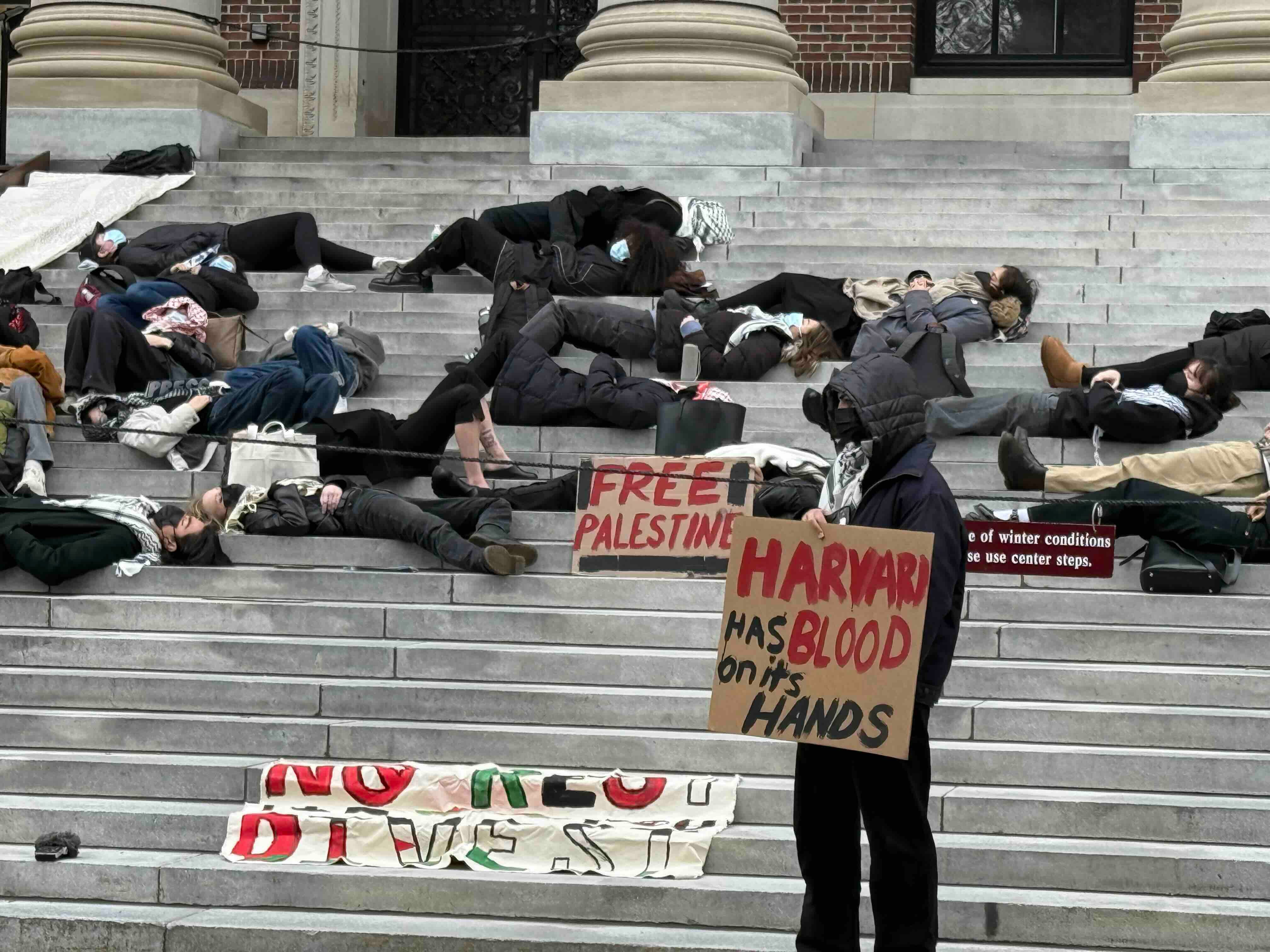
The courtroom faceoff this week between lawyers for Harvard and the federal government over billions of dollars in research funding and Harvard’s antisemitism generated front-page headlines and a social media post from President Trump describing the federal judge, Allison Burroughs, as a “TOTAL DISASTER” and Harvard as “anti-Semitic, anti-Christian, and anti-America.”
Trump said this afternoon in the Oval Office that he’d also cut back future funding of Harvard, an issue the court case doesn’t directly address. “We want money to go to all universities, not Harvard…They’re not going to get very much,” he said.
Yet behind the scenes, and not previously reported elsewhere, Harvard has been quietly and very slowly moving to improve its academic standing in the field of Jewish studies. It once dominated this field, with star professors such as Isadore Twersky, who in addition to serving as the Littauer Professor of Hebrew Literature and Jewish Philosophy at Harvard was also an Orthodox rabbi who served as the rebbe of the Talner hasidic sect. Those professors attracted undergraduates and graduate students.
Harvard’s hiring spree is not quite the academic equivalent of Mark Zuckerberg reportedly wooing artificial intelligence whizzes to Meta from Silicon Valley startups by offering nine-figure offers. But there are certain parallels, starting with the realization by Harvard that if it doesn’t make some high-profile hires, it will fall further behind. Yet Harvard’s hiring differs from private-sector technology companies in that even a well-funded university that is trying with apparent sincerity to improve is moving at what seems to non-academics like a glacially slow pace, and with only mixed success. In comparison to the accelerated and costly legal, lobbying, and public relations effort Harvard has devoted to the research funding court battle, the faculty hiring project is happening on a more leisurely academic timeline, which means some students currently at Harvard may be gone before they benefit from any improvements.
Even that slow pace risks angering other constituencies on the campus. On July 14, Harvard President Alan Garber, Provost John Manning, Executive Vice President Meredith Weenick, and Vice President for Finance Ritu Kalra announced that “the University-wide hiring freeze for faculty and staff will continue, with accommodations for extraordinary cases such as positions essential to fulfilling the terms of gift- or grant-funded projects.” The same letter mentioned “painful layoffs.” With some parts of Harvard laying off staff and most of Harvard facing a hiring freeze, newly arriving Jewish studies scholars may face a somewhat ambivalent embrace from the rest of the university.
Here’s a rundown, with names, of what’s happening, in detail, on the faculty hiring front at Harvard, in Jewish studies:
Harvard has posted a position for a “Tenured Professor in Near Eastern Languages and Civilizations,” "with a specialization in Jewish history, religion, and culture in antiquity and/or late antiquity. The successful candidate must have demonstrated expertise in Rabbinic and other Jewish literatures of the ancient world; facility with the relevant languages; deep knowledge of the surrounding civilization(s) in which Jews were embedded, i.e., some combination of Hellenistic, Roman, Eastern or Western Christian, and/or Zoroastrian; command of relevant disciplines in the Humanities including historical method.” The keywords for the search include “History, Religion, Judaism, Rabbinics, Biblical interpretation, Jewish society, Talmud, Midrash, Magic, Comparative Religious Law.” The contact listed for the search is Jay Harris, an excellent teacher from whom I took a couple of classes while I was an undergraduate. The downside on this position is that, according to the posting, “the appointment is expected to begin on July 1, 2027.” That’s nearly two years from now. If the hire is a replacement for Harvard professor Shaye Cohen, Cohen was “honored at his retirement” on September 27, 2024, and his retirement “has taken effect” on July 1, 2025. Why not start the search sooner to have a replacement hit the ground running with no interruption in service for students, rather than a multiple-year wait? Harris didn’t immediately reply to an email seeking comment.
The Near Eastern Languages and Civilizations website also lists a new-to-Harvard scholar, Jessica Marglin, as Visiting Professor of Near Eastern Languages and Civilizations (Academic Year 2025-2026). Harvard had aspired before the hiring freeze, and apparently still aspires, to lure Marglin to Harvard on a more permanent basis, but she is still also listed at the University of Southern California as the Ruth Ziegler Chair in Jewish Studies and Professor of Religion, Law and History, where she writes, “I specialize in the history of Jews in modern North Africa and the Mediterranean, with a focus on law.” Reached by email, she declined to comment to The Editors. Marglin’s father, Stephen Marglin, a graduate of the Harvard Class of 1959, has been a member of the Harvard economics faculty since 1965.
Part of the issue with closing the deal on bringing Jessica Marglin to Cambridge permanently appears to be her husband, a distinguished scholar in his own right, Nathan Perl-Rosenthal. He has been tagged in the Harvard context with the dreaded academic label of “trailing spouse”—that is, an academic who is less coveted by the hiring institution than his wife. Perl-Rosethal, a son of longtime New Republic art critic Jed Perl, is professor of History, French and Italian and Law at USC. Harvard typically sets trailing spouses up at Boston University, Northeastern, Wellesley or Brandeis, or finds some non-full-professsor job for them at Harvard, but if Harvard is sufficiently slow, condescending, arrogant, and alienating along the way, Marglin and Perl-Rosenthal might just decide after the academic year to return to L.A. where the weather is better and where the deans and department chairs are flexible, friendly, and accommodating rather than rigid. Reached by email, Perl-Rosenthal declined to comment to The Editors.
Then there’s Ruth Wisse’s old job as the Martin Peretz Professor of Yiddish Literature. Wisse retired from Harvard in 2014. A junior professor, Saul Zaritt, was pushed by his colleagues for promotion to that tenured post, but he was blocked in June 2024 by Garber. Instead of launching a search immediately, Harvard has dawdled in posting the vacant position, leaving other institutions, such as the University of Toronto, which offers a masters degree in Yiddish studies, to move more quickly in snapping up the available talent. Some hope that the Harvard position will eventually be filled by Miriam Udel, now at Emory, who could be a strong player. On this one, Harvard appears to be in no rush, as it’s already been more than a decade after Wisse’s departure.
One move that has been reported was that the Harvard Divinity School named Shaul Magid to a five-year renewable post as “Professor of Modern Jewish Studies in Residence, effective July 1, 2025.” Magid has been romantically linked with Annette Yoshiko Reed, who is credited with his photo in the Harvard announcement and who is Krister Stendahl Professor of Divinity and Professor of New Testament and Early Christianity at Harvard. Magid’s November 2023 book “The Necessity of Exile” says “I believe Israel is mired in an increasingly chauvinistic ethnonational project,” and also says, he does not believe “that liberalism and Zionism can be seen as compatible in any easy way.” Magid writes that the book is “in some sense anti-Zionist—or, more precisely, as I suggest below, counter-Zionist.” The first blurb on the book’s Amazon page is from Peter Beinart. Magid has a July 20, 2025, post up on Substack defending a friend of his who is publicly and falsely accusing Israel of genocide in Gaza. As Magid’s example unfortunately suggests, hiring Jewish studies professors doesn’t necessarily translate into an improvement in the tone or accuracy of the campus conversation about Israel.
The overall context is that fewer and fewer undergraduates are enrolling in the history, literature, language and religion classes that these sorts of professors teach. They are choosing instead to take computer science, engineering, and economics, which offer more lucrative and reliable career paths. Even the University of Chicago is reportedly considering a plan to consolidate its 18 arts and humanities departments into eight. Because tenure-track academic jobs in these fields are so scarce, and the academic programs are ranked in part on whether graduate students get jobs, Harvard’s central administration has capped the numbers of graduate students that senior Harvard scholars in Jewish studies can take on. So Harvard’s story is partly a national story of decline of these fields.
And, as in other industries and even in politics, the baby-boom generation is slowly and in some cases grudgingly retiring and giving way to a much younger cohort. Because of a court case that eliminated mandatory retirement ages for college professors as “age discrimination,” turnover can be slow. Harvard administrators and professors are fond of pronouncing that this problem can’t be fixed overnight. And haste isn’t appropriate if Harvard is to be saddled with newly tenured hires for 50 years at a time. Yet during the transition period, it can feel like the boat is taking a long time to turn around, if it’s turning at all.
Know someone who would enjoy or benefit from reading The Editors? Please help us grow by forwarding this email along with a suggestion that they subscribe. Or send a gift subscription:
The realization by Harvard that if it doesn’t make some high-profile hires, it will fall further behind who in what?
Does anyone know if the Magid appointment at the Divinity School requires the assent of Alan Garber?