

Duncan Kennedy Is a Perfect Example of Campus Israel-Hate
Plus, Biden’s $64 million anonymous donor; economists define newsworthiness

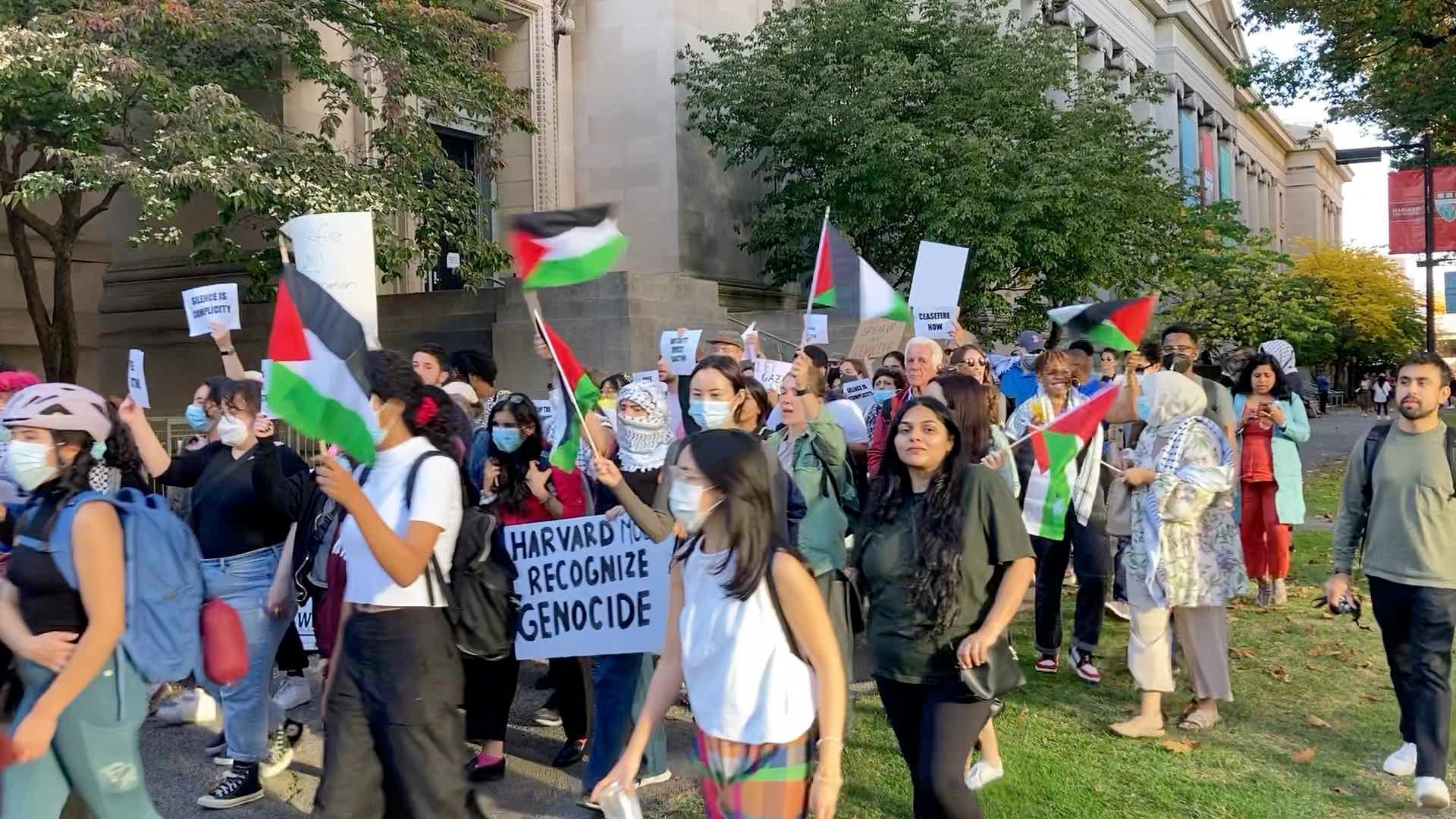
The Carter Professor of General Jurisprudence, emeritus at Harvard Law School, Duncan Kennedy, may be the perfect topic for The Editors. He brings together in one package so many of our regular themes—the failures of higher education and the failures of the press when it comes to free enterprise, religion, and America’s role in the world.
Kennedy has been on my radar screen for a while, but he landed on it again with a new piece in the Crimson headlined “Is Israel an Apartheid State?” He could have skipped the question mark, because his claim clearly is that it is.
Kennedy’s article is full of false claims. For example, he asserts, “the apartheid accusation is rarely discussed in the mainstream media.” That is simply inaccurate; a search for Israel and apartheid in the New York Times, for example, generates more than 300 results for the past five years. He refers to “approximately 700,000 Israeli settlers” in the West Bank; the actual number is more like 500,000, and the larger number is only attained by adding in Israeli residents of eastern Jerusalem, including neighborhoods, like the Jewish Quarter of the Old City, where Jews have lived for many centuries. He refers to “the basic legal structure of separation and domination in the West Bank, which is effectively race-based (Jewish vs. Palestinian).” Yet Jews are not a “race,” and in fact the distinctions that Israel draws between Israeli citizens of any race or religion and noncitizens are similar to those drawn by America at our own border crossings or in our own territories.
What’s nice about Kennedy’s case, though, is that there is such ample biographical information about him available online that it makes it easy to trace where the errors and the radicalism come from. In a 2022 podcast, he tells the story of his education at Shady Hill School, Phillips Andover, Harvard, and Yale Law School. His step-mother Mary Brewster Kennedy was the sister of Yale president Kingman Brewster Jr. He describes himself as an atheist. “It’s not like there’s a conflict between your elite background and your radicalism. The elite background is what constitutes the context, causes, generates, feeds your radicalism,” he explains, talking about one of his Shady Hill School teachers but in language that could have been about himself.
In an interview published in 2015, he explains how he started a Marx Study Group at Harvard in the 1970s and read Karl Marx’s essay “On the Jewish Question.” “Marx’s theory of conflict as the motor of history, class struggle, ideology critique, and his exquisite polemical historical writings, especially ‘On the Jewish Question’, were foundational for my work,” Kennedy explains. That “On the Jewish Question” essay includes Marx’s infamous line, “Let us consider the actual worldly Jew…What is his worldly God? Money. …Money is the jealous god of Israel, in face of which no other god may exist.”
In another interview, conducted in 2014, Kennedy confessed that he hadn’t been to Israel since 1992 or 1993, and dilates on this theme of Jewish money: “you can’t underestimate everything from inter-marriage to the general social integration of educated, relatively wealthy Jews into the system, but also their own experience of Jewish success. So their paranoia about anti-Semitism is way, way down. They actually are likely to say, ‘we are fucking rich. Wow.’”
In the same interview, Kennedy attacked Sheldon Adelson, a politically active philanthropist and businessman, blaming Jews themselves for bringing on anti-Jewish hate: “They don’t seem to realize that Las Vegas casino owners…if there is a form of money which is disreputable in American culture—it is that. So it’s inviting anti-Semitic stereotyping.”
One of Kennedy’s works proposed, as he summarized it, “equal pay for everyone, random admissions for law school, equalization of law schools by random assignment of professors within a given geographical area.”
The “equal pay for everyone” plan sure could help to cure the problem of rich Jews.
Kennedy’s piece for the Crimson argues against what he says is an overly expansive government definition of antisemitism that would penalize calling Israel racist. One can certainly understand why Kennedy would be concerned about the definition of antisemitism.
The nice thing about this particular story, though, for our purposes, is that it shows how the Jew-hate and the anti-meritocracy and the anti-capitalism and the disregard for truth all travel together, and how news organizations (in this case, the Crimson) and universities (in this case, Harvard) all too frequently enable and elevate the weak ideas rather than subjecting them to withering scrutiny.
The $64 million question: CBS News reports on what it calls a “$64 million mystery,” a “single anonymous donation” that helped Joe Biden defeat Donald Trump in 2024. “Most speculate the money originated with a single, super-wealthy Biden supporter. But it could also have come from a privately held company or a shell corporation,” the article says.
Anonymous political speech, and thus, campaign spending, falls under the First Amendment’s protections of political speech, notwithstanding occasional claims by the campaign-finance-regulation crowd that the policy interest of preventing corruption outweighs the free speech rights. Yet even if such spending should be and is legal, it’s an interesting question, largely unexplored in the CBS article, whether Biden himself, or the president’s inner circle of aides, knows who spent the $64 million. If he does, he might also have some ideas about what issues that donor is most keenly interested in, and what, if anything, Biden might have to do on those issues to earn another $64 million, or more, this time around.
Veepstakes: President Trump’s vice presidential search is zeroing in on Senators Rubio, Vance, and Tim Scott, and on North Dakota Governor Doug Burgum, NBC News reports. ABC News says the Trump campaign has asked those four for materials, and adds Reps. Byron Donalds, Elise Stefanik, and Ben Carson, who was secretary of housing and urban development in the first Trump administration.
Economists define newsworthiness: Four economists are out with a new National Bureau of Economic Research working paper, “What Is Newsworthy? Theory and Evidence,” that makes some interesting methodological contributions to the issue of measuring media bias.
The economists—Harvard’s Luis Armona and Jesse Shapiro, the University of Chicago’s Emir Kamenica, and Stanford’s Matthew Gentzkow—used a database called the Vanderbilt Television News Archive, which has the ABC, CBS, and NBC evening newscasts from 1968 to 2013. They looked at how the newscasts covered unemployment, the stock market, weather, and combat deaths in Afghanistan and Iraq.
They use a measure called a “continuous ranked probability score” that predicts whether a topic will make the news. They also identify two kinds of bias. One, they call, “realization bias,” when “the outlet treats different realizations with the same score differently. We focus on the propensity to report negative unemployment news more than positive unemployment news.” Another, they call “domain bias,” when “the outlet treats different domains differently, holding constant the score. We focus on the propensity to report on US military casualties in Iraq more than those in Afghanistan.”
The paper says the model of “benevolent, selective reporting”—when news gets reported because it varies surprisingly from what an audience or the decisionmakers would ordinarily expect—”provides a useful benchmark or control variable for future studies of biased reporting in the news and other domains.”
For example, if you were trying to figure out if the press was biased in emphasizing joblessness news when Republicans control the White House, or being unduly alarmist about weather reporting to push a climate-change-response agenda, or pushing an anti-war agenda, you might use this model as a baseline to measure departures, rather than starting from some zero-coverage-based assumption. They found the stock market is on the news more when it goes up or down a lot, all the more so in a period of low volatility. And there’s more weather coverage when the precipitation level varies from usual. What gets on the news is what departs from expectations. George Gilder says “information is surprise.” That turns out to be pretty close to the definition that the nightly newscasts adhered to on the topics the economists looked at.
One fun way to use this model might be to look at change at an outlet—say, the New York Times, or the Washington Post—over time, to see whether the coverage strays from what is predicted by the model.
I confess to being a little cynical/skeptical the other day when Harvard historian James Hankins wrote:
A president of Harvard also has the power to use the university’s extraordinary resources in public relations to foreground the work of its best scientists and scholars. He or she can make sure the world knows the wonderful things that are being done by our faculty and researchers. If the news coming out of Harvard is about its scientific and scholarly achievements and not about its political stances, public attitudes will change.
I wrote privately, “the idea that everyone would love Harvard if the university PR machine just got out word of all the fantastic scholarship of the professors seems a bit unrealistic… some portion of the professors seem to be mainly working on finding new ways to show how terrible America is…the less the general public finds out about that, the better off Harvard’s reputation will be.” The economics research on media bias seems, to me, at least, promising, and potentially the sort of thing that might help Harvard’s reputation (and Stanford’s, and the University of Chicago’s) rather than hurt it. It’s not curing cancer or winning World War II, but it’s not nothing, either.
Thank you: If you find something surprising or unexpected in The Editors, please help us keep meeting our responsibilities by becoming a paying subscriber. We aren’t anywhere as prosperous as Duncan Kennedy imagines us to be, but we have aspirations.
And please consider sharing the newsletter with someone else who might enjoy signing up for it.
Agree about Duncan Kennedy, who taught two generation of adoring students to be as radical as he is. Re: Hankins, the premise is that Harvard would choose a sensible person like John Manning who wants to depoliticize the place and will make some outstanding appointments that set the tone. That's how Niall Ferguson became a prof at Harvard 20 years ago.