


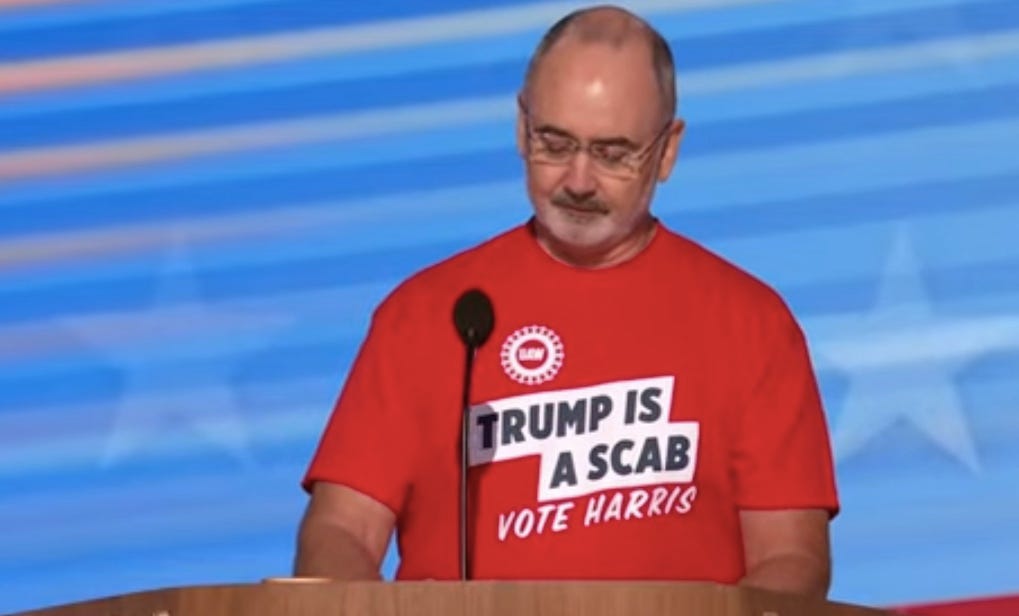
Even the Democrats are starting to sour on “elite” higher education, if the first day of the Democratic National Convention is any indication.
Rep. Joyce Beatty, a Democrat of Ohio, said, “JD Vance likes to talk about how he's from Ohio but as soon as he could, he ran away to Yale and Silicon Valley, cozying up with billionaires.”
The president of the United Automobile Workers, Shawn Fain, talked about the UAW workers at Cornell University “fighting corporate greed.” By “corporate greed,” he meant Cornell.
And in the biographical video introducing the story of Kamala Harris’s youth and origins, the video described her as coming from “East Bay.” The word “Berkeley” was not uttered. It’s as if Harris is embarrassed to admit she is from there. People in the San Francisco area do talk about the “East Bay” as the region that includes Oakland, Berkeley, Piedmont, Orinda, Emeryville, and the like, but it was hard to avoid seeing it as in intentional effort to obscure Harris’s connection to the home of the flagship campus of the University of California, a place known for high-powered academics and also for its radical or “progressive” political leanings.
The Democrats may figure they already have the college professor and college-town vote locked up already with demographic trends (college-educated voters have been trending Democrat in recent years), student-loan forgiveness, abortion rights, and other policies. So their convention messaging is aimed at the same “working class” voters in Michigan, Pennsylvania, Nevada, Arizona, North Carolina, Georgia, and Wisconsin that Trump and Vance are trying to win over.
It is an interesting situation though. With Kennedy and Nixon the Democrats were the Ivy League intellectual types and the Republicans were not. Now the Republicans are running two Ivy League guys (Trump of Wharton and Vance of Yale Law, which Trump mentions first thing whenever Vance comes up for discussion) and the Democrats are running Harris (Howard and U.C. Hastings law) and Walz (Chadron State College, Minnesota State University, University of Houston).
Not many people on the Ivy League campuses will be confused—they’ll be voting for the Democrats. But it says something about the declining prestige and public image of these universities that the Democrats are joining in the public bashing of them rather than rising to their defense.
What the Wall Street Journal News Section Won’t Tell You About the Philadelphi Corridor: The Wall Street Journal recently carried a news story headlined “Netanyahu, Sinwar Are Hurdles to Deal.” The newspaper reported, “On Wednesday, ahead of the summit, an Israeli official said Netanyahu insisted that Israeli troops must remain in the Philadelphi corridor, the 9-mile border zone between Egypt and Gaza. That position is anathema to Hamas and goes against the recommendations of Israel’s security establishment, which has said it isn’t necessary.”
If you relied only on the Journal news article, you’d think that an Israeli presence in the Philadelphi corridor is just an unreasonable demand injected by Netanyahu to throw a wrench into the ceasefire talks. The paper doesn’t explain why that position is anathema to Hamas. The reason is that it would cut off the terrorist organization’s supply of weapons smuggled in by tunnels from Egypt.
Even the New York Times, which is not exactly a pro-Netanyahu newsletter, did better on this than did the Journal. A Times article quoted a retired Israeli major general, Yaakov Amidror, now a fellow at the Jewish Institute for National Security of America. “If Israel evacuates its forces now, within a year, Hamas will be strong again,” Amidror said. The Times, unlike the Journal, also explained that “Israel used its occupation of Rafah to cut off tunnels between Egypt and Gaza, a critical weapons supply route for Hamas.”
A former national security aide to Vice President Cheney and retired U.S. Navy Reserve Lieutenant Commander, David Wurmser, posted that the corridor “is essentially the strategic watershed. If Israel holds it…Hamas dies. Without it, it’s only a matter of not much time before Gaza returns to Oct 6 & Israel faces another, far more terrible war.”
A second Journal article, today, also mentions the issue of the corridor and the tunnels, while omitting the key point that they are Hamas’s source of weapons:
Other significant obstacles to a deal include Israel’s demands that it retain some forces at the Philadelphi corridor, a 9-mile border between Egypt and Gaza that Israel took over in May, and for an international body to screen Palestinians returning to northern Gaza. Egypt is committed to Israel’s complete withdrawal from the corridor and the Rafah border crossing with Egypt, a senior Egyptian official said late Monday.
Israel is also pushing for a wall to be built on the corridor to prevent Hamas from digging tunnels and wants access to feeds from cameras and sensors monitoring the area, Arab mediators said. An Israeli technical team wrapped up meetings with counterparts in Cairo to discuss the corridor and Rafah, with little progress, according to mediators.
Israel had cameras and sensors on its border fence with Gaza on October 7, and they proved not to be of much use.
Some people say Israel could withdraw from the Philadelphi corridor to get the hostages returned as part of a ceasefire deal, then retake it again after the hostages are back home. But if Egyptian, American, or other forces are stationed in the area after Israel’s initial withdrawal, retaking it could be not so simple. There’s no reason to believe that Egyptian officials who had been profiting from the smuggling operations would not revert to their earlier practices.
Anyone failing to grasp the significance of the issue might benefit from checking out the photos and videos posted by the military reporter for the Times of Israel, Mannie Fabian, who says the Israel Defense Forces found “more than 50 tunnels,” including at least one “big enough for vehicles to pass through.”
I’m not saying this issue should torpedo a deal for a ceasefire and hostage return—that’s for Israel’s elected government to decide, not for me sitting in America. Getting the hostages back is an Israeli war aim and something for which a lot of people, myself included, have been praying.
Yet for American politicians or journalists or protester-activists or professors to ignore or disregard this concern about weapons-smuggling from Egypt to Hamas, or to press Israel to overlook it, is foolish. Look at the situation on Israel’s border with Lebanon, where a supply pipeline from Iran and Syria has allowed Hezbollah to build up a vast arsenal of reportedly 150,000 rockets, missiles, and drones. Allowing any version of that in Gaza would be a disaster, a giveback of the gains achieved at great cost by Israeli soldiers in fighting over the past year. As I wrote back on August 1, “what the Hamas guy means by a ‘ceasefire’ is what looks to Israelis like an Israeli surrender.”
Even a ceasefire in Gaza that leaves Hezbollah armed and in place in Lebanon puts Israel in the position of not able to return its 80,000 citizens safely to their homes in the north. America has been trying to connect the ceasefire and hostage deal in Gaza with a ceasefire in Lebanon or against Iran, where Israel has an opportunity now to make gains. Some Israelis say it is a mistake to connect the two. “The war to stop means Israel will lose the war,” an Israeli brigadier general (reserve) Amir Avivi, who is founder of the Israel Defense and Security Forum, said this morning. “We need to win the war, not stop the war.”
University of Florida Hires: The University of Florida’s Hamilton Center for Classical and Civic Education is hiring three new professors—Princeton’s Allen Guelzo, the Wall Street Journal’s Walter Russell Mead, and Charlie Laderman from King’s College in London. It suggests that the University of Florida will be gaining in status and in representation of non-left-wing faculty even after Senator Sasse’s stepping down as president.
Changes in higher education can take a long time—Guelzo and Laderman won’t even be joining the University of Florida until summer of 2025, a year after the announcement. And it’s not so clear how, or if, the “Hamilton Center” interacts with the other departments on campus. Some conservative higher education reformers oppose the idea of separate centers, preferring to place the non-left-wing professors directly into the mainstream history or political science departments or other relevant departments, where, the argument goes, they are more integrated into the intellectual life of the university, and less isolated.
Program notes: I ran into some tech trouble last night that delayed the delivery of this newsletter. Sorry for the temporary interruption in service. If you appreciate this newsletter, please share it with others and help us grow.
And if you’ve made it this far and aren’t yet a paying subscriber, please, if you can spare the $8 a month or $80 a year, join today to assure your full continued access, support our growth, and sustain our independent journalism.
Excel;lent piece on WSJ--and its increasingly flawed reporting. Onthe Hamilton Center in Florida, I noticed that Walter Russell Mead has an article in the new Foreign Affairs which seeks to revive a Hamiltonian tradition in US foreign policy.