

Dartmouth Advertises for Jews While Columbia Task Force Pushes Hiring Zionist Professors
Mamdani: “Antisemitism has become a code word....Antisemitism is about disciplining us”

There’s a lot of action on the story of Ivy League universities attempting to course-correct in response to various pressures from Congress, the Trump administration, and concerned alumni, parents, students, donors, trustees, and faculty. This report includes mentions of developments at Columbia, Harvard, Yale, Dartmouth, and Brown, among other institutions.
At Columbia, the Columbia University Task Force on Antisemitism—cochaired by Ester Fuchs, Nicholas Lemann, and David Schizer—yesterday released its fourth report, this one on “The Classroom Experience at Columbia: Protecting the Academic Freedom of Faculty and Students.”
Some highlights: “Intellectual Diversity on the Middle East: We heard from many students that an academic perspective that treats Zionism as legitimate is underrepresented in Columbia’s course offerings, compared to a perspective that treats it as illegitimate. The University should work quickly to add more intellectual diversity to these offerings. Columbia would benefit from full-time tenure line faculty expertise in Middle East history, politics, political economy and policy that is not explicitly anti-Zionist. We recommend the University address this imbalance through the establishment of new chairs at a senior level in Middle East history, politics, political economy and policy.” Later on, the report says that Zionism isn’t just “underrepresented,” it’s absent: “Columbia lacks full-time tenure line faculty expertise in Middle East history, politics, political economy, and policy that is not explicitly anti-Zionist. This is an important gap in the University’s academic capacity, which should be addressed through the establishment of new chairs at a senior level in Middle East history, politics, political economy and policy. Columbia is missing an opportunity for leadership here; correcting that should be an urgent priority.”
“No Boycotts: Academic freedom entails openness to scholars and students from other countries. As such, boycotts of faculty, students, researchers, or scholars from other countries are not consistent with academic freedom.”
“Since a fundamental mission of a university is to educate students, their rights must be protected. From the beginning, academic freedom has been understood as pertaining to students as well as faculty members; in the terminology of the German inventors of the concept as we know it, its two key components are lehrfreiheit and lernfreiheit, the freedom to teach and the freedom to learn. These freedoms are equally important. The power imbalance between instructors and students makes it imperative that a great university guard against singling out or unfairly treating students in academic settings because of their identity or their views. Classes should not stray from openminded intellectual exploration into indoctrination—even, or especially, in service of what the professor believes to be a morally urgent cause.”
The report speaks of the need “to avoid a politicized classroom,” quoting the Columbia Faculty Handbook: “Faculty should confine their classes to the subject matter covered by their courses and not use them to advocate any political or social cause.”
The report also describes some things that have occurred at Columbia: “The most flagrant recent violation of academic freedom at Columbia came when a group of student protesters entered an in-progress class taught by a visiting Israeli professor—one of a limited number available to students who did not want to study the Middle East only from an anti-Zionist perspective—and attempted to prevent it from proceeding. Students in the class reported the student protesters appeared to have targeted the class precisely because it was designed to study Zionism, rather than merely to condemn it—and because of the national origin of the teacher.”
And: “one Israeli student was told, ‘You must know a lot about settler colonialism. How do you feel about that?” Another, a veteran of the Israel Defense Forces (IDF), like the vast majority of Columbia’s Israeli students (Israel requires most of its citizens to serve in the military), told us she was called an occupier. Such events occurred even prior to Oct. 7. An Israeli student who served in the IDF attended a class, which included discussions about the conflict. The student said when the IDF was discussed it was presented as an army of murderers. The instructor pointed at the student (in front of the class) and said since she had a combat role in the IDF, she should be considered as one of the murderers. Another—Jewish, not Israeli—student reported being told: ‘It’s such a shame that your people survived in order to commit mass genocide.’”
The task force report says, “These are fundamentally not teaching behaviors that arise from scholarly values. True academic freedom would prevent them, not protect them.”
Also, “We heard about an especially egregious incident in a required introductory course at the Mailman School of Public Health, which more than 400 entering students were required to take. The teacher told the students three of the school’s major donors, who were Jewish, had made their gifts with the aim of ‘laundering blood money.’”
Also, “We heard about a student with an exam scheduled on Yom Kippur, which is the holiest day of the year for religiously observant Jewish students. When the student asked the director of the program for an accommodation, the student reportedly was encouraged to take a leave of absence instead of missing exams and classes because of holidays—even though University policy requires instructors to accommodate religious observance in this situation.”
Also, “many Jewish and Israeli students told us about teachers who introduced a harsh moral condemnation of the state of Israel into a class where that is not obviously pertinent to the topic being taught.” For example, “An introductory class on astronomy began with a unit on ‘Astronomy in Palestine,’ in which, as the class’s syllabus put it, ‘as we watch genocide unfold in Gaza, it is also important to tell the story of Palestinians outside of being the subjects of a military occupation.’ A student reported that during a vocabulary exercise in an introductory Arabic class, the teacher proposed this sentence: ‘The Zionist lobby is the most supportive of Joe Biden.’ A student told us in a class on feminism, the professor opened the first session by announcing it had been 100 days since Israel began waging war on Gaza. We heard similar reports, where harsh condemnations of Israel were made a central element of classes in ways that blindsided Jewish and Israeli students, in a class on photography, a class on architecture, a class on nonprofit management, a class on film, a music humanities class, and a Spanish class.”
Also: “We are angry and heartbroken that members of the Columbia community (including some members of the faculty) would condone (or even celebrate) terrorist atrocities, deploy antisemitic tropes, and peddle bigoted stereotypes. These statements have been appalling and we condemn them.”
The Columbia task force is strong, but the question is whether the institution as a whole takes the recommendations onboard or rejects them. Not a good sign is this, in the Columbia Spectator student newspaper, from Mahmoud Mamdani, a Columbia professor who is the father of mayor-elect Zohran Mamdani, appearing the same day as the task force report: “I think the sort of policing of the classroom began with the Middle East and antisemitism. But antisemitism has become a code word. It’s got nothing to do with antisemitism. It’s a code word, like anti-communism was a code word in the 1950s. Antisemitism is about disciplining us, getting us to do what we are expected to do.”
At Harvard, an event demonizing Israel by the François-Xavier Bagnoud Center for Health and Human Rights was the topic of a November 18, 2025 article by Robert Friedman here at The Editors (“‘Unbridled Brutality’ of Israeli ‘Genocide’ Is Denounced at Harvard Public Health Event”). The positive news on that front is that the dean of the Harvard T.H. Chan School of Public Health, Andrea Baccarelli, on December 9 announced a long-overdue reset of the FXB Center: “going forward, FXB will focus on children’s health—particularly during early development, when children are most vulnerable.” Also, “As part of this transition in focus, effective Jan. 9, 2026, Mary T. Bassett will step down as director of the FXB Center after seven years in the role.”
At Yale, a doctoral student, Morgan Kneusel, publishes an opinion piece in the Daily News calling for restricting conservative speech on the campus. “I’m sick of hearing ‘free speech’ be used as a blanket excuse to promote or condone hate, fear and violence. …If the goal ‘is trying to understand, really, the full range of views and critiques,’ as professor Beverly Gage told the News, then might I suggest student discussions or literature and news reviews or any of dozens of alternative academic exercises that don’t offer people like Gov. Ron DeSantis, Douglas Murray and [Ethics and Public Policy Center president Ryan] Anderson a stage, or condone their presence on said stage. Normalizing their speech permits everyday people to grip their prejudices tighter.”
She writes: “I anticipate that the aforementioned figurative pens, though perhaps a different subset of them, will claim that I’m being hypocritical — that I’m intolerant toward the Buckley Institute’s students. In a sense, they’d be right….I don’t see anything worth trying to tolerate.”
At Dartmouth, President Sian Leah Beilock announced plans to expand the ROTC program and double the number of undergraduate military veterans on the campus. The student newspaper, the Dartmouth, reports:
Dartmouth has the smallest ROTC presence among the Ivy League colleges, with an average of 15 to 20 cadets enrolled in the program at a time, according to Dartmouth News. This year, however, the total ROTC program doubled to 32 cadets, 27 of whom are enrolled from the classes of 2028 and 2029.
According to Dartmouth ROTC program director Ian Short, the 2029 freshman ROTC cohort is the largest freshman class since the Vietnam War.
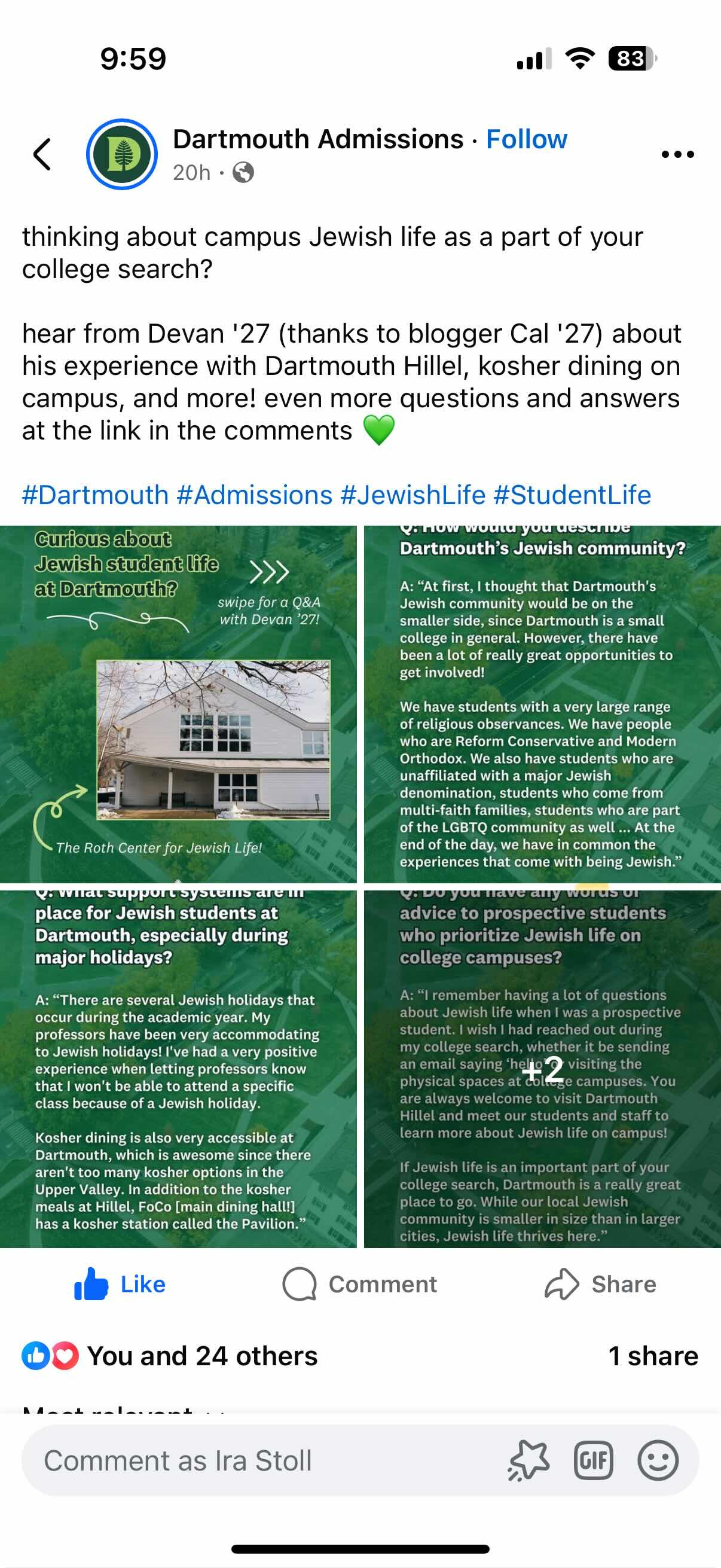
I’ve also noticed social media posts from the main Dartmouth Admissions social media account: “thinking about campus Jewish life as part of your college search? Hear from Devan ‘27..about her experience with Dartmouth Hillel, kosher dining on campus, and more!” A series of slides show questions and answers on topics such as, “What support systems are in place for Jewish students at Dartmouth, especially during major holidays?”
At Brown, the university’s main social media account posted a recap of what was described as “a historic gathering” that “celebrated 130 Years of Jewish Life at Brown. This event united over 1,000 attendees—including alumni from class years across eight decades, students, faculty, and staff—in honoring the accomplishments and impact of the Jewish community.” As Ellen Ginsberg Simon wrote in the Times of Israel, “At some point during Shabbat dinner, between the ridiculously decadent noodle kugel and Robert Kraft’s talk about combatting antisemitism in a tent pulsing with over 1,000 Jewish Brunonians – or Jewnonians, as we say – I realized that my alma mater has become the Jewish Ivy.” She went on, “At an alleged 24 percent (full disclosure – I have no means of independently verifying this, but I heard it repeatedly all weekend), Brown now boasts the highest percentage of Jewish students in the Ivy League. Mind you, most of the other Ivies actively have been excluding Jewish students for the past decade, so the competition is not exactly stiff.”
There are a lot of separate themes to put together here relating to quality and to nondiscrimination and to academic freedom and to community and to competition and choice and the market for higher education. Some of those themes relate specifically to Jews or Israelis, some to broader issues of diversity and political or ideological bias on campuses.
The Ivies get disproportionate attention, but one of the big stories of the past few years has been the flow of talent to non-Ivy institutions including Washington University in St. Louis and Vanderbilt (which issued a joint statement of principles), as well as to places such as UChicago, Johns Hopkins, the University of Florida, Stanford, MIT, USC, and Tulane—and to NYU particularly for medical school and law school. That’s not even mentioning Bari Weiss University in Austin, Texas.
There’s a lot of criticism, including from here, much of it deserved, about how frustratingly slow the pace of change is at these institutions, and how endowment funds and tenured faculty combine to work against accountability or urgency. The bigger picture, if you look beyond any single institution, is a fairly dynamic and fluid market with sophisticated customers, and plenty of competitors alert to seize opportunities for gain.
And the religious stuff is not a sideshow. It’s been part of the history of American higher education back to colonial times, when, at least according to the Harvard side of the story, Yale was founded by Congregationalist clergy motivated, at least in part, by unhappiness that Harvard had gotten lax.
That doesn’t mean that there’s no need or role for government enforcement of antidiscrimination law or scrutiny when it comes to terms of sponsored research or student loan subsidies. Even the best of these campuses remain works in progress. Keeping the institutions on track and improving requires constant vigilance at the governance level. Community involvement can help.
Day to day at a place like Columbia, it can feel like Mahmoud Mamdani is outmaneuvering Ester Fuchs, Nicholas Lemann, and David Schizer. Yet even a place as rotten as Columbia has Fuchs, Lemann, and Schizer to provide some clear and thoughtful analysis. And prospective students and faculty in America—as opposed to those already stuck inside institutions—have a lot of possible options.
Thank you: The Editors is a reader-supported publication that relies on paying customers to sustain its editorial independence. If you know someone who would enjoy or benefit from reading The Editors, please help us grow, and help your friends, family members, and associates understand the world around them, by forwarding this email along with a suggestion that they subscribe today. Or send a gift subscription. If it doesn’t work on mobile, try desktop. Or vice versa. Or ask a tech-savvy youngster to help. Thank you to those of who who have done this recently and thanks in advance to the rest of you.
You quote the report as saying " that an academic perspective that treats Zionism as legitimate is underrepresented in Columbia’s course offerings, compared to a perspective that treats it as illegitimate. The University should work quickly to add more intellectual diversity to these offerings. Columbia would benefit from full-time tenure line faculty expertise in Middle East history, politics, political economy and policy that is not explicitly anti-Zionist. We recommend the University address this imbalance through the establishment of new chairs at a senior level in Middle East history, politics, political economy and policy.” Later on, the report says that Zionism isn’t just “underrepresented,” it’s absent: “Columbia lacks full-time tenure line faculty expertise in Middle East history, politics, political economy, and policy that is not explicitly anti-Zionist. This is an important gap in the University’s academic capacity, which should be addressed through the establishment of new chairs at a senior level in Middle East history, politics, political economy and policy. Columbia is missing an opportunity for leadership here; correcting that should be an urgent priority.”
This is, of course, an admirable aspiration. But the "rubber hits the road, so to speak, when it comes to implementation. The faculty controls hiring - and one can be sure that faculty (not limited to those with an anti-Zionist agenda by the way) will resist making "non explicit anti Zionism" a prerequisite for filling such positions as imposing an improper ideological test. And there many ways of bashing Zionism and Israel that can be camouflaged as "not explicitly anti-Zionist."
As the recent example of hiring in this area at Harvard ( as you have written about) reveals, creating such faculty positions is no guarantee that they will not be filled by anti-Zionists. Precisely the opposite is more likely, especially in a field in which hundreds of faculty -perhaps including most of those who would be regarded as possessing the requisite credentials by Columbia and other Ivies and including, of course, Harvard's own Derek Penslar - have publicly declared that Israel is an apartheid state.
Perhaps I am too pessimistic about the likelihood of success on this front. Time will tell.