

Cellphone Study: Just 5% Are Weekly Churchgoers
Plus, Israel’s priorities, Galle-Desmond Rule of Tax-Increase Advocacy


Only about 5 percent of Americans attend religious services weekly, even if “weekly” is generously defined as 36 out of 47 weeks, according to a new paper by an economist at the University of Chicago’s Booth School of Business.
In the National Bureau of Economic Research working paper, “Religious Worship Attendance in America: Evidence from Cellphone Data,” professor Devin Pope uses cellphone geolocation data to show that Americans are in churches, mosques, and synagogues far less regularly than they tell survey researchers when they are asked to report their own behavior.
Even the self-reported survey data about weekly attendance had been trending downward, with Pew and Gallup both putting the recent levels around 30 percent. Those declines prompted a Harvard professor of epidemiology, Tyler VanderWeele, to write an article citing research suggesting that the decline may be contributing to increases in the suicide rate and in depression. (See “Church Attendance Slump Caused Mental Health Crisis, Harvard Professor Suggests.”)
The cellphone data used in the new paper are from 2019, before the Covid-19 pandemic and the reaction to it further eroded in-person attendance at religious services.
While Pope’s data show the surveys overestimate weekly attendance, the same data also show the self-report-based surveys underestimate annual attendance. “73% of my sample attended a religious service at least once” during the nearly year-long sample period, he writes. “This is higher than the 46% of Americans who report in surveys to go to a religious service at least once per year.”
About 45 million Americans attend a worship service during a typical week of the year, he writes.
Pope also uses the cellphone data to provide breakdowns about differences in attendance among denominations and religions, to track how many minutes congregants tend to stay at the place of worship, and even, by matching the census tracts of the residences of the cellphone owners, drawing conclusions about congregant incomes. That lets him compare income of never attenders and weekly attenders, or between Jews and Jehovah’s Witnesses.
He uses weather data to show that “cold temperatures and precipitation lead to less worship attendance.”
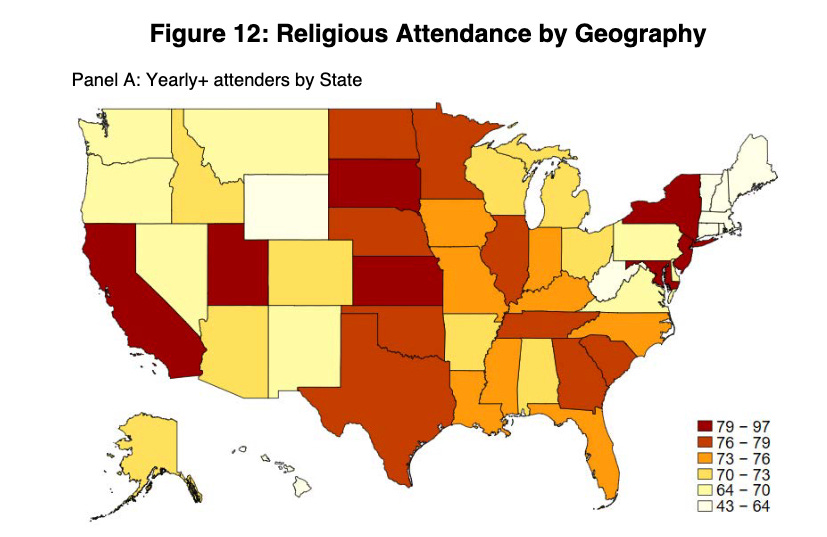
And he finds that “frequent religious service attenders are less likely to go to strip clubs, liquor stores, casinos, or go to the gym.”
Pope mentions the previous research on religion and mental health: “research has provided causal evidence that increased religiosity can lead to lower levels of depression (Lucchetti, Koenig, and Lamas 2021), fewer deaths of despair (Giles, Hungerman, and Oostrom 2023), more prosocial behavior (Benjamin, Choi, and Fisher 2016; Bottan and Perez-Truglia 2015), less crime (Moreno-Medina 2023), and less drinking and drug use (Gruber and Hungerman 2004).”
He also acknowledges that plenty of people may be praying privately or studying religious texts at home or in other locations that aren’t official “places of worship.”
I’m not an academic economist, but I read a lot of social science papers as part of a university-based job I had from 2019 to 2023, and this looks to me like a pretty nicely done paper.
Israel’ s priorities: Among the most useful information sources on the war has been a daily briefing by Israel’s Defense and Security Forum, often featuring its chairman and founder, Brigadier General (reserve) Amir Avivi, who meets regularly with Prime Minister Netanyahu.
Highlights from today’s briefing:
More than 50 percent of the Iranian missiles failed either in Iran or on the way to Israel. “They are not producing really high quality missiles,” General Avivi said.
Avivi is certainly a hawk on Iran, holding it accountable for the activities of Hamas, Hezbollah, and the Houthis—“They are managing everything, funding, directing all the attacks….They are the head of the snake and their head needs to be cut….Iran has built Hamas, has built Hezbollah…Everything that’s happening is really generated by Iran.”
Yet he also said that Israel has three priorities right now.
“Our first priority is Rafah,” in Gaza, where Israel needs to go in, get the hostages, and defeat the remaining Hamas battalions.
The second priority is Hezbollah, in Lebanon, where Israel either militarily or diplomatically needs to push Hezbollah back from Israel’s northern border to allow a safe return of the tens of Israel’s residents who have been evacuated from their homes in northern Israel.
The third priority is Iran, he said.
Given the desirability of moving against Iran with a broad coalition rather than alone, Avivi suggested that a “snap-back,” restoring the economic sanctions that were lifted by the Iran nuclear deal, might be a good immediate step.
That aligns with a post by Senator Cotton, who wrote this afternoon, “President Biden has repeatedly said he wants a diplomatic solution for Iran. Here’s three: 1. Rescind the billions of dollars of sanctions relief for Iran, 2. Reimpose sanctions on Iran’s nuclear program, 3. Restrict Iran’s oil exports to China.”
Speaking of China, Avivi made the case that if Iran’s aggression goes unmet, Beijing and other powers would get the message. “China is looking at this,” he said, mentioning the possibility of a move against Taiwan. “Russia is looking at this,” he said. “This is a very problematic message the West is sending.”
Mobile millionaires: Under the headline “The Myth of the Mobile Millionaire,” Brian Galle, writing in the Atlantic, asserts “The notion that rich taxpayers will flee if the state comes for their money is mostly fiction.”
The word “mostly” is doing a lot of work in that sentence. You might as well write, “is at least partly true.”
Galle turns out to be a law professor at (tax-exempt) Georgetown University, and “support for this project was provided by the William and Flora Hewlett Foundation.” Elsewhere, he’s an advocate of “an annual tax on extreme wealth” and a “state-level wealth tax.”
In a 2023 article, Galle says he and two other professors, David Gamage of Indiana University and Darien Shanske of U.C. Davis, are “the codrafters of a pending bill in California that would impose a wealth tax on Californians with a net worth over $50 million,” and “have been charged with codrafting proposed legislation to implement President Biden’s Billionaires Minimum Income Tax reform proposal.”
What makes me chuckle about this is how frequently it is that someone pushing a tax increase turns out to be based in or funded by some wealthy place—the $12.7 billion Hewlett Foundation—that is set up in a way that avoids taxation.
There was another example of this in the New York Times over the weekend—Princeton University sociologist Matthew Desmond, who won a Pulitzer for his book Evicted, publicly agonizing about taking the mortgage interest deduction on his taxes. “Roughly 84 percent of the funds distributed by the mortgage-interest deduction flow to white households. Black households claim 4 percent,” he writes. “My family qualifies for this ridiculous deduction. But we don’t want it. What we want is to live in a country where fewer public dollars flow to stable homeowners and more flow to renting families crushed by the high cost of housing. So we’ve decided to create that society in miniature form, and with full recognition that we have the privilege of doing so, by donating what we receive from the mortgage-interest deduction to affordable housing initiatives on top of our regular giving.”
The tax breaks that benefit Desmond most aren’t the mortgage interest deductions but the ones that allow Princeton’s $34 billion endowment to grow largely tax free and that otherwise support elite higher education.
Call it the Galle-Desmond Rule of Tax-Increase Advocacy. When someone is publicly advocating for tax increases, the person frequently turns out to be based at a tax-exempt organization.
Thank you!: If you are enjoying and learning from this newsletter, please pass it along to friends or family members along with a suggestion that they subscribe.
Great points! Re: church going, no surprise with New England, but interesting to see New York and California being high attendance areas. I wonder how demographics also play into this, what groups are attending, and their socioeconomic placements. Re: Israel, and geopolitics as a whole, the Iranian government is central in a lot of the trouble we witness. Much of it starts there. Hence, like you wrote before, the most bang for the buck would be somehow helping the youth to create problems for the rulers. Re: taxes, cut government spending, cut taxes some, and go from there.