

California’s Governor Versus the First Amendment
Plus, Trump takes on the Republican Squad; University of Virginia

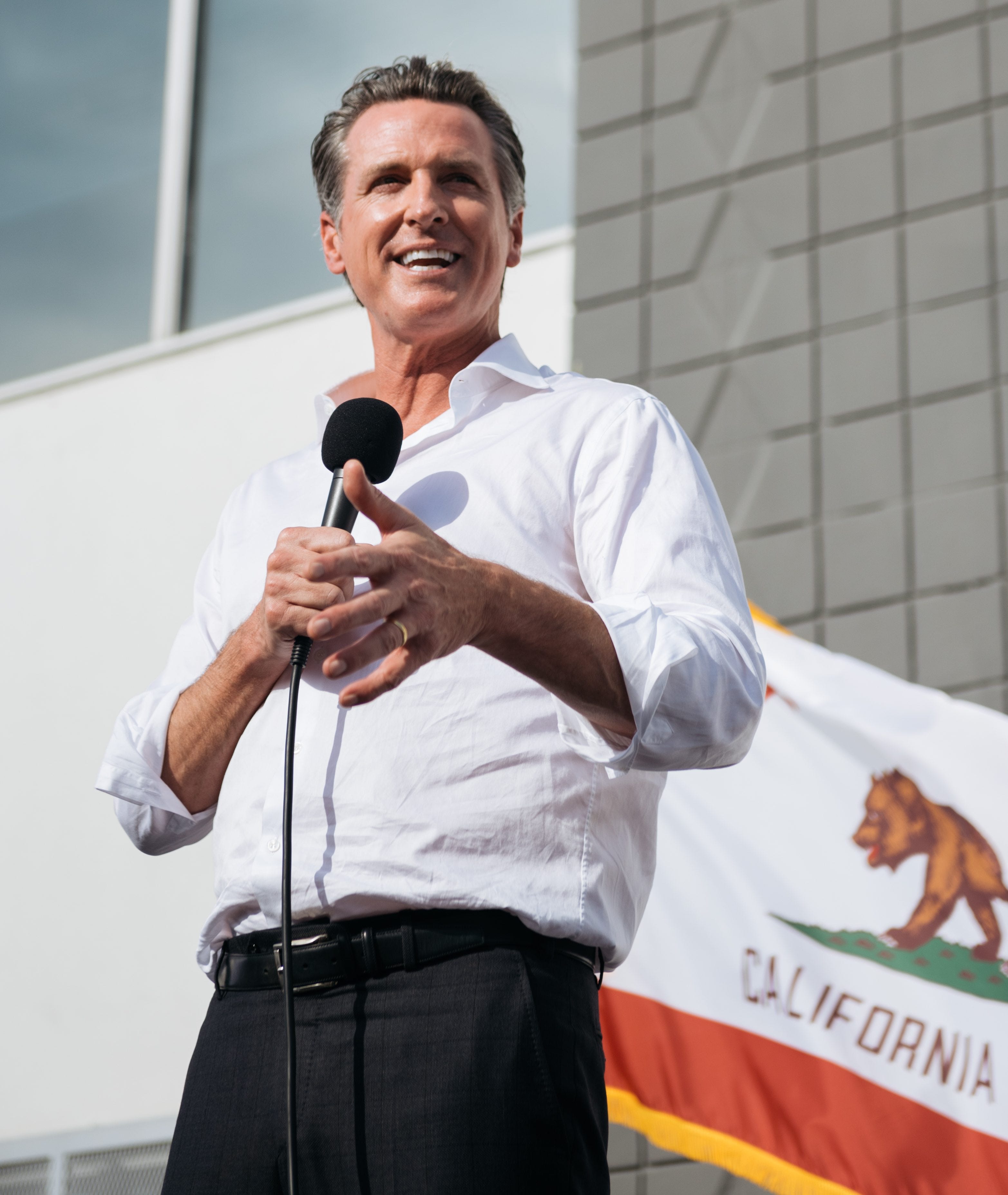
Between Sarah Palin suing the New York Times and President Trump suing Bob Woodward, the Des Moines Register, ABC News, and CBS News, Republican politicians have been the ones in the news in recent years suing news organizations. Now Governor Newsom, Democrat of California, seems to have been inspired by the trend and is suing Fox News for $787 million in punitive damages over the network’s reporting on the timing of a phone call between Newsom and President Trump.
Set aside for now whether politicians routinely suing news organizations is a generally good trend or a bad one. What’s intriguing is that Newsom, in an action brought in Delaware Superior Court, is bringing not only a defamation case but an action under California’s Unfair Competition Law, which, Newsom’s suit says, prohibits any “unlawful, unfair or fraudulent business act or practice and unfair, deceptive, untrue or misleading advertising.”
The idea that news coverage or opinion journalism qualifies for regulation as “advertising” or a “business act or practice” under this law is about as direct a legal assault on the First Amendment as can be imagined. The First Amendment says “Congress shall make no law …abridging the freedom of speech, or of the press.” The courts have ruled the prohibition on Congress to apply also to the states. Media bias, incompetence, and inaccuracy are real problems, but under the Constitution, the way to combat it is by pointing it out, not by outlawing it at the state level. The state law approach basically empowers the courts to substitute judges for editors and producers.
You can barely open a newspaper without encountering some alarm about Trump authoritarianism. Where are the “norms” people to be found when it is a Democratic politician suing a conservative media outlet for a vast sum? And where are the “free speech” people who are at the barricades over the the mildest restrictions on violent pro-Hamas protesters or professors? With the governor displaying this sort of attitude toward press freedom, it’s no wonder that high-quality news organizations of the profit-seeking variety are increasingly scarce in the Golden State.
Maybe Newsom is hoping for a settlement of the sort that Trump has gotten or is seeking from other news organizations or their parent companies. Owners of news organizations and customers of them—across the political spectrum—will be hoping that Fox News doesn’t succumb to an attempted financial shakedown from Sacramento. It’d incentivize a flood of nonsense claims by politicians against news organizations. That could weaken watchdog journalism at a moment when it is needed—directed not only at the White House but at Democrats like Newsom, too.
The University of Virginia: Jim Ryan’s resignation as president of the University of Virginia, under pressure from the Trump administration, is attracting a lot of attention.
Senator Mark Warner, Democrat of Virginia, called it “the most outrageous action, I think, this crowd has taken on education,” and said, “This federal D.O.E. and Department of Justice should get their nose out of University of Virginia. They are doing damage to our flagship university.”
“Mr. Ryan’s resignation is a victory for intimidation and fear over the rule of law…a sad day for the university, which will suffer the consequences of this bad decision,” the university’s former lawyer, Timothy Heaphy writes in the New York Times. Crimson Courage, the Democrat-dominated donor group pressing Harvard not to reach an antisemitism settlement with the Trump administration, declared itself “saddened and deeply concerned.” Frederick Hess of the center-right American Enterprise Institute, says he has “profound concerns.”
“I find it deeply troubling that the DOJ appears to have conditioned access to federal funds on Ryan’s resignation. That is a hugely troubling precedent. I’d have been appalled if the Biden administration had tried this and the same applies here,” Hess said. “The goal of higher ed reform should not be the collection of scalps but the pursuit of principled, sustainable change. This is not that. Rather, this is overreach that will inevitably give rise to tit-for-tat payback when the next Democratic administration decides to target the leaders of red-state flagships. That’s not a win for anybody.”
In a way the Ryan story is a sideshow to the bigger public higher education story in Virginia, which is the way George Mason is gaining on the University of Virginia. Since 2018, when Ryan took over in Charlottesville, George Mason has climbed to 109 from 140 on the US News list of national universities, while the University of Virginia improved to 24 from 25. Not that the U.S. News rankings are the end-all-and-be-all, but they are indicative. Virginia has been basically coasting on its reputation, while George Mason has been rapidly improving. George Mason faculty—Eugene Kontorovich, David Bernstein, Tyler Cowen, and many more—are out in the world burnishing their institution’s brand. The George Mason crew aren’t all knee-jerk left-wingers.
Nobel Laureate Angus Deaton, a senior scholar at Princeton, mentioned George Mason in his remarks at the 2017 American Economics Association Annual Meeting during a panel discussion moderated by James Heckman on “Publishing and Promotion in Economics: The Curse of the Top Five.” Said Deaton, “There is a battle going on between people who think economics should be done one way and people who think economics should be done another way. The Top Five reinforces this very narrow view and nothing outside of that is allowed so that the department gets narrower and narrower and people all look like they are doing the same thing. . . . I think that is a real threat. . . .but maybe that is a good thing because it opens up opportunities for other departments and departments that were not top departments can follow new lines. I think some of the stuff coming out of George Mason, for instance, really interesting different approach to economics and it’s enormously valuable to have that there even for people who don’t agree with it.”
Anyway, people who are sophisticated about higher education don’t necessarily think that President Trump can do a better job of running the University of Virginia than Jim Ryan can. But focusing on the relative stasis or the “intimidation” at the University of Virginia without noting the energy and viewpoint diversity at George Mason—in the economics department and the Antonin Scalia Law School in particular—only tells part of the story. You don’t have to be a George Mason economist or a Scalia law professor to understand that competition and choice and the talent market can help change higher education for the better. It doesn’t all have to be federal government pressure, though in some cases the federal pressure can help accelerate the pace of reform at institutions that are badly in need of it.
Trump takes on Massie, Paul: Our June 15 post here, “Republicans Have an Anti-Israel ‘Squad,’ Too,” highlighted Rep. Thomas Massie, Republican of Kentucky and Senator Rand Paul of Kentucky. Since then, President Trump has been on a rampage against Massie and Paul. Trump posted today, “New poll: Anybody I Endorse beats Thomas Massie of Kentucky by 25 points. Get ready. Massie is a very bad guy!” One June 28, Trump posted, “Did Rand Paul Vote ‘NO’ again tonight? What’s wrong with this guy??? DJT” On June 24, Trump posted referring to Massie as a “Third Rate Congressman…very bad for the Constitution…a LOSER!”
Trump seems more focused on the opposition by Paul and Massie to the One Big Beautiful Bill than on the anti-Israel stuff or the foreign policy “isolationism,” but for whatever reason there seems to be plenty of overlap. Anyway, it’s an encouraging development to see Trump targeting these guys. Not that there isn’t room for diversity of views within the Republican Party, but as I wrote the other day, what Rand Paul and Thomas Massie did on social media went beyond reasonable debate and crossed the line into demonization and double standards.
Know someone who would enjoy or benefit from reading The Editors? Please help us grow by forwarding this email along with a suggestion that they subscribe. Or send a gift subscription:
The case against Jim Ryan at UVA is detailed at https://www.resetuva.com/ and https://www.deiatuva.com/
As Ira Stoll has detailed here, there is a strong argument against the federal government dictating the leadership of universities. But there is also a strong argument that universities should be wary of having leadership that causes a breakdown of trust with the feds, whether by acting in ways that are illegal or having a conflict of interest that undermines the relationship.
Trust is hugely important. The absence of trust leads to the government enforcing the law by micromanagement, e.g., using consent decrees.