

British Labour Sent 100 To Help Harris Campaign
Boris Johnson tries to turn Trump into a Ukraine hawk

[The Editors is called The Editors, plural, not The Editor, singular, for a reason. When I launched it, a shrewd friend advised, “it can’t just be you.” I’m delighted to start introducing some additional voices. Today’s comes from Michael Mosbacher, who is associate comment editor at London's Daily Telegraph. He is a past editor of Standpoint and The Critic, having co-founded both British magazines.—Ira Stoll.]
The British response to Donald Trump’s victory has been entertaining. The left-wing press — including the state broadcaster, the supposedly impartial BBC — has had a meltdown. Politicians who have been banging on for years about what a monster the 45th president is are busy rowing back, saying their assessment was always much more nuanced and that their past statements have been taken out of context.
Quite how you take British Foreign Secretary David Lammy’s past comments out of context is another question. In 2018 he described Trump as a “woman hating, Neo-Nazi sympathizing sociopath,” and on another occasion as a “deluded, dishonest, xenophobic narcissist.”
It perhaps also is a lesson that those with top-flight political aspirations would be wise to avoid presenting talk-radio shows. Lammy had a weekly three hour show on the U.K.’s leading talk radio broadcaster, LBC — only ending when Labour won office in July. You have to fill those hours with something, much of which you may come to regret when you move over to the world of diplomacy.
During the U.S. election campaign, Labour came in for much criticism from conservative commentators for sending — or at least letting them go, as the party insists this was not an official operation — around 100 Labour party activists and staffers to work for the Kamala Harris campaign. The Trump team responded by saying that this was election interference.
The help probably had no effect on the outcome, but is symbolic for how British politicians of both main parties closely follow American politics with a kind of admiration verging on aspirational envy. Talk to people like Michael Gove, until July a leading Tory cabinet minister, one time leadership candidate and now editor of The Spectator , and they will wax lyrical about Robert Caro’s so-far four volume life of Lyndon Johnson. A certain type of British politician enjoys nothing more than discU.S.sing the intricacies of Johnson’s 1948 Democratic primary win in the Texas race for the U.S. Senate. Talk to Labour politicians of the Tony Blair years and they are equally obsessed with Bill Clinton’s triangulations.
And this lustful, yearning look across the Atlantic is not surprising. In the U.K.'s 2019 general election — the figures are not yet available for this year’s election — the Conservatives, the highest spending party, laid out just over £16 million (roughly $20.7 million) on their national campaign (U.K. population, 68 million). Now there may be some smoke and mirrors employed in these figures and the true spending might be slightly higher, but it certainly won’t be vastly more. This contrasts with the $32 million Bernie Sanders spent on his dead-certain Senate reelection in Vermont (population, 650,000) this year.
The average backbench British member of Parliament employs a staff of 5, in the U.S. House of Representatives it is 15 and in the Senate 250. Yet, ever since binge watching The West Wing in the early 2000s, every House of Commons office seems to have a Chief of Staff – previously they were happy with the lowly moniker of “researcher.”
Fantasizing about U.S. politics is an occupational hazard for all U.K. politicians — while Britain’s Europhiles might hanker for the U.K. to be more like its continental neighbors in its politics (or they did until the populist, right-wing turn in country after European country — and even the most blinkered Brussels aficionado can no longer claim that Europe’s economies are going great guns), they never dream about being part of German or French election campaigns. That love is exclusively reserved for the United States.
The Labour government clearly is not in a good position when it comes to having good relations with the incoming Trump administration. If the buzz is accurate and Blair era minister and svengali Peter Mandelson is made Britain’s next ambassador to Washington, he will need to use all his skills to smooth things over.
Most Tories are also not noted for their outstanding relations with the Trump team. New party leader Kemi Badenoch would not be drawn on who she would have supported in the U.S. election before the vote, and past Tory grandees like Michael Gove and ex-leader William Hague made their preference for Harris very clear. In private conversations this attitude is the default position of many and probably most of the party’s MPs. Among those who do welcome Trump’s election, it is not due to any great esteem for the once and future president, but rather because they are enjoying the paroxysms of anguish expressed by Britain’s progressive Trump haters.
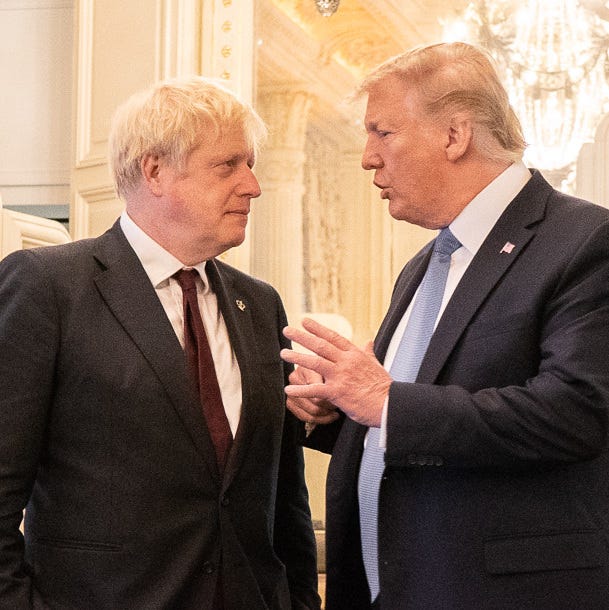
There are a few exceptions. The 49-day former prime minister Liz Truss and the unsuccessful Tory leadership candidate Robert Jenrick are Trump admirers, as are some other MPs. Boris Johnson did express his support for the Republican candidate, but this seems part of a cunning plan to persuade Trump to fully support Ukraine, rather than a more straightforward endorsement. Johnson seems to think the way to turn Trump into a Ukraine hawk is by persuading him that becoming the savior of Kyiv should be his permanent legacy, or at least part of it. The U.K.’s number one Trump fan remains the Brexit campaigner and Reform party leader Nigel Farage — his dream is to be the British Trump, although the U.K. electoral system makes that rather less likely.
But perhaps the most common reaction of the U.K. political class is one of disappointment. The U.S. political process they are so addicted to following has thrown up a result they hate. Those that understand Trump and his appeal, what Germans would call Trump-versteher, are in the distinct minority.