

Britain Will Be First Islamist Country With an A-Bomb, JD Vance Warns
Starmer is no Corbyn, but Labour is trying to win back Muslim voters

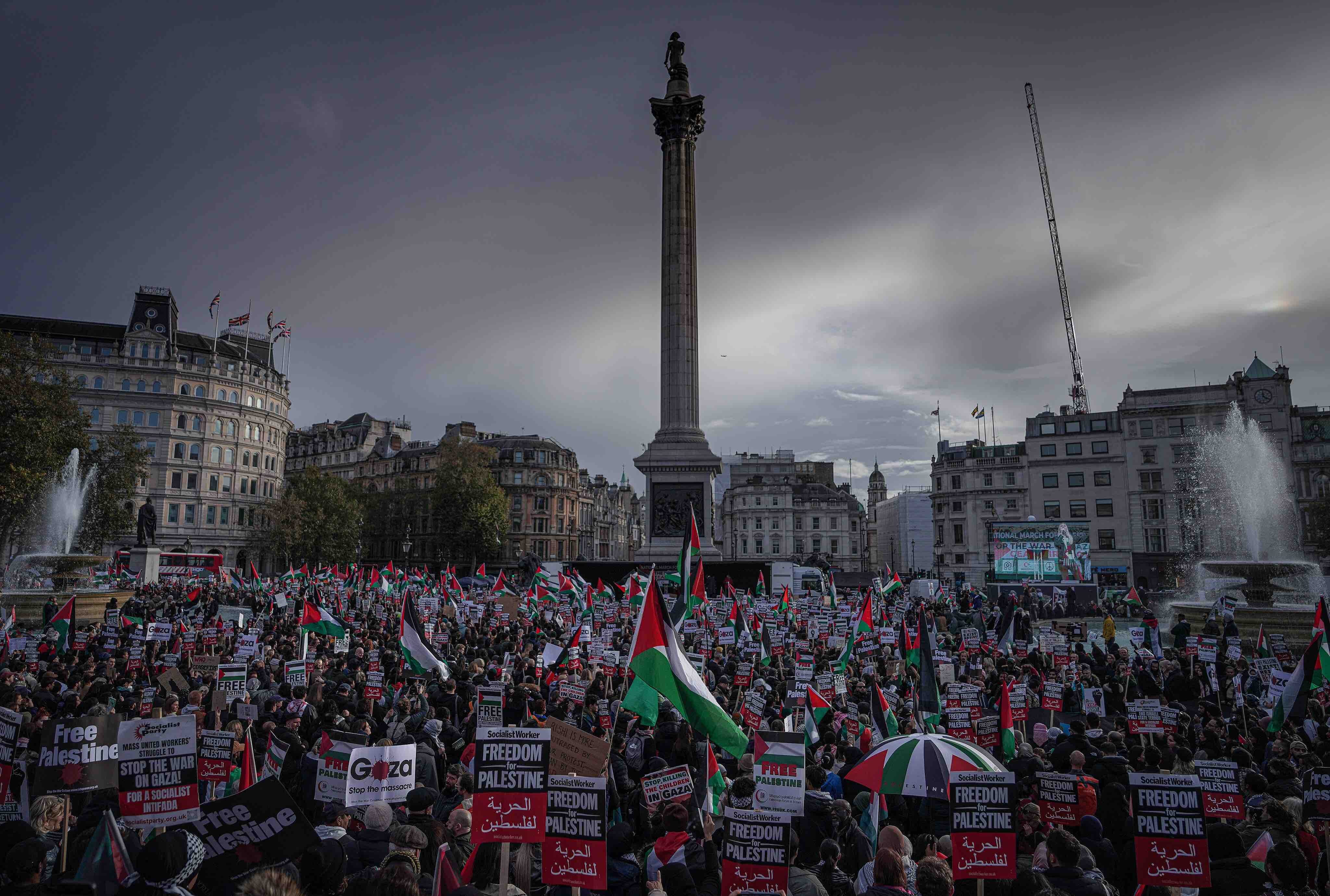
Shortly before Donald Trump picked Senator JD Vance as his running mate, Vance asked at a conference in Washington, “What is the first truly Islamist country that will get a nuclear weapon?” After considering Iran, and acknowledging that Pakistan “maybe already, kind of counts,” he suggested “maybe it’s actually the UK, since Labour just took over.”
The remarks touched a nerve in the UK. Writing from London, I can report with a fair degree of certainty, the Islamists are not yet in control of Westminster, their flag is not yet fluttering over Downing Street, and Taliban checkpoints are nowhere to be seen.
But the Labour Party, with its recent unhappy flirtation with the wilder shores of anti-Semitism, won a landslide victory in Britain’s July 4 general election. It is worth exploring this past and the party’s relationship with Muslim voters.
Before Keir Starmer took over the leadership of the party in 2020, Labour went through a grim period under Jeremy Corbyn. Support for Israel was anathematised and Jewish Labour members of parliament were ostracized. Some, such as Luciana Berger and Louise Ellmann, reported that internal party harassment had gotten so bad that they felt they were left with no option but to leave the party. The Jewish Labour Movement was unable to endorse Labour in the 2019 general election, an unprecedented move for a direct affiliate of the party. Labour’s “anti-Zionism” under Corbyn was just one aspect of a wider denigration of the West and all things western.
Why did the party head down this noxious cul-de-sac?
Around four million Muslims, about 6 percent of the total population, reside in Britain. Until this year’s election, 70 percent or more of British Muslims voted Labour. Their impact on elections has previously been less significant than this might suggest, as Muslim voters are heavily geographically concentrated. The 650 members of the House of Commons are elected from constituencies, the British equivalent of American congressional districts. While in just under 100 of the UK’s 650 constituencies 10 percent or more of the electorate are Muslim, their vote really matters in the 30 or so seats where Muslims make up a quarter or more of the electorate. Where concentrations are lower, the Muslim vote is much more closely aligned to the general population.
Most of these constituencies have historically been very strongly Labour voting; they are not areas, with perhaps a mere handful of exceptions, that will ever vote Conservative. These seats until this year were already in Labour’s pocket, and voted Labour under Corbyn, but also still voted Labour—with one East London exception—in 2005 when George W Bush’s Iraq war ally Tony Blair was leader.
Chasing votes is not the explanation for Corbyn’s obsessive antipathy to Israel, rancid ideology is. When the north London MP spoke of his “friends in Hamas” and “friends in Hezbollah,” he would later insist he was only using “inclusive language.” But here was a man whose closest lieutenants during his time as party leader were Andrew Murray and Seumas Milne, two upper class alumni of a publication called Straight Left, which published from 1979 to the mid 1990s.
This was ostensibly a Left-wing monthly trade union movement newspaper— with a miniscule circulation. In fact it was a pro-Soviet faction within the already pro-Soviet Communist Party fighting against any signs of reformism. In the vernacular of the extremely factional far Left, it was a Stalinist rag; a fairer description might be Brezhnevite. Soviet-style “anti-Zionism,” alongside Putin apologia, is this pair’s leitmotif. That is the milieu from which Corbyn was getting his advice.
(Between their Straight Left days and working for the Leader of the Opposition’s office, Milne and Murray pursued journalist careers—Milne became Comment/Opinion Editor of The Guardian; Murray’s endeavors were rather more niche, the Communist Morning Star and the Soviet Novosti press agency.)
When Starmer, now the prime minister, took over as leader of Labour, breaking with this unhappy episode had to be one of his key endeavors. And to a considerable extent, he has been successful. Corbyn has found himself excluded from the party, the most malignant actors have lost their influence, and some of those Jewish members who were previously forced out have returned.
For 1970s Labour leader Harold Wilson, backing Israel was one of the cornerstones of his political being. This was not the case for Starmer. But his attitudes were normal, unlike the derangement exhibited by his predecessor.
In the immediate aftermath of Hamas’s October 7 pogrom, Starmer’s response was all that one could have hoped for from a European center-left leader, robustly defending Israel’s right to defend itself. Over time this support has slackened, but it is still much better than Corbyn.
And Starmer has paid some electoral price for taking a sane position on Israel. Labour’s support in heavily Muslim areas has slumped; it fell by up to 25 percent in this May’s local elections. More dramatically, in this month’s general election four independent Muslim candidates, standing on a “solidarity with Gaza” platform, defeated sitting Labour MPs – in an election where Labour was advancing everywhere else – in heavily Muslim areas in England’s Midlands and North.
Corbyn, this time standing as an independent against Labour, was additionally reelected, although in his case anti-Israel agitation was only part of the platform.
“This is for Gaza” is not what one expects to hear from a newly elected MP at an electoral declaration in an English city, but that was the reaction of Shockat Adam at his count on July 4. So certainly four, and perhaps five, MPs owe their election directly to conflict more than 2,000 miles away from the UK. And it could have been worse, as another four independent Muslim candidates came very close to winning.
The question now is whether Labour has permanently lost support from much of the Muslim community, or whether those voters will return to the fold when the current conflict fades. Will the presence of MPs standing on a specifically Muslim platform become a permanent feature of British politics? As far as I know, it would be the first European country where a wholly separate Muslim political movement had secured a foothold in parliament.
What it has certainly done is make many Labour MPs worried. And this is coloring Labour’s policy towards Israel. First Britain’s new Foreign Secretary David Lammy announced that the UK would resume funding for UNRWA, the largely discredited UN agency that funnels aid to the Palestinian Arabs. Then the British government made clear it will no longer formally object to the ICC’s application for an arrest warrant against Benjamin Netanyahu. And this week the UK looks set to suspend some arms sales to Israel. These decisions signal Labour’s attempt to win back Muslim votes.
No, Labour Britain has not gone Islamist, at least not yet. But Labour certainly has a challenge with holding on to the Muslim vote. This will have unfortunate political repercussions, especially in terms of the UK government’s Israel policy.