

Britain Moves To Nationalize Steel Industry
Earlier state ownership, China, Miliband’s net-zero zeal nearly killed it already

Britain’s Parliament rushed back from Easter recess on Saturday to pass emergency legislation for the state to take control of the UK’s last remaining steel-making blast furnace. It was only the sixth occasion since World War II that the House of Commons has met on a weekend. That is a measure of how urgent Keir Starmer’s Labour government feels action is.
Starmer was fearful that the Chinese owners of the facility in Scunthorpe, about 150 miles north of London, were about to close it. That would put an end to the UK’s ability to make virgin steel — as opposed to recycled steel. The Scunthorpe plant is apparently losing around £700,000 ($915,000) every day. The only other remaining British blast furnace, in Port Talbot in Wales, closed in September 2024. Once such a furnace has gone cold, it is difficult and costly to reignite.
The government’s move amounts to a de facto nationalization of British Steel. Formal state ownership will almost certainly follow. The Labour Government elected last year has already legislated to nationalize the railways and set up a new state-owned renewable energy firm. Now steel will follow.
The 1945 Labour government nationalized steel along with myriad other industries. Steel was one of the very few to be returned to the private sector by the Tories in the 1950s. It was then taken back into state control by Labour in 1967, before being privatized by Mrs. Thatcher in 1988. Now the yoyo continues, but this particular move is not primarily motivated by socialist ideology.
It is rather about strategic interests. Virgin steel is essential for the defense industry, so there is cross-party agreement that action needs to be taken to keep the furnace going and for Britain to continue to have its own supply.
What makes the wrangle over Scunthorpe particularly piquant is that British Steel has been owned since 2020 by Jingye, a Chinese company, after going into insolvency the previous year. Many now question the wisdom of Boris Johnson’s Tory government allowing a mainland Chinese entity to control a plant so crucial to British defense.
Nigel Farage, the UK’s premier Trump fan and leader of the populist Reform UK party, is suggesting the Chinese only bought British Steel to close it down and make the country dependent on the People’s Republic. China produces around a billion tons of steel per year, while its nearest competitor, India, produces only about 150 million tons. The United States lags behind at 80 million, Germany is at slightly under 40 million, with the UK being a positive minnow at 4 million tons.
Britain was once a steel-making powerhouse. Its empire was literally built on steel. What is behind its decline?
Post-war state ownership and the subsequent uncertainty of whether it would remain in the private sector when it was denationalized is part of the story. The lack of protection for property rights discouraged investment.
But Britain’s commitment to net zero, the statutory pledge for the UK to reach zero net greenhouse gas emissions by 2050, is also a significant part of the recent story. Climate-change commitments are a major reason why UK industrial energy prices are among the highest in the world, perhaps the highest. Steel production is vastly energy intensive, and UK prices for this sector are at least 50 percent more than those of Germany and twice that of many other competitors.
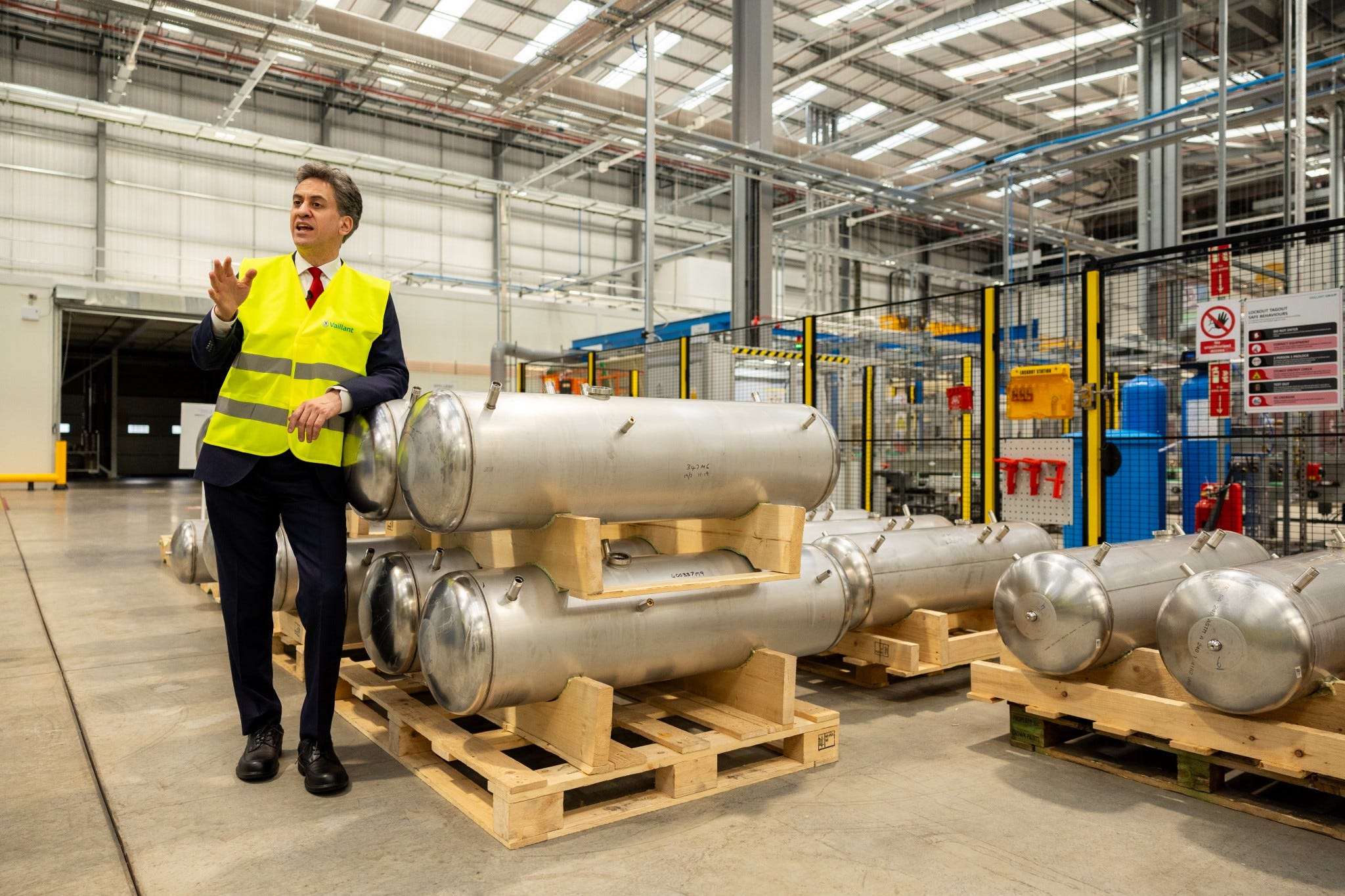
One politician is more responsible for this commitment than any other: Ed Miliband.
Miliband was energy secretary when the Climate Change Act first enshrining the net zero commitment, then for an 80 percent reduction, was passed in 2008 by the last Labour government. This commitment was further ramped up by the Conservatives under Theresa May and is now again being championed by Ed Miliband, once more energy secretary in Starmer’s Labour Government.
Ed Miliband, alongside his brother David — now based in New York and president of the International Rescue Committee — were prominent in the Gordon Brown Labour government. When Labour lost in 2010, David was the favorite to become the next party leader. To general astonishment, his younger brother Ed stood against him in the leadership election and was the narrow winner. He stood down after unexpectedly losing the 2015 election.
Not long after his brother beat him, David decided to quit politics and move to America. Wanting to avoid the constant reminder of his defeat at his brother’s hands has often been ascribed as the motive, although the $1.2 million salary will surely not have put him off.
The Miliband boys are sons of Ralph, a Jewish Marxist academic at the London School of Economics who was hugely influential in the 1970s and 80s on the far Left of the Labour Party. Their childhood home was a magnet for social gatherings of the Marxist intelligentsia. Ed records how Joe Slovo, the exiled last white General Secretary of the South African Communist Party, would help him with his homework.
The socialism of both Miliband brothers is emphatically pink compared to that of their parents’ scarlet red. For Ed, greenery has replaced his father’s old Marxist faith. But just as surely, the younger Miliband has sacrificed Britain’s steel industry to the god of net zero.
Michael Mosbacher is Associate Comment Editor at London’s Daily Telegraph. He is a past Editor of Standpoint and The Critic, having co-founded both British magazines.
Why do British people want their country to be net zero for greenhouse gas emissions? The advantage of net zero is for the whole planet. Why do more than your share?
How important was it to inform the reader that Ralph, the Marxist father, was Jewish? Did he have red hair? Was he tall or short?