

Biden Insults Trump’s Hair
Plus, the Talmud on war profiteering; Trump’s Time interview

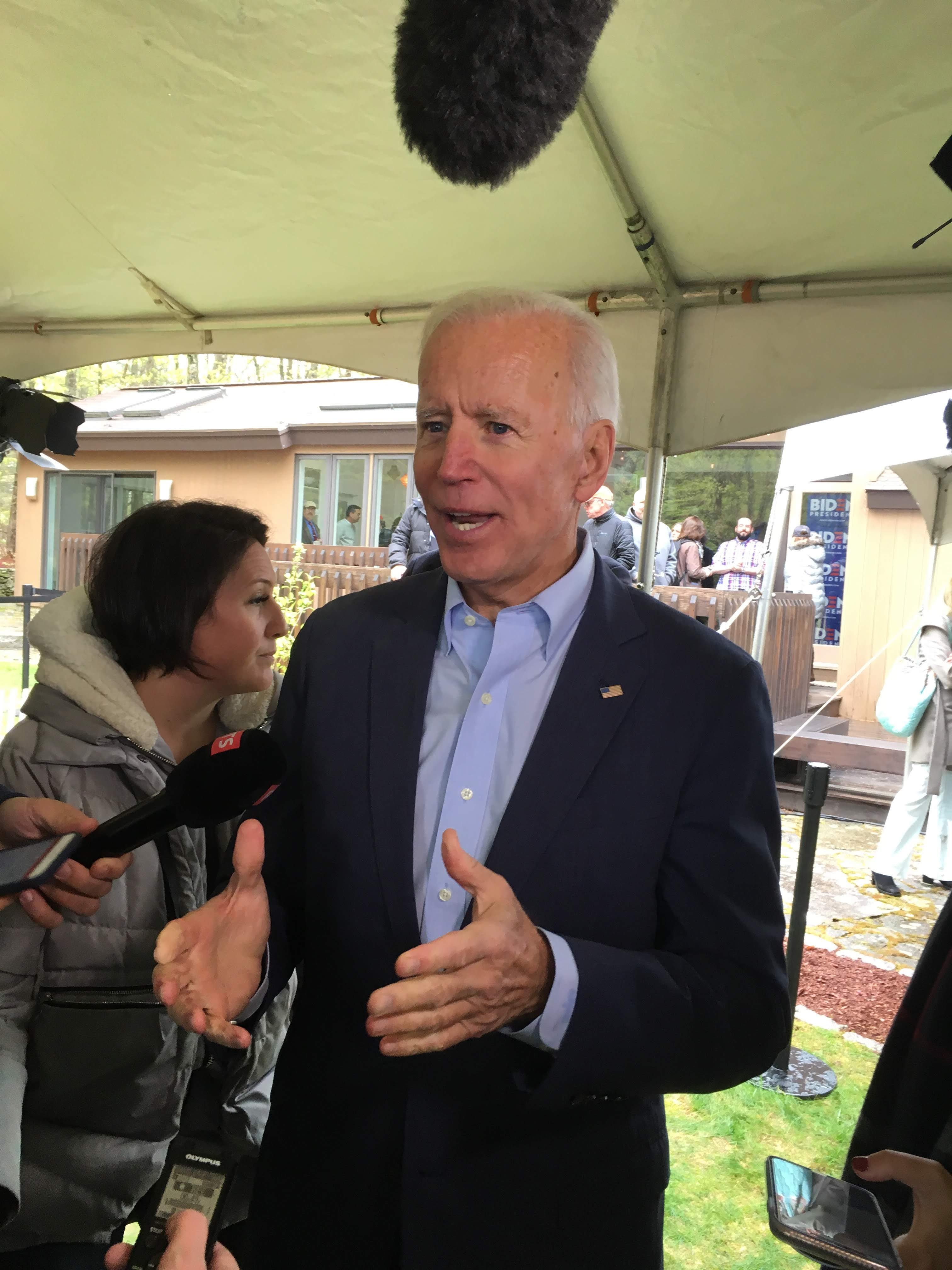
The White House today released a transcript of President Biden’s remarks at a campaign reception on May 1, 2024, at the Mayflower Hotel. From the White House transcript:
Trump is trying to make the country forget just how dark and unsettling things were when he was president. But we'll never forget.
We'll never forget lying about the pandemic, telling the Amer- -- because th- -- remember that interview he did -- honest interview; he got exposed -- telling them he knew it was -- the pandemic was deadly? And he -- what did he tell people? It was mentioned already: Inject bleach.
Well, all that bleach apparently injected into his hair instead of his arm. (Laughter.)
One of Biden’s strongest appeals is talk about the soul of America. As Biden put it in September 2022: “The soul of America is defined by the sacred proposition that all are created equal in the image of God. That all are entitled to be treated with decency, dignity, and respect.” He called on people to heed “not our worst instincts but our better angels.”
How is it dignified or decent or heeding the better angels for a presidential candidate to make fun of his opponent’s hair? It’s coarse, a cheap shot. If Biden wants to debate policy or character or values or records with Trump, great. But make fun of his hair? Come on, man, as Biden sometimes says.
Biden used a version of a similar line on April 26, 2024, at a campaign event in Irvington, New York. There, according to the White House transcript, Biden said, “We’ll never forget how -- him lying about COVID, telling the American people to inject bleach into their arms. He injected it into his hair. He got it wrong.”
Biden also said it April 24, 2024, to the Building Trades Unions:
by the way, remember when he was trying to deal with COVID? He said just inject a little bleach in your veins. (Laughter.) He missed; it all went to his hair. (Laughter.)
Look, I shouldn't have said that. (Applause.) I probably shouldn’t have said that. (Laughter.)
March 26, 2024 at a campaign reception in Raleigh, North Carolina, Biden said, “by the way, I'll be happy to compare physical characteristics with Donald Trump. Granted, I don't have his orange hair, but I -- (laughter).”
There’s some honest reporting about this material in the press: Matt Viser of the Washington Post wrote a piece headlined “Biden is aiming increasingly personal and sarcastic jabs at Trump,” observing, accurately, that “The tactic thrusts Biden, who has built a career as a congenial politician who is above name-calling and denigration, into a more personally combative form of politics.” Viser observed, “It’s a significant change,” noting, “Biden has built an image as a politician who cares about civility and wants to unify a divided country. He talks regularly about not being brought up to make fun of others.”
With the exception of Viser, however, a lot of reporters have given Biden a pass on this stuff. It’s too bad, because talking about civility, decency, dignity and better angels while simultaneously making fun of someone’s hair risks reinforcing the idea that Biden is a phony. There’s certainly other data to support that idea, such as when he misled New Hampshire voters about his own income.
The Talmud on war profiteering: One of the key demands of the anti-Israel protesters on campuses is divestment from companies making profits from the Israel-Hamas war. Yale, for example, responded to this demand for “divestment from military weapons manufacturing”—a staple of so-called “socially responsible investing,” or “ESG,” for environmental, social, and governance—with a statement on April 17 noting that “military weapons manufacturing for authorized sales did not meet the threshold of grave social injury, a prerequisite for divestment, because this manufacturing supports socially necessary uses, such as law enforcement and national security.”
In that context, it’s worth noting a recent passage I covered in my page-a-day journey through the Talmud. In a previous post (“How High a Price Is ‘Exploitation’?”) I noted a Talmudic consensus around the idea that selling an item for a price more than one sixth higher than its value amounts to “exploitation.” In percentage terms, that’s a 16.66 percent markup.
The more recent passage, Bava Metzia 58b, quotes a rabbi, Yehuda ben Beteira, who expressed the opinion that in the case of “one who sells a horse, or a sword, or a helmet during wartime, these items are not subject to the laws of exploitation, because they then have the capacity to preserve life, and a person is willing to pay any price for them.”
I found this an attractive opinion on two levels. First, it recognized that even potentially “offensive” weapons such as a horse or a sword have potentially life-saving purposes.
Second, as a free-market-oriented person, I appreciated the approach to price controls. You might think that regulations on exploitative pricing would be especially needed in a case like this, of weapons in wartime, when combatants are willing to pay nearly anything. But Yehuda ben Beteira seems to recognize the other side, which is that that limiting profits would limit the supply of the lifesaving weapons, and that allowing unlimited profits will create strong incentives for the supply to increase to meet the demand.
Any institution considering divesting from weapons manufacturers on the grounds that their profits are somehow immoral may want to consider both these aspects of Yehuda ben Beteira’s position before making any decisions. I’m not saying the institutions should have their decisions dictated by a rabbi who lived 2,000 years ago. But he makes some valid substantive points worth considering. And if today’s institutions are going to ignore his view, they would do themselves a service by making clear to the public, or at least to their own community, if they aren’t looking to the Talmud, what alternative legal and ethical and moral texts are they relying on to inform their judgments?
Trump Time interview: Trump gives two interviews to Time magazine that are long but worth a look for a flavor of what he is saying and planning these days. The most newsworthy parts in my opinion had to do with the U.S.-Israel relationship:
I want to know—you said you want to get Israel to wind down the war. You said it needs to “get it over with.” How are you going to make that happen? Would you consider withholding aid?
Trump: I think that Israel has done one thing very badly: public relations. I don't think that the Israel Defense Fund [perhaps he means the Israel Defense Forces?-The Editor] or any other group should be sending out pictures every night of buildings falling down and being bombed with possibly people in those buildings every single night, which is what they do.
So you won’t rule out withholding or conditioning aid?
Trump: No, I—we have to be. Look, there's been no president that's done what I've done for Israel. When you look at all of the things that I've done, and it starts with the Iran nuclear deal. You know, Bibi Netanyahu begged Obama not to do that deal. I ended that deal. And if they were smart and energetic, other than trying to get Trump, they would have made a deal because they were in bad shape. They should have made a deal with Iran. They didn't prosecute that. They didn't make that deal. But I did Golan Heights.
You did.
Trump: Nobody even thought of Golan Heights. I gave them Golan Heights. I did the embassy and in Jerusalem. Jerusalem became the capital. I built the embassy. I even built the embassy.
Right.
Trump: And it's a beautiful embassy for a lot less money than anybody ever thought possible. And you've heard that. But there's been no president that's done what I've done in Israel. And it's interesting. The people of Israel appreciate it. I have like a 98%—I have the highest approval numbers.
Do you know who doesn’t have a high approval rating right now in Israel, though?
Trump: Bibi.
Yeah. Do you think it's time for him to go?
Trump: Well, I had a bad experience with Bibi. And it had to do with Soleimani, because as you probably know by now, he dropped out just before the attack. And I said, “What's that all about?” Because that was going to be a joint and all of a sudden, we were told that Israel was not doing it. And I was not happy about that. That was something I never forgot. And it showed me something. I would say that what happened on—the October 7 should have never happened.
It happened on his watch.
Trump: No, it happened on his watch. And I think it's had a profound impact on him, despite everything. Because people said that shouldn't have happened. They have the most sophisticated equipment. They had—everything was there to stop that. And a lot of people knew about it, you know, thousands and thousands of people knew about it, but Israel didn't know about it, and I think he's being blamed for that very strongly, being blamed. And now you have the hostage situation—
Has his time passed?
Trump: And I happen to think that on the hostages, knowing something about the enemy, and knowing something about people, I think you have very few hostages left. You know, they talk about all of these hostages. I don't believe these people are able or even wanting to take care of people as negotiations. I don't—I think the hostages are going to be far fewer than people think, which is a very sad thing.
You think you could work better with Benny Gantz than Netanyahu in a second term?
Trump: I think Benny Gantz is good, but I'm not prepared to say that. I haven't spoken to him about it. But you have some very good people that I've gotten to know in Israel that could do a good job.
Do you think—
Trump: And I will say this, Bibi Netanyahu rightfully has been criticized for what took place on October 7.
Do you think an outcome of that war between Israel and Hamas should be a two state solution between Israelis and Palestinians?
Trump: Most people thought it was going to be a two-state solution. I'm not sure a two-state solution anymore is gonna work. Everybody was talking about two states, even when I was there. I was saying, “What do you like here? Do you like two states?” Now people are going back to—it depends where you are. Every day it changes now. If Israel’s making progress, they don't want two states. They want everything. And if Israel's not making progress, sometimes they talk about two-state solution. Two-state solution seemed to be the idea that people liked most, the policy or the idea that people liked above.
Do you like it?
Trump: It depends when. There was a time when I thought two states could work. Now I think two states is going to be very, very tough. I think it's going to be much tougher to get. I also think you have fewer people that liked the idea. You had a lot of people that liked the idea four years ago. Today, you have far fewer people that like that idea.
You said–
Trump; There may not be another idea. You know, there are people that say that that situation is one of the toughest, the toughest to settle.
Yeah, absolutely.
Trump: Because children grow up and they're taught to hate Jewish people at a level that nobody thought was possible. And I had a friend, a very good friend, Sheldon Adelson, who felt that it was impossible to make a deal because the level of hatred was so great. And I think it was much more so on one side than the other, but the level of hatred of Jewish people was so great, and taught from the time they were in kindergarten and before. He felt that—and he was a great dealmaker. He was a very rich man. He was a rich man because of his ability to make deals. And he loved Israel more than anything else. He loved Israel, and he wanted to protect Israel. And he felt that it was impossible to make a deal because of the level of hatred.
Do you feel that way now?
Trump: I disagreed with it. But so far, he hasn’t been wrong.
Thank you: If you find this newsletter worth reading, please help us grow by becoming a paying reader and sharing it with friends. Our pricing is non-exploitative, and while our product may not save your life in the same way military equipment does, we will do our best not to make fun of your hair.
I'm very much enjoying The Editors. I would like to make perhaps a small suggestion. I find the Torah insights to be fascinating because I'm interested in comparative religion in general. I'm not Jewish (I'm a Latter-day Saint) but I find Jewish history and philosophy to be intellectually compelling. I'm wondering if perhaps a separate series on your Daf Yomi readings would be a great thing to do?
Regardless, please continue sharing those insights because I'm learning a lot.