

Biden, in Farewell Address, Mentions the Editors
Plus, surprise follow-up on anti-capitalist Columbia law professor

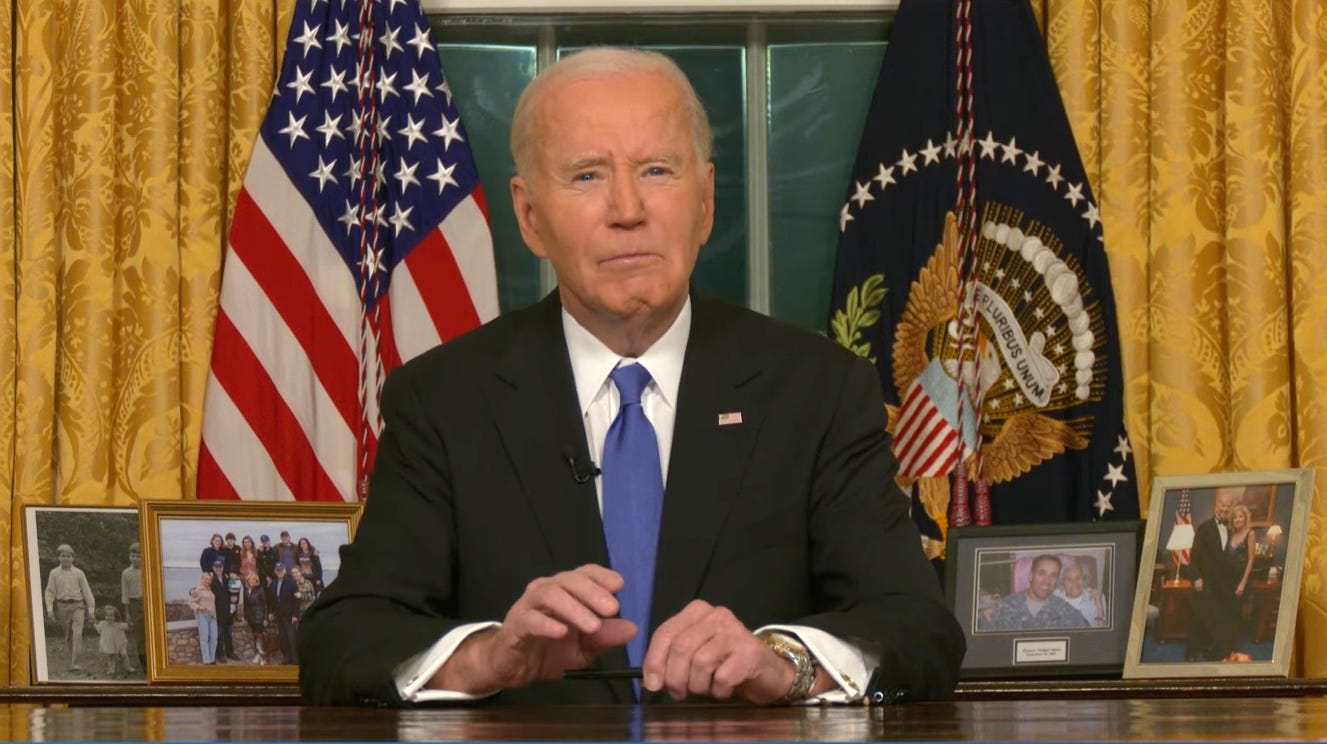
President Biden gave a farewell address to the nation last night, and he mentioned us—The Editors—by name. Well, sort of, at least. “Americans are being buried under an avalanche of misinformation and disinformation enabling the abuse of power. The free press is crumbling. Editors are disappearing. Social media is giving up on fact-checking. The truth is smothered by lies told for power and for profit,” Biden said.
Speaking for The Editors, contrary to Biden’s claim, we aren’t “disappearing,” we are right here with the trustworthy information to pierce through the nonsense—including Biden’s own. The Free Press isn’t crumbling, either; it’s prospering, and we don’t mind at all being mentioned by Biden in the same breath with that publication.
In fairness to Biden and in all seriousness, his concerns about trustworthy information and analysis, or the lack of it, while surely somewhat different from my own, probably are also at least somewhat similar to some of the ones that partly motivate this project. The veracity crisis is a bipartisan, consensus issue—when Trump talks about “fake news” and when Biden talks about “lies,” or when I ask “where are the editors?”—we all are expressing similar frustrations. The devil is in the details. My hope and bet is that in the long run, the most power and profit comes with being the most trustworthy source of information. It’s possible I have an overly rosy perspective.
Biden’s lament for disappearing editors wasn’t the only part of his farewell address that made me chuckle. He warned of “the dangerous concentration of power in the hands of very few ultra-wealthy people…an oligarchy is taking shape in America of extreme wealth, power, and influence that literally threatens our entire democracy…a tech-industrial complex.” He said, “We need to get dark money — that’s that hidden funding behind too many campaigns’ contributions — we need to get it out of our politics.”
This comes after an election in which Michael Bloomberg (Bloomberg), Bill Gates (Microsoft), Laurene Powell Jobs (Apple), and Alexander Soros all reportedly made vast donations in support of Vice President Harris and the Democrats. If there’s indeed an “oligarchy,” it’s not just on the Donald Trump and Elon Musk side of things, and you kind of wonder where Biden was in terms of denouncing it when Bloomberg and Gates were being solicited for the $50 million contributions to back Harris. What was the pitch, exactly? “Hey Mr. Bloomberg and Mr. Gates, can you pitch in $50 million each to help us Democrats fight the oligarchy and the tech-industrial complex?”
If Biden really thinks “editors are disappearing,” maybe he means the ones who could have saved him from some of the embarrassment on the way out the door by dialing back some of the more purple prose in his farewell speech.
The curious case of Katherine Franke: Yesterday, in a piece headlined “Columbia Professor Departs With Shot at “Bankers and...Capitalists,” we highlighted an anti-Israel professor at Columbia Law School, Katherine Franke, who, on her way out the door, complained:
As Columbia’s Board of Trustees has become constituted largely by hedge fund managers, investment bankers, and venture capitalists, the university has become more of a real estate holding concern than a non-profit educational institution. With this degradation of the university’s leadership has come, in some cases, an inability to resist pressures placed on the university by outside entities carrying a brief for the destruction of higher education, and in other cases, a shared commitment to a right-wing, and pro-Israel, ideology.
After publishing the piece we learned a bit more about Franke’s family background.
Her father was Richard J. Franke, who for 22 years was the CEO of the investment bank John Nuveen & Company and who also was a trustee of the University of Chicago and a Fellow of the Yale Corporation for twelve years, and its Senior Fellow for six. In other words, the lady complaining that too many bankers on the board are ruining Columbia is herself the daughter of a banker who was on the boards of Yale and of the University of Chicago. According to his obituary, Richard J. Franke was survived by, among others, “daughters Katherine (and her partner Janlori Goldman and their daughter Maya).” Janlori Goldman is listed on a Jewish poetry website as explaining that her grandparents “were atheists, socialists, anti-zionists, and distrustful of authority.”
As for Richard Franke, in 2004 he published, “Cut From Whole Cloth,” a 521-page, exhaustively detailed history of his Catholic and Lutheran German family and his ancestors’ immigrant journey to America. There’s no mention at all in the book of the Holocaust, Nazis, or Jews, aside from a passing reference in half a sentence to a cousin “who became a member of the Hitler youth.” The only extended reference in the book to German soldiers during World War II is to a generous unknown German soldier who “in an improbable gesture of mercy,” kept a wounded American soldier, a Franke relative, alive with an IV.
What to make of all this? Events on these university campuses are driven not only by world events but by individuals who themselves are the products of families. Sometimes to understand the dynamics at a place like Harvard or Columbia or the University of Pennsylvania you need to be not a geopolitical analyst of events in the Middle East or a scholar specializing in the economics or politics of higher education. You almost have to be a psychologist to understand how the daughter of a German-American banker and Yale board member might become an anti-Israel activist railing against the malign influence of bankers on elite university boards.
The preeminent historian of the Middle East Bernard Lewis, in his brilliant article from the December 2005 American Scholar, "The New Anti-Semitism,” wrote of how Jew-hating serves two purposes, one for disloyal Jews and one for non-Jews:
In anti-Semitism's first stage, when the hostility was based in religion and expressed in religious terms, the Jew always had the option of changing sides. During the medieval and early modern periods, Jews persecuted by Christians could convert. Not only could they escape the persecution; they could join the persecutors if they so wished, and some indeed rose to high rank in the church and in the Inquisition. Racial anti-Semitism removed that option. The present-day ideological anti-Semitism has restored it, and now as in the Middle Ages, there seem to be some who are willing to avail themselves of this option.
For non-Jews the rationale brought a different kind of relief. For more than half a century, any discussion of Jews and their problems has been overshadowed by the grim memories of the crimes of the Nazis and of the complicity, acquiescence, or indifference of so many others. But inevitably, the memory of those days is fading, and now Israel and its problems afford an opportunity to relinquish the unfamiliar and uncomfortable posture of guilt and contrition and to resume the more familiar and more comfortable position of stern reproof from an attitude of moral superiority. It is not surprising that this opportunity is widely welcomed and utilized.
I consider myself pretty good at writing and thinking and investigating on this topic, but I don’t think I can do any better than Lewis, who died in 2018 at age 101. He is missed at a moment such as this, but he leaves us his words and students to help understand what is happening.
Kemp tax cut: While all the spotlight is on Trump and Washington, there is plenty of action too at the state level. In Georgia, Governor Brian Kemp delivered his State of the State address:
In Georgia, we don’t conduct the people’s business with trillion-dollar deficits or endless continuing resolutions. Just because we take in more money, doesn’t mean we need to create new big government programs to fund for eternity.
Instead, we budget conservatively, fund our priorities, keep government efficient, cut taxes, and then return your money back to you. Between multiple tax rebates, multiple suspensions of the state gas tax over the past two years, the homeowner tax relief grant you passed last year, and the largest state income tax cut in history that the members seated here helped us accelerate, we’ve committed to saving Georgia taxpayers over 7.6 billion dollars!
And because of our conservative approach to budgeting and this body’s support in holding the line on state spending, along with the incredible economy we’ve bolstered, we’re able to double down on that relief. The prior acceleration you passed last session brought down the Georgia income tax rate to 5.39 percent, down a full 36 basis points from where we started in 2022. Today, I’m proposing a further cut of 20 basis points, bringing us down to just 5.19 percent - saving Georgians another 7.5 billion dollars over the next 10 years!
Because, at the end of the day, that’s your money — not the government’s, and here in Georgia, we believe you should keep more of it!
Compared to states such as Florida, Texas, and New Hampshire with zero state income tax, a reduction to 5.19 percent may seem like not much to cheer about, but sometimes one has to pay attention not only to the level but also to the direction and rate of change. Kemp also talked about state-level tort reform to curb litigation costs for businesses.
Recommended reading: On the “media accountability” and “religion” topics, I recommend the latest piece by Mark Oppenheimer of the Oppenheimer Substack, headlined, “The Atlantic’s Fear-mongering About Evangelicals.” He writes, “there is a history of these articles, scaring secular readers that the armies of Christian theocrats are coming for their government.”
Thank you: Please act today to help make sure that, contrary to Biden’s fears, The Editors aren’t disapprearing. You can give a gift subscription, become a paying subscriber if you aren’t already one, or upgrade your existing paid subscription to founding member.