


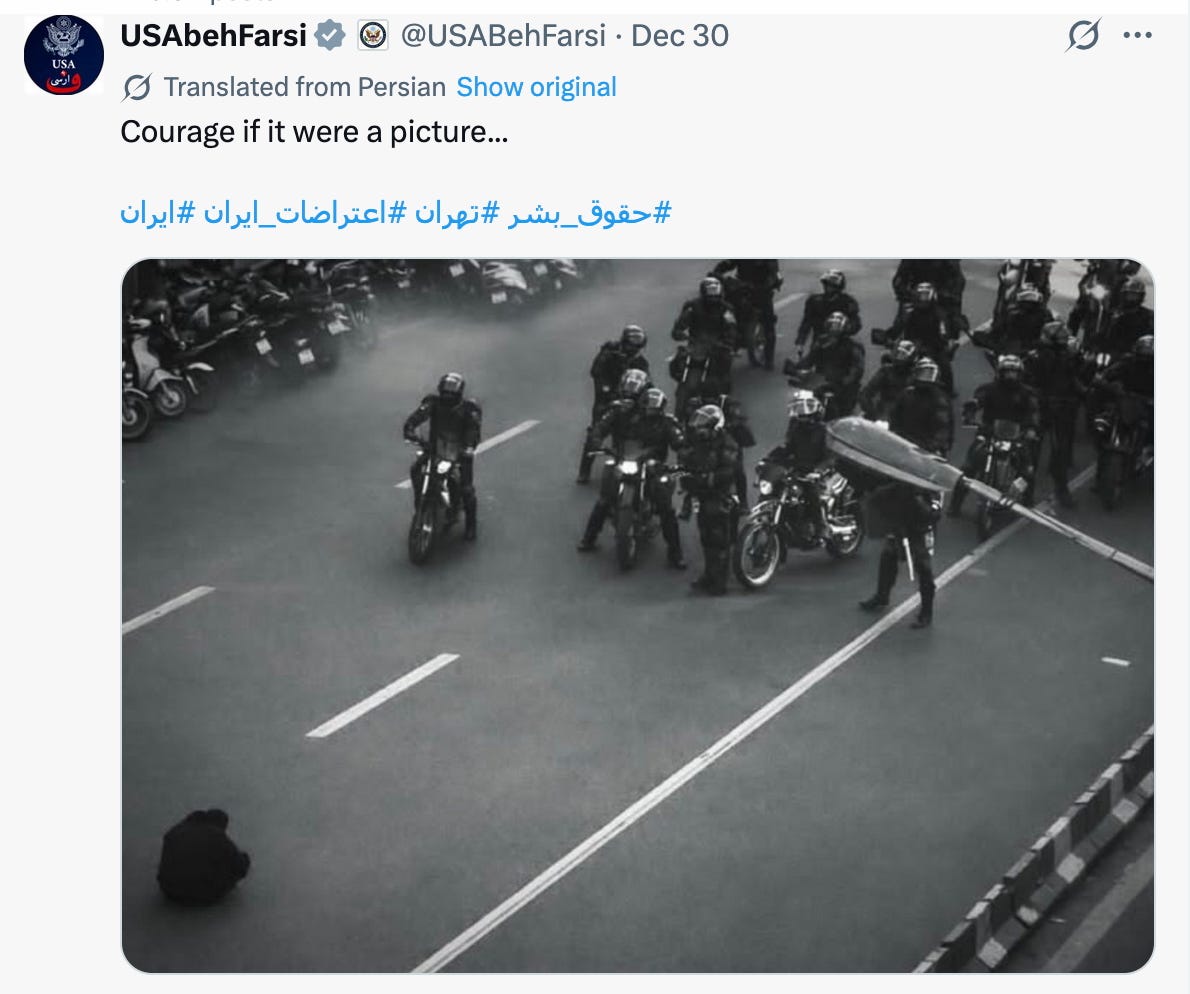
What is motivating the protests on the streets of Iran, and what, if anything, will quell them?
To read at least some of the press coverage, it’s a dispute over, of all things, monetary policy.
The Associated Press reports from Tehran:
Iran on Wednesday appointed a new governor to the central bank after the former one resigned following a record currency fall against the U.S. dollar that sparked large protests.
The plummeting of the rial, Iran’s currency, sparked the largest protests in the country in three years, with rallies that began Sunday and continued until Tuesday.
A report by the official IRNA news agency said President Masoud Pezeshkian’s Cabinet appointed Abdolnasser Hemmati, a former economics minister, as new governor of the Central Bank of the Islamic Republic of Iran. He replaces Mohammad Reza Farzin, who resigned on Monday.
Experts say a 40% inflation rate led to public discontent. The U.S. dollar traded at 1.38 million rials on Wednesday, compared to 430,000 when Farzin took office in 2022. Many traders and shopkeepers closed their businesses and took to the streets of Tehran and other cities to protest.
An Iranian-American who writes a newsletter about Iran, Alireza Talakoubnejad, says that the rapid depreciation of the Iranian currency against the dollar is “the primary reason there has been an outbreak of protests.”
Yet this is more than simply an economic story, some say. Middle East analyst and Editors contributor David Wurmser writes that economic pressure leads to regime collapse “when their reigning elites lose ideological faith and thus signal confusion or lack of resolve.” He adds, “If Iran collapses, it is not because of economic collapse, which has been endemic for years, but because the street feels flailing will and failing regime ideological confidence, at which a scramble ensues among critical nodes of the regime to turn coat and survive.” Wurmser notes that “what happened last summer when Israel humiliated the Ayatollahs has a lot to do with the current circumstance. …The other key factor here is President Trump. …in his statements during the Netanyahu summit this week, in contrast to last summer, he made it clear policy now shifted and that this has become the first American administration that stands with the Iranian people rather than prefer to sell them out.”
A U.S. government social media account in Farsi said, “Iranians across the country have united in the course of peaceful protests and are demanding respect, access to services, and the right to self-determination. Their resolve demonstrates the power of people who refuse to remain silent. The United States stands in solidarity with the people of Iran in their pursuit of their fundamental rights.” Another post says, “We are deeply concerned by reports and videos showing that peaceful protesters in Iran are facing intimidation, violence, and arrest. Demanding basic rights is not a crime. The Islamic Republic regime must respect the rights of the Iranian people and end the crackdown.”
And the policy director of United Against Nuclear Iran, Jason Brodsky, notes that crowds in Kermanshah are chanting “death to the dictator” and that students at Tehran University were chanting “freedom.” “As has been the case in previous cycles, these protests have quickly morphed from economic into political,” Brodsky said.
The view here at The Editors is that the economic and political are closely related. A weak currency signals not only hardship for consumers that goes by the name “inflation” or “affordability crisis,” it signals a lack of confidence by world capital markets and by the domestic public in the government whose reputation backs the currency.
The United States government under President Trump, Secretary of State Rubio, and Secretary of Treasury Bessent have increased pressure on Iran’s “shadow fleet,” imposing sanctions on more than 180 vessels responsible for shipping Iranian petroleum products. Iran lost a key ally when Bashar Assad’s regime in Syria was toppled. Iran’s proxy militias of Hamas in Gaza and Hezbollah in Lebanon have been dramatically weakened by Israel in the war that followed October 7, 2023. What Iran needs isn’t only a new central banker, but a new regime, one not dedicated to using Iranian tax dollars and petroleum revenues to fund terrorism, internal oppression, regional wars, or nuclear proliferation.
The students and shopkeepers who have been most active in the current wave of protests have displayed great courage against a government that uses against its opponents and critics not only water cannon and tear gas but also torture and live ammunition and the hangman’s noose. One woman’s rights activist, Zahra Tabari, was sentenced to death earlier this year “after a trial via video link that lasted less than 10 minutes,” the BBC reported. An Iranian human rights lawyer, Khosrow Alikordi, was found dead in his office on December 5, 2025. Another Iranian, Omid Sarlak, “was found dead after he posted a video on social media of himself setting an image of Supreme Leader Ayatollah Ali Khamenei on fire,” Radio Free Europe/Radio Liberty reported earlier this year. If the U.S. press, such as NPR and the New York Times, devoted half the effort they devote to the West Bank and Gaza to stories like those of Zahra Tabari, Khosrow Alikordi, and Omid Sarlak, Americans might be better informed about what’s really happening in the Middle East.
Experience has shown that Iranians will have to take the lead in any regime change effort; it can’t be imposed from outside, though the U.S. and other regional players can and should certainly provide support if it is requested. And most crucially of all, we should not undercut the courageous protesters by offering the theocratic, terror-sponsoring regime a lifeline in the form of a “deal.” Richard Perle’s article here at The Editors from October 2024, “Tell the World the Truth About Iran, Says Richard Perle,” holds up today: “abandon the foolish conceit that diplomatic engagement with the mullahs in Tehran can advance our interests or the democratic cause. It hasn’t and it won’t….We have pulled our punches in the hope of moderating the regime. It is at last clear we have nothing to lose by helping those who wish to bring the regime down.”
Thank you: The Editors is a reader-supported publication that relies on paying customers to sustain its editorial independence. If you know someone who would enjoy or benefit from reading The Editors, please help us grow, and help your friends, family members, and associates understand the world around them, by forwarding this email along with a suggestion that they subscribe today. Or send a gift subscription. If it doesn’t work on mobile, try desktop. Or vice versa. Or ask a tech-savvy youngster to help. Thank you to those of who who have done this recently and thanks in advance to the rest of you.
The Western Press needs to give greater coverage to the Iranian protests to show that we in the West are following this issue closely and that we care. And, yes, Westerners should hold solidarity protests in support of the Iranian people. With Trump as President, this is our best chance for regime change in Iran. Now is the time!
The NYT ran an article with the headline "Protests Over Sinking Economy in Iran Spread to Universities": https://www.nytimes.com/2025/12/30/world/middleeast/iran-protests-currency-inflation-universities.html
I submitted a comment saying "Protests Over Sinking Economy in Iran Spread to *American* Universities", now that would be news.
The comment was disallowed.