


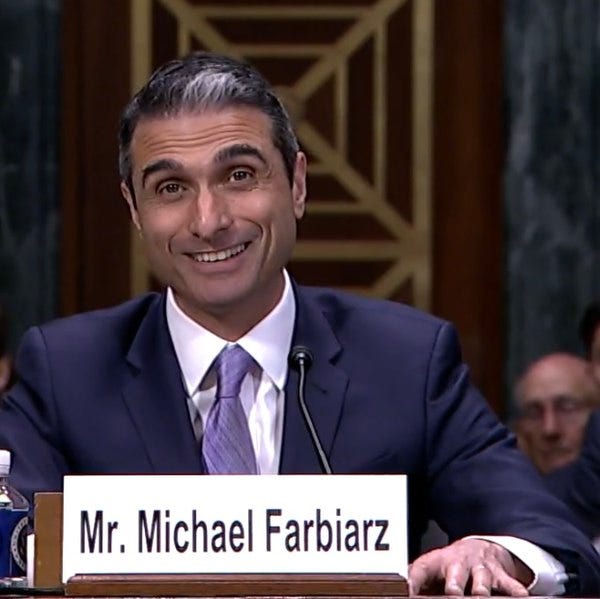
Apple lucked out by having the iPhone antitrust case assigned to Judge Michael Farbiarz of the U.S. District Court for the District of New Jersey. That’s not to predict that he’ll rule one way or another, but it is to predict that he’ll follow the law rather than rule against Apple because it’s profitable or bought back stock or has a dominant share of the market, none of which are illegal under U.S. law, at least yet. When he was nominated in 2022 I sent the following draft editorial to the New York Sun:
Judge Farbiarz
President Biden’s announcement that he intends to nominate Michael Farbiarz to the U.S. District Court for the District of New Jersey might be the best judicial news from the Garden State since the Senate confirmed Samuel Alito. Though Princeton has its bucolic charm, Paterson its mighty waterfalls, and we once ate a memorably good meal at a diner near the now-closed New York Times printing plant in Edison, we’ve never entirely seen the attraction of New Jersey. However, if Farbiarz is confirmed—as we hope he rapidly will be—businesses and individuals might consider relocating to the state just for the chance of drawing him as judge. If the Senate does nothing else other than confirm him, we’d count it as an extraordinarily productive session.
We’ve known him since college, and we also know and respect the two federal judges for whom he clerked, José Cabranes and Michael Mukasey. What does Farbiarz bring that’s special beyond integrity and intelligence? For one thing, it’s great to have some Democrat-appointed judges on the bench who are not hostile to religion. Farbiarz is the sort of fellow who, in his spare time, for fun, while on vacation, studies the Talmud. It doesn’t mean he’d rule one way or another. But so many of our current legal controversies involve religious beliefs, especially minority or unpopular ones, that someone who shares the Constitution’s deep respect for those beliefs is a particularly welcome addition to the federal bench. For another thing, as general counsel of the Port Authority of New York and New Jersey, Farbiarz has been on the management side in negotiations with public-employee unions. That, too, is perspective that might prove useful, and somewhat unusual, on the bench, in a way that could serve the public interest.
It’s the appellate and Supreme Court nominations that make the headlines and attract the attention. For litigants and accused criminals and ordinary citizens, though, the rule of law on which American freedom depends rests to a large degree on district judges. The American justice system has real issues—prosecutorial overreach, the “trial penalty” that leads to plea bargains in many cases, civil litigation so risky and protracted that it adds costs to consumers while enriching lawyers. There are structural reforms to be made. The whole system, though, works a whole lot better with independent-minded, high quality judges. That is why the prospect of Judge Farbiarz is so encouraging for those of us who care about justice.
Public housing in Paris: The New York Times has a generally admiring if not entirely unskeptical account of public housing in Paris, headlined, “How Does Paris Stay Paris? By Pouring Billions Into Public Housing”:
One quarter of all Paris residents now live in public housing, up from 13 percent in the late 1990s. The mixité sociale policy, promoted most forcefully by left-wing political parties, notably the French Communist Party, targets the economic segregation seen in many world cities.
“Our guiding philosophy is that those who produce the riches of the city must have the right to live in it,” said Ian Brossat, a communist senator who served for a decade as City Hall’s head of housing. Teachers, sanitation workers, nurses, college students, bakers and butchers are among those who benefit from the program.
Making the philosophy a reality is increasingly hard — the wait list for public housing in Paris is more than six years long…. The Fondation Abbé Pierre, an influential charity, was unusually emphatic in its annual report, published in February, calling France’s affordability crisis a “social bomb,” with rising homelessness and 2.4 million families waiting on public-housing applications, up from 2 million in 2017.
Paris’s housing program is part of the trade-off of the welfare state: affordable health care and education in exchange for some of the highest income-tax rates and social charges in Europe. Public housing, however, is increasingly available only for those lucky enough to get it…. The current goal is for Paris to have 30 percent public housing for low-income residents and 10 percent for middle-income residents by 2035.
Mr. Baudrier, the Paris City Council member, said he believes that in the long term, 60 percent of housing in the city should be public and reserved for low- and middle-income families.
Could it be that if you reserve a quarter to sixty percent of the apartments for government owned rentals at below-market rates, homelessness will increase and there will be six-year-long waiting lists, because the government does a worse job at allocating resources than does the free market system of supply and demand?
The Times points out that the French right is also on board with these plans. In describing the tradeoffs, it mentions the high income tax rates but it doesn’t mention the negative effects those tax rates have on economic growth. Nor does it mention that subsidized rental housing discourages homeownership. Homeownership can be a way to accumulate capital, protect against inflation, and build long-term equity. In the U.S. we’ve also found that segregating poor people in public housing projects can have problematic effects in terms of crime and isolation.
A July 2023 New York Times article from a Paris suburb about “riots” reported, “Mr. Luhaka, 22, a Black soccer player, was cutting through a known drug-dealing zone in his housing project in a Paris suburb in 2017 when the police swept in to conduct identity checks. Mr. Luhaka was wrestled to the ground by three police officers, who hit him repeatedly and sprayed tear gas in his face. When it was over, he was bleeding from a four-inch tear in his rectum, caused by one of the officers’ expandable batons. Mr. Luhaka’s housing project, and others around Paris, erupted in fury.” That context is missing from this most recent Times account.
Recommended reading: David Brooks in the New York Times: “If this war ends with a large chunk of Hamas in place, it would be a long-term disaster for the region. Victorious, Hamas would dominate whatever government was formed to govern Gaza. Hamas would rebuild its military to continue its efforts to exterminate the Jewish state, delivering on its promise to launch more and more Oct. 7s. …Israel must ultimately confront Hamas leaders and forces in Rafah rather than leave it as a Hamas beachhead.”
There are some things in the Brooks piece I disagree with, particularly the false claim that “Israel’s core problems flow from the growing callousness with which many of its people have viewed the Palestinians over the past decades.” Actually Israel’s problems flow from the refusal of some Palestinians to accept its right to exist as a Jewish state, and from the failure of America and the world to confront the Iranian regime that is sponsoring Palestinian rejectionism.
But on the issue of whether Israel should press ahead with taking Rafah, the Brooks column is pretty good.
Recommended reading, II: The April 2024 issue of Boston magazine has a long piece by Rachel Slade headlined, “A Conservative Thought Experiment on a Liberal College Campus.” It is about Professor Eitan Hersh’s political science course at Tufts on American Conservatism. Part of the assigned reading is Brown University professor Glenn Loury’s “The Case for Black Patriotism.” From the Boston magazine article:
All of this leaves the students questioning their understanding of social justice. Here we have at least one Black intellectual arguing that liberal ideology—one built around notions of institutional harm and victimhood—will never raise up communities. Rather, people need the strength of will to help themselves to overcome injustices of the past. If Loury’s position is correct, that this oppressor-oppressed narrative is harming the Black community while fueling the backlash (a.k.a. white nationalism), then it’s no longer useful.
So where does that leave Tufts’ young social justice warriors?
Loury’s “Late Admissions: Confessions of a Black Conservative” is coming May 14. The Boston magazine article is a good reminder that for all the bleak ideological conformity on “elite” college campuses, there are also professors like Hersh and Loury who are thinking independently and challenging their students to do so, too. Knowing about them makes me smile and gives me hope.
Maureen Farrell Versus Bill Ackman: Maureen Farrell has a profile in the New York Times of Bill Ackman, who has an X post up rebutting the profile and explaining why the New York Times doesn’t like him:
I have taken on issues in opposition to and that are important to the woke left, and my posts on these topics have had considerable impact. This is quite threatening to the leftwing media as the New York Times used to be the paper of record, and now a guy with an X account can impact and help shape people’s views on important issues, but only if they find what he has to say convincing. The media no longer have a monopoly on opinions or the narrative. As their power diminishes, they attack those that threaten their power.
A freakout over Ronna McDaniel: Political staffers have been rotating into network news journalism for years, including longtime NBC “Meet the Press” moderator Tim Russert (a former staffer to Senator Moynihan and Governor Mario Cuomo); ABC News “This Week” host George Stephanopoulos (a former aide to President Clinton); and MSNBC “Hardball” host Chris Matthews (a former aide to Tip O’Neill). So it’s strange to see a total freakout happening at NBC and among the “media ethics” crowd over NBC’s decision to bring the former chairman of the Republican National Committee, Ronna McDaniel, on as paid on-air contributor. Laurence Tribe, Carl M. Loeb University Professor of Constitutional Law Emeritus at Harvard University, tweeted, “I boycotted NBC’s ‘Meet the Press’ today and will do so until Insurrectionist lowlife Ronna McDaniel is no longer a so-called ‘analyst’ at NBC.” Chuck Todd went so far as to say on-air, “There’s a reason why there's a lot of journalists at NBC News uncomfortable with this.”
To a lot of Americans, it looks like a double standard, in which Democratic political operatives are allowed to go work for the news media, but Republicans, at least in the Trump era, aren’t. There may be an exception for those who, like Chris Christie, vociferously denounce Trump. Some of the universities are similar—they’ll have Republicans as fellows or speakers, but not Trumpy Republicans. A lot of these same people will tell you that they’re worried the discussion about antisemitism is going to interfere with freedom of speech about Israel and the Palestinians, artificially constraining the discussion. But many of these same people don’t want any Trump voices represented on the news or in academia, without a lot of handwringing about how that absence will constrain the discussion. Nate Silver wrote in March 2017 that one reason the mainstream press underestimated Trump’s victory chances was that “There Really Was a Liberal Media Bubble.” Some of the audience (Professor Tribe) and some of the people working there (“a lot of journalists at NBC News”) apparently prefer it that way.
Thank you!: Thanks for being a reader. We couldn’t do this without your support. If you are finding this newsletter of value, please consider sharing it with friends along with a suggestion that they subscribe.